
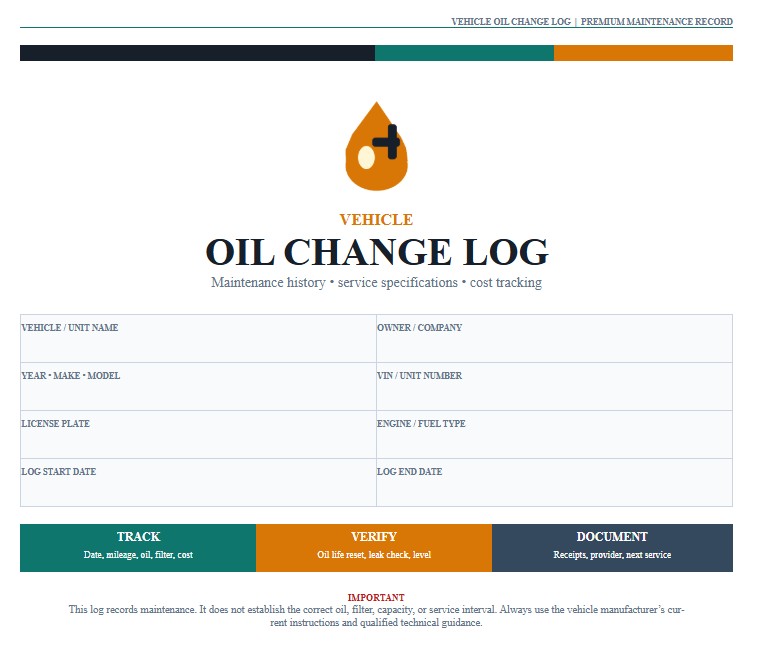
The Vehicle Oil Change Log Template provides an organized way to document engine oil and filter service for a personal vehicle, company car, work truck, rental unit, or fleet asset. A consistent maintenance record can help owners track service intervals, confirm which oil and filter were used, estimate when the next change is due, support vehicle history records, and retain evidence of completed maintenance. The log can be completed by a vehicle owner, employee, fleet manager, mechanic, service advisor, or other responsible person. This page provides downloadable Word, PDF, and Excel versions of the template, together with practical guidance for completing and using the document. The Word version is easy to customize, the PDF version offers a stable layout for printing and archiving, and the Excel version supports repeatable entries, sorting, and ongoing maintenance tracking. Service timing and product specifications should always be verified against the vehicle manufacturer’s current instructions.
Download the Vehicle Oil Change Log Word Template
The Word format is useful when you want to edit the vehicle information, add a company name or logo, change the service fields, expand the notes area, or adapt the log before printing, sharing, signing, or adding it to a maintenance binder.

Download the Vehicle Oil Change Log PDF Template
The PDF format is useful for printing, archiving, emailing, or maintaining a fixed-layout version of the log. It is especially practical when service entries will be completed by hand or stored with invoices, inspection reports, and other vehicle records.
Download the Vehicle Oil Change Log Excel Template
The Excel format is useful for maintaining repeatable service rows, recording dates and mileage, tracking oil and filter details, entering dollar amounts, sorting maintenance history, and managing multiple vehicles or fleet assets in one structured file.
How to Complete and Use This Document
Start by identifying the vehicle clearly. Enter the year, make, model, vehicle identification number, license plate number, engine type, and any internal unit or asset number used by a business. When the log is used for a fleet, also include the department, assigned driver, vehicle location, or responsible manager. Accurate identification prevents records from being filed under the wrong vehicle, particularly when a company operates several similar cars or trucks.
Create one entry immediately after each oil change. Record the service date and the odometer reading shown when the work was completed. Do not enter an estimated mileage when an exact reading is available. If the vehicle uses engine hours in addition to mileage, as may occur with work trucks, emergency vehicles, construction equipment, or vehicles that idle extensively, include the hour-meter reading as well. The manufacturer’s maintenance schedule should determine whether mileage, elapsed time, engine hours, an oil-life monitoring system, or a combination of these factors controls the service interval. Oil change requirements vary by vehicle, engine, operating conditions, and oil specification, so a universal interval should not be inserted into every log. Manufacturers generally direct owners to follow the scheduled maintenance information for the specific vehicle.
Document the oil used with enough detail to make the entry useful later. Typical fields include the oil brand, viscosity grade, specification or approval, conventional or synthetic type, and quantity added. Copy this information from the container, invoice, or service report rather than relying on memory. The required viscosity and performance specification can differ even among engines installed in the same model year. Confirm the correct product in the owner’s manual, maintenance guide, manufacturer service information, or other current documentation applicable to the vehicle.
Record whether the oil filter was replaced and enter its brand and part number. The log may also include the drain-plug gasket, oil-life monitor reset, fluid-level verification, leak inspection, and any related observations. If the technician notices low oil, contamination, metallic material, an unusual odor, leakage, abnormal oil consumption, warning lights, damaged threads, or another concern, describe the finding in the notes field. Record any corrective action taken and identify follow-up work that remains open. A log should document what occurred, but it should not replace diagnosis by a qualified technician.
Enter the name of the service provider or person who performed the work. For commercial service, include the repair facility, work-order or invoice number, technician or service advisor, and total cost. For owner-performed maintenance, record the purchaser, date, product details, and disposal or recycling location when useful. Keep receipts, invoices, filter labels, photographs, and related records with the log. The Federal Trade Commission advises vehicle owners to retain service records and receipts, including oil-change documentation, because they may help demonstrate that required maintenance was performed.
Complete the next-service fields only after checking the applicable maintenance schedule. Enter a target date, target mileage, target engine-hour reading, or oil-life threshold as appropriate. Driving conditions such as repeated towing, heavy loads, extensive idling, dusty operation, frequent short trips, off-road use, or other severe service may affect the manufacturer’s maintenance schedule. Customize the template when the vehicle requires additional tracking fields, such as diesel oil specifications, multiple filters, oil sampling, telematics data, fleet approval, purchase-order numbers, or maintenance-provider authorization.
Review the completed record for missing mileage, incorrect oil specifications, transposed dates, duplicate entries, and unexplained gaps. Fleet organizations should establish who creates the entry, who reviews it, where supporting documents are stored, and how overdue service is escalated. The log should remain consistent with the company’s preventive maintenance program, warranty procedures, safety policies, accounting controls, and record retention practices.
Used oil and filters must be handled responsibly. The U.S. Environmental Protection Agency advises that used motor oil should be recycled or otherwise managed properly and notes that many automotive service facilities and collection programs accept it. Businesses that generate, store, transport, or recycle used oil may be subject to federal and state management requirements that do not ordinarily apply in the same way to a household vehicle owner. Verify current state, county, city, environmental, workplace, and company-specific rules when the log is used by a repair shop, fleet, government entity, or other organization.