
A commercial HVAC maintenance agreement is a written service contract used by building owners, property managers, facility operators, landlords, tenants, and HVAC contractors to define how heating, ventilation, air conditioning, refrigeration, and related building comfort systems will be inspected, maintained, serviced, and documented. In the United States, this type of agreement is commonly used for office buildings, retail spaces, restaurants, warehouses, medical offices, schools, multifamily properties, industrial facilities, and other commercial sites where equipment uptime, energy performance, indoor air quality, and recordkeeping matter. The agreement usually identifies the parties, covered equipment, service schedule, preventive maintenance tasks, exclusions, emergency response terms, pricing, payment conditions, insurance requirements, safety responsibilities, and termination rights. This page provides downloadable Word and PDF versions of the commercial HVAC maintenance agreement, along with practical guidance for completing, customizing, and using the document before it is signed or added to a company service file.
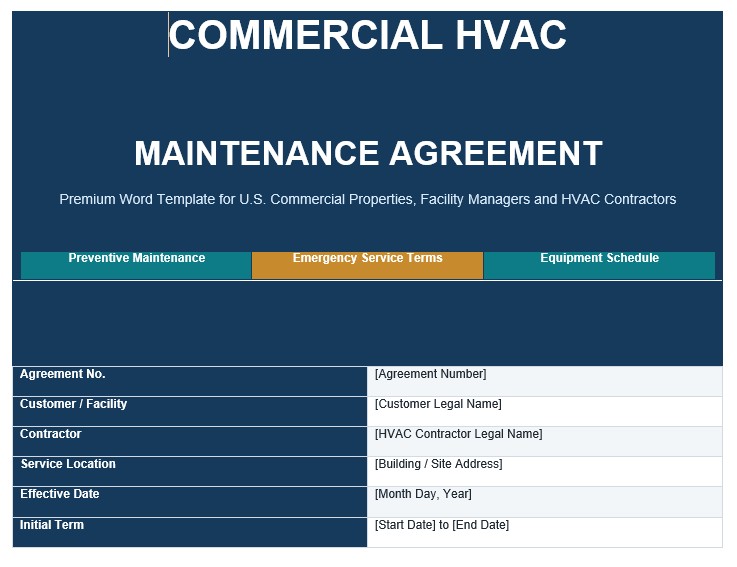
Download the Commercial HVAC Maintenance Agreement Word Template
The Word format is useful when you want to edit the commercial HVAC maintenance agreement freely before printing, sharing, signing, or adapting it to a specific building, contractor, service plan, equipment list, or company approval process.

Download the Commercial HVAC Maintenance Agreement PDF Template
The PDF format is useful for printing, archiving, sharing with management, attaching to a contractor file, or using a fixed-layout version of the agreement once the commercial terms and service schedule have been reviewed.
How to Complete and Use This Document
Begin the commercial HVAC maintenance agreement by identifying the parties accurately. The agreement should state the legal name of the HVAC contractor or service provider, the customer’s legal name, the property owner or managing agent if different, the service address, billing address, primary contact, emergency contact, phone numbers, email addresses, and the effective date. For commercial properties, it is important to clarify whether the customer is the owner, tenant, landlord, property manager, facility operator, or another authorized representative. If a tenant is signing for work in leased premises, the agreement should be checked against the lease to confirm who is responsible for HVAC maintenance, repairs, replacements, after-hours access, permits, and capital improvements.
The scope of work should be specific. A commercial HVAC maintenance agreement commonly covers scheduled preventive maintenance, inspections, cleaning, lubrication, filter replacement, belt checks, coil inspection, condensate drain inspection, electrical component checks, thermostat or control checks, operational testing, basic performance readings, and written service reports. The agreement should identify which equipment is included, such as rooftop units, split systems, air handling units, make-up air units, exhaust fans, economizers, boilers, chillers, pumps, cooling towers, variable air volume boxes, controls, refrigeration equipment, or other assets. Use an equipment schedule whenever possible. Include manufacturer, model number, serial number, location, capacity, asset tag, and service frequency for each unit.
Define the service frequency and response expectations. The agreement should say whether maintenance will be monthly, quarterly, semiannual, annual, seasonal, or based on operating hours. It should also distinguish scheduled service from emergency service. If emergency response is included, state the covered hours, after-hours rates, weekend or holiday charges, response targets, dispatch procedure, and whether emergency labor or parts are included or billed separately. Avoid vague language such as “service as needed” unless the agreement explains who decides when service is needed and what charges apply.
Pricing and payment terms should be clear before the agreement is signed. State whether the customer pays a fixed monthly fee, annual fee, per-visit amount, time-and-materials rate, or a combination. Identify taxes, trip charges, diagnostic fees, fuel surcharges, overtime rates, refrigerant charges, filter costs, parts markups, labor rates, and payment due dates if they apply. The agreement should also explain whether repairs, replacement parts, refrigerant, crane service, lift rental, controls work, duct repairs, permits, engineering services, and equipment replacement are included or excluded. If discounts on repairs are offered to maintenance agreement customers, write the discount terms precisely.
Include legal and administrative terms that match the business relationship. Important clauses may address contract term, renewal, cancellation, termination for nonpayment, customer access obligations, safe working conditions, parking or roof access, limitation of liability, warranty limitations, indemnification, insurance, workers’ compensation coverage, subcontractors, force majeure, dispute resolution, governing law, notices, assignment, entire agreement, and amendments. Because contract rules, licensing requirements, lien rights, consumer protection rules, commercial contracting practices, and insurance expectations can vary by state, county, and city, the template should be reviewed before use in a specific jurisdiction.
Commercial HVAC work can also involve technical and regulatory considerations. Refrigerant-related work should be performed only by properly qualified personnel, and federal refrigerant handling requirements may apply to technicians who maintain, service, repair, or dispose of regulated equipment. Employers and contractors should also follow applicable workplace safety procedures when servicing electrical, mechanical, thermal, or pressurized systems. If the property is subject to local building codes, energy ordinances, indoor air quality requirements, health department rules, school or healthcare standards, landlord-tenant obligations, or company-specific facility procedures, verify those requirements before relying on a general agreement.
Before signing, review all attachments and exhibits. Common attachments include an equipment list, preventive maintenance task list, service calendar, pricing schedule, certificate of insurance, contractor license information, excluded services list, customer site rules, and sample service report. Keep a signed copy with the customer file, purchasing records, facility maintenance records, and equipment history. For high-value buildings, multi-site portfolios, public contracts, healthcare facilities, schools, industrial sites, or agreements involving significant liability or long-term cost commitments, it is wise to have the document reviewed by a qualified attorney, insurance advisor, CPA, facility professional, or licensed HVAC contractor before use.