
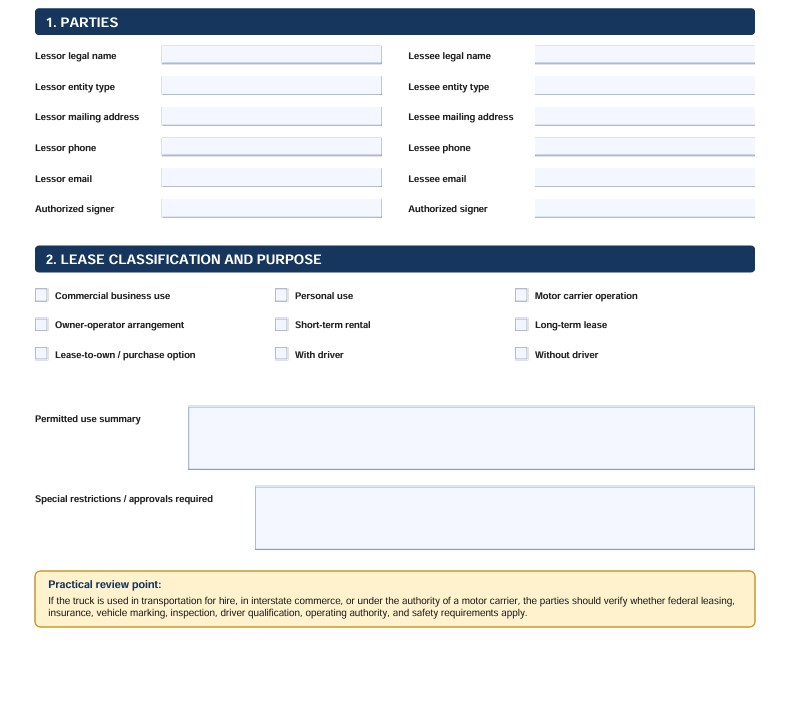
A truck lease agreement template is a written contract used when one party leases a truck to another party for business, commercial, fleet, delivery, construction, agricultural, or personal use. In the United States, this type of agreement may be used for pickup trucks, box trucks, semi-trucks, dump trucks, refrigerated trucks, tow trucks, work trucks, or other commercial vehicles. A well-prepared truck lease agreement helps define who owns the truck, who may operate it, how long the lease lasts, how payments are made, who is responsible for insurance, maintenance, registration, taxes, permits, damage, mileage, repairs, return condition, and default. This page provides downloadable Word and PDF versions of the truck lease agreement template, together with practical guidance for completing, reviewing, customizing, printing, signing, and storing the document for U.S. use.
Download the Truck Lease Agreement Template Word Template
The Word format is useful when you want to edit the truck lease agreement template freely before printing, sharing, signing, negotiating terms, or adapting it to a specific vehicle, fleet arrangement, owner-operator relationship, rental transaction, or business use.

Download the Truck Lease Agreement Template PDF Template
The PDF format is useful for printing, archiving, sending a fixed-layout draft for review, keeping a signed copy in company records, or preserving the final version after both parties have approved the agreement.
How to Complete and Use This Document
Start the truck lease agreement by identifying the parties accurately. The agreement should state the full legal name, mailing address, phone number, and email address of the lessor, who is the party providing the truck, and the lessee, who is the party leasing and using the truck. If either party is a business, use the exact legal entity name rather than only a trade name. If a guarantor, fleet manager, dispatcher, broker, or authorized representative is involved, identify that role clearly and attach proof of authority if needed.
Describe the truck in detail. Important fields include year, make, model, body type, VIN, license plate number, state of registration, unit number, odometer reading, engine hours if applicable, color, fuel type, gross vehicle weight rating, equipment installed, trailer or liftgate information, accessories, keys, cards, GPS devices, decals, and any included documents. The agreement should also state whether the vehicle is leased with or without a driver, whether it may be used with trailers, and whether it may be operated across state lines.
Next, complete the lease term and payment section. Include the effective date, start date, end date, renewal options, rent amount, payment frequency, due date, method of payment, late fees, deposit, security hold, mileage charges, excess wear charges, taxes, tolls, fuel costs, parking charges, fines, and any purchase option if one exists. Avoid vague payment language. A good agreement should make clear what is due, when it is due, where it is paid, and what happens if payment is late or unpaid.
The use and operation section is especially important for trucks. State the permitted use of the vehicle, geographic limits, authorized drivers, minimum driver qualifications, license requirements, drug and alcohol policy if applicable, cargo restrictions, hazardous materials restrictions, passenger restrictions, towing restrictions, off-road use restrictions, and whether smoking, modifications, decals, or subleasing are allowed. If the truck is being used in a regulated commercial operation, the parties should verify whether federal motor carrier rules, USDOT registration, operating authority, driver qualification, hours of service, inspection, maintenance, cargo securement, insurance, or leasing rules apply.
For leases involving authorized motor carriers and owner-operators, federal leasing regulations may require specific written lease terms, including provisions related to possession, control, responsibility, compensation, chargebacks, receipts, insurance, escrow funds, equipment identification, and termination. These rules are fact-specific and should not be handled with a generic form alone. The parties should consult FMCSA requirements, applicable state law, and a qualified trucking attorney or compliance professional before signing.
Include a detailed maintenance and repair allocation. The agreement should state who is responsible for routine maintenance, oil changes, tires, brakes, inspections, repairs, roadside assistance, towing, preventive maintenance records, damage caused by misuse, warranty claims, and manufacturer recalls. If the lessee must return the truck in a certain condition, define normal wear and tear, cleaning requirements, fuel level, tire condition, missing equipment, accident damage, and inspection procedure at return.
Insurance should be addressed before the truck is released. The agreement should identify required liability coverage, physical damage coverage, cargo coverage if relevant, workers’ compensation if applicable, deductibles, additional insured or loss payee requirements, proof of insurance deadlines, and responsibility for uninsured losses. Registration, title, license plates, permits, International Registration Plan, International Fuel Tax Agreement, local permits, and state-specific filings should be handled according to the actual use of the vehicle and the jurisdictions involved.
The agreement should also cover default, early termination, repossession rights if lawful, notice requirements, dispute resolution, governing law, venue, indemnification, limitation of use after default, return of property, and survival of payment obligations. Because truck leases may involve state commercial law, UCC Article 2A as adopted by the relevant state, consumer leasing rules for certain personal leases, transportation regulations, tax treatment, and insurance requirements, both parties should review the agreement carefully before signing. For high-value trucks, interstate motor carrier operations, owner-operator arrangements, finance leases, lease-to-own terms, or disputed responsibilities, consult a qualified attorney, CPA, insurer, lender, or fleet compliance professional.
Before signing, attach supporting documents such as inspection reports, photos, title or registration copy, insurance certificates, payment schedule, maintenance schedule, equipment list, driver authorization list, and any required regulatory documents. Each party should sign and date the agreement, keep a complete copy, and update the records whenever the lease is renewed, amended, assigned, terminated, or the vehicle is returned.