
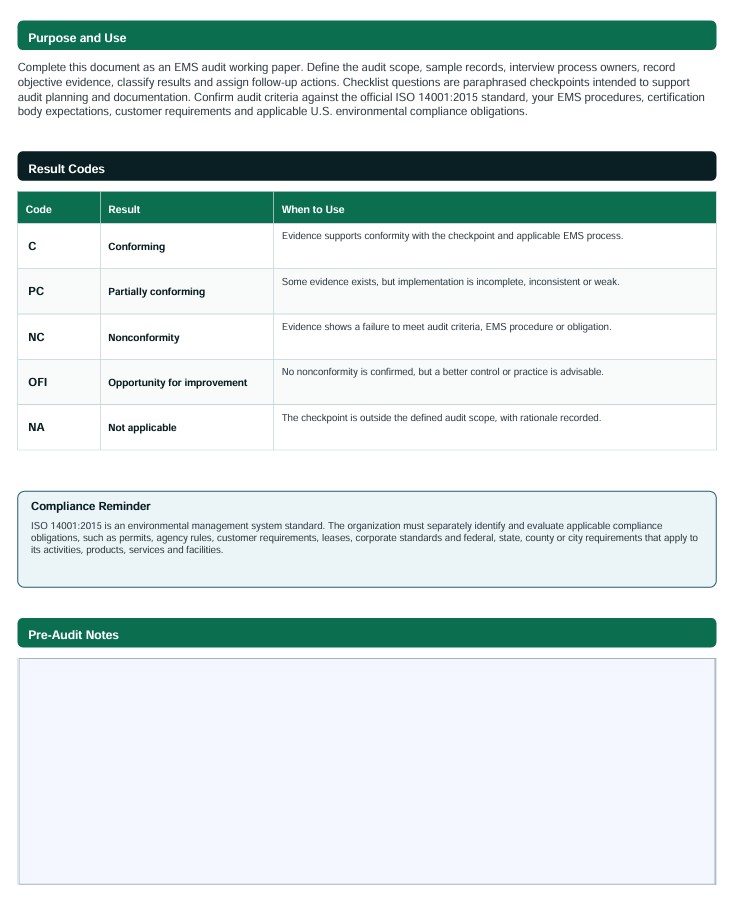
The ISO 14001:2015 Checklist is a practical template used to review an organization’s environmental management system against the structure and expectations of ISO 14001:2015. It can help a U.S. business, nonprofit, public agency, contractor, manufacturer, service provider, or facility manager organize an internal audit, gap assessment, compliance review, certification readiness check, or supplier evaluation. A well prepared checklist helps document environmental aspects, compliance obligations, operational controls, objectives, monitoring activities, corrective actions, and management review evidence in a consistent format. This page provides downloadable Word, PDF, and Excel versions of the ISO 14001:2015 Checklist, together with practical guidance for completing and using the document. The template should be adapted to the organization’s scope, industry, facilities, permits, legal obligations, and internal procedures, and it should be used as a working record rather than as a substitute for the ISO 14001:2015 standard itself or professional environmental compliance advice.
Download the ISO 14001:2015 Checklist Word Template
The Word format is useful when you want to edit the ISO 14001:2015 Checklist freely before printing, sharing, signing, or adapting it to a specific facility, department, audit program, certification project, or internal environmental management procedure.

Download the ISO 14001:2015 Checklist PDF Template
The PDF format is useful for printing, archiving, sharing, or using a fixed-layout version of the ISO 14001:2015 Checklist during internal audits, site reviews, management meetings, or certification preparation activities.
Download the ISO 14001:2015 Checklist Excel Template
The Excel format is useful when the ISO 14001:2015 Checklist needs repeatable rows, audit findings, responsible persons, due dates, status tracking, corrective action logs, department lists, facility records, or sortable compliance evidence.
How to Complete and Use This Document
An ISO 14001:2015 Checklist should be completed with the same level of care as any other environmental management system record. Start by identifying the organization, facility, business unit, audit date, audit scope, audit criteria, lead auditor or reviewer, participating departments, and the version of the checklist being used. The audit scope is especially important because ISO 14001:2015 is built around the organization’s environmental management system, not just one isolated activity. The scope should make clear whether the review covers a single site, multiple locations, production operations, warehouses, offices, field services, contractors, or specific processes that can affect environmental performance.
The checklist should normally follow the main structure of ISO 14001:2015, including context of the organization, leadership, planning, support, operation, performance evaluation, and improvement. For each topic, the user should record the clause or requirement being reviewed, the question asked, the documents or evidence examined, the people interviewed, the result of the review, and any finding that requires follow-up. Common evidence may include an environmental policy, environmental aspect and impact assessments, compliance obligation registers, training records, emergency preparedness procedures, operational control procedures, monitoring data, internal audit reports, corrective action records, management review minutes, and records showing progress toward environmental objectives.
When completing the checklist, avoid treating it as a simple yes-or-no exercise. A “yes” answer should be supported by objective evidence, such as a controlled procedure, permit record, inspection log, waste manifest, stormwater record, air emissions calculation, wastewater monitoring result, chemical inventory, spill response drill record, or management review note. A “no” answer should be written clearly enough to support corrective action. If the evidence is incomplete, outdated, inconsistent, or unavailable, the finding should explain the gap rather than simply marking the item as nonconforming. This makes the checklist more useful for internal improvement, external certification preparation, and management decision making.
For a U.S. user, it is important to distinguish ISO 14001:2015 from environmental law. ISO 14001:2015 is a voluntary environmental management system standard unless it is required by a customer contract, procurement rule, grant condition, supplier qualification process, or other specific obligation. However, an organization using the checklist should still identify and evaluate its applicable compliance obligations. Depending on the facility and operations, those obligations may involve federal environmental requirements, state environmental agency rules, county or city permits, wastewater discharge limits, air quality permits, hazardous waste rules, spill prevention requirements, stormwater permits, underground storage tank rules, chemical reporting, or industry-specific obligations. Requirements can vary significantly by state, locality, facility size, activity, and permit status, so the checklist should prompt the user to verify current requirements with the appropriate authority or a qualified professional.
The checklist should also be customized to the organization’s real environmental risks and opportunities. A small office may focus on energy use, purchasing, recycling, emergency response, and contractor control, while a manufacturer may need more detailed sections for wastewater, air emissions, hazardous waste, chemical storage, maintenance, calibration, process controls, training, incident response, and supplier controls. A construction, logistics, food processing, healthcare, laboratory, or public works organization may need additional questions tailored to its operations. If the template includes generic language, revise it so that the wording matches the company’s procedures, job titles, locations, environmental aspects, and document control system.
Before using the completed checklist as an audit record, review it for consistency, completeness, and traceability. Each finding should identify the affected process or location, the evidence reviewed, the issue found, the person responsible for follow-up, the corrective action required, and the target completion date. Where corrective actions are assigned, the organization should verify effectiveness after completion rather than simply closing the item administratively. If the checklist will be used for certification readiness, it should be reviewed against the actual ISO 14001:2015 requirements and the organization’s documented EMS, because a checklist alone does not prove conformity.
Keep copies of completed checklists with internal audit records, corrective action records, management review materials, and any supporting documents required by company policy or applicable compliance obligations. If the checklist is being used for a regulated facility, a high-risk operation, a customer audit, or ISO certification preparation, it may be appropriate to consult an experienced environmental manager, ISO 14001 consultant, accredited certification body, environmental attorney, or qualified compliance professional. Professional review is especially useful when there are unresolved permit questions, enforcement concerns, significant environmental aspects, multi-state operations, or uncertainty about whether federal, state, county, city, industry, or contract-specific requirements apply.