
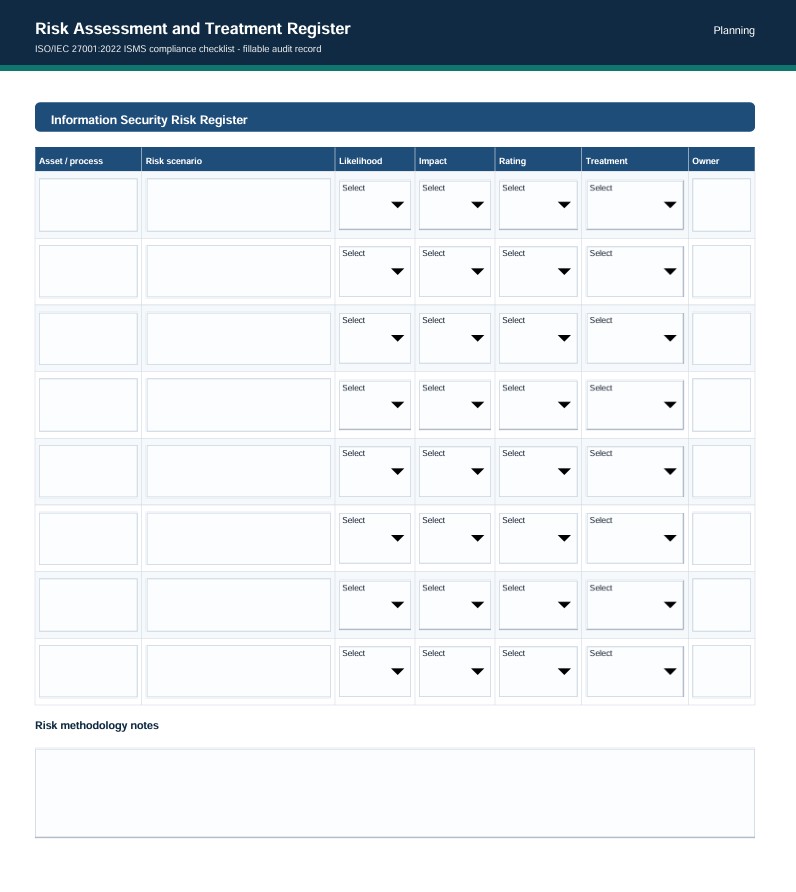
The ISO 27001 Compliance Checklist is a practical template used to assess whether an organization’s information security management system, or ISMS, is aligned with ISO/IEC 27001 requirements and related security control expectations. U.S. businesses commonly use this checklist for internal audits, certification readiness, vendor security reviews, cybersecurity governance, risk treatment planning, and evidence tracking before an external audit. It can help document security policies, risk assessments, access controls, incident response procedures, supplier controls, employee responsibilities, corrective actions, and management review activities in a structured format. This page provides downloadable Word, PDF, and Excel versions of the ISO 27001 Compliance Checklist, together with practical guidance for completing and using the document. The template should be customized to the organization’s scope, systems, data types, legal obligations, customer commitments, and selected ISO 27001 edition, especially where contracts or certification bodies require a specific version.
Download the ISO 27001 Compliance Checklist Word Template
The Word format is useful when you want to edit the ISO 27001 Compliance Checklist freely before printing, sharing, signing, or adapting it to a specific organization, audit scope, department, client requirement, or internal security procedure.

Download the ISO 27001 Compliance Checklist PDF Template
The PDF format is useful for printing, archiving, sharing, or using a fixed-layout version of the ISO 27001 Compliance Checklist during internal audits, security reviews, certification preparation, or management meetings.
Download the ISO 27001 Compliance Checklist Excel Template
The Excel format is useful when the ISO 27001 Compliance Checklist needs repeatable rows, audit findings, control status tracking, risk ratings, responsible owners, due dates, corrective actions, evidence references, schedules, or sortable compliance registers.
How to Complete and Use This Document
An ISO 27001 Compliance Checklist should begin with clear identification details. Enter the organization name, business unit, facility or cloud environment, audit date, checklist version, audit scope, reviewer, responsible security owner, and the ISO 27001 edition being assessed. This last point matters because many organizations are transitioning from older ISO 27001 materials to ISO/IEC 27001:2022, while some contracts, vendor questionnaires, or certificates may still reference a specific edition. The checklist should state whether the review is a preliminary gap assessment, an internal audit, a supplier review, a certification readiness exercise, or an ongoing compliance monitoring record.
Define the scope before answering the checklist questions. A strong ISO 27001 checklist does not simply ask whether security controls exist. It should identify which information assets, systems, data stores, people, locations, vendors, cloud services, applications, and business processes are included in the ISMS. For a U.S. company, the scope may include corporate IT, SaaS platforms, production systems, customer data environments, employee devices, third-party hosting providers, payment-related systems, healthcare data workflows, financial records, intellectual property, or confidential client information. If the scope is unclear, the checklist may produce misleading results because controls can appear complete in one area while important systems remain outside the review.
Complete each checklist item using objective evidence. For ISO 27001, common evidence includes the information security policy, risk assessment methodology, risk treatment plan, Statement of Applicability, asset inventory, access control policy, identity and access management records, employee onboarding and termination records, security awareness training, supplier security reviews, incident response procedures, business continuity documentation, backup records, vulnerability management reports, internal audit results, management review minutes, and corrective action logs. For each requirement or control, record whether it is implemented, partially implemented, not implemented, not applicable, or pending review. A status should not be marked as complete unless the organization can point to current, controlled, and relevant evidence.
The checklist should also capture risk and accountability. ISO 27001 is built around management of information security risk, so the document should connect checklist findings to business impact, likelihood, risk owner, control owner, target remediation date, and priority. If an item is not applicable, explain why. For example, a physical data center control may not apply to a fully remote SaaS company that relies on a cloud provider, but the company should still evaluate supplier assurance, contractual responsibilities, access permissions, logging, encryption, backup, and incident notification requirements. A blank or unsupported “not applicable” answer is weak evidence and may be challenged during an audit or customer review.
For U.S. users, it is important to understand that ISO 27001 is generally a voluntary information security management standard unless it is required by a customer contract, procurement process, regulator, insurance requirement, grant condition, or internal company policy. It does not replace federal, state, county, city, or industry-specific cybersecurity, privacy, breach notification, financial, healthcare, education, defense contractor, or consumer protection obligations. Depending on the organization, additional requirements may relate to HIPAA, GLBA, state privacy laws, state data breach notification laws, payment card requirements, government contracting clauses, SEC cybersecurity disclosure rules, or sector-specific regulations. These obligations vary by industry, data type, location, and contractual commitments, so the checklist should include a compliance obligations section and users should verify current requirements before relying on the document.
Customize the template to match the organization’s real operating environment. A small professional services firm may need practical sections for access control, vendor management, endpoint security, backup, employee training, and incident response. A software company may need more detailed coverage for secure development, change management, cloud infrastructure, logging, vulnerability management, code repositories, customer data segregation, and supplier monitoring. A healthcare, fintech, government contractor, managed service provider, or ecommerce business may need additional questions that reflect regulated data, customer audit rights, contractual security schedules, or specific reporting obligations.
Before finalizing the completed checklist, review it for consistency, traceability, and actionability. Each finding should identify the affected system or process, the evidence reviewed, the gap found, the risk level, the corrective action, the responsible owner, the due date, and the verification method. Keep completed checklists with internal audit records, management review materials, risk treatment records, policies, procedures, and supporting evidence. If the checklist will be used for certification readiness, a high-value customer review, a regulated environment, a merger or acquisition diligence request, or a cybersecurity incident follow-up, it is advisable to consult a qualified information security professional, ISO 27001 consultant, auditor, attorney, privacy professional, or compliance advisor before treating the checklist as complete.