
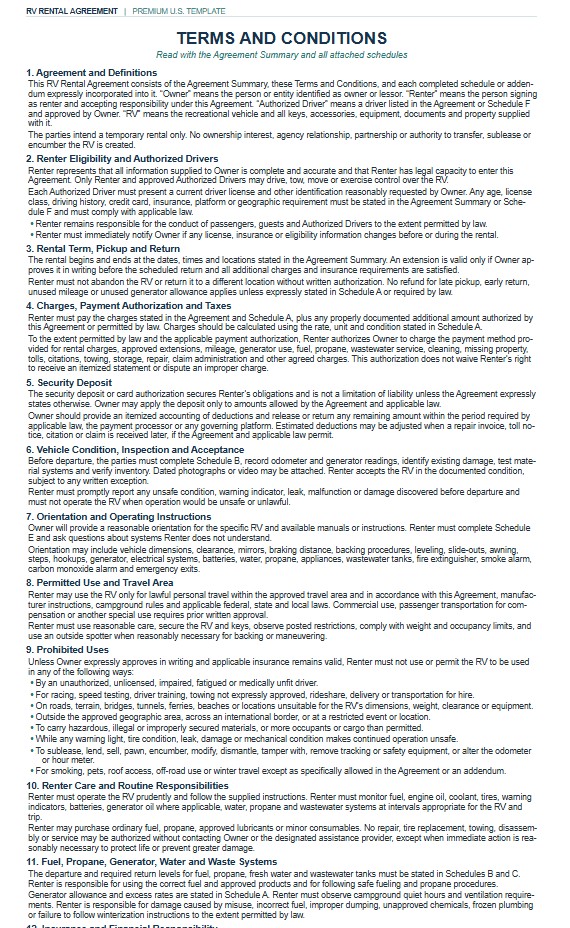
The RV Rental Agreement Template is designed to help recreational vehicle owners, rental businesses, and renters document the terms of a temporary RV rental in the United States. A well-prepared agreement identifies the vehicle and authorized drivers, establishes the rental period and price, explains insurance and security deposit arrangements, and sets expectations for mileage, generator use, fuel, cleaning, maintenance, damage, breakdowns, and return conditions. Clear written terms can reduce misunderstandings and provide an organized record if a payment, damage, insurance, or scheduling dispute occurs. This page provides downloadable Word and PDF versions of the RV rental agreement, together with practical guidance for completing, customizing, signing, and retaining the document. Because vehicle rental, insurance, consumer protection, licensing, tax, and business requirements can vary by state and locality, the template should be reviewed and adapted for the location where the RV rental business operates and where the vehicle will be used.
Download the RV Rental Agreement Word Template
The editable Word format is useful when the RV owner or rental company needs to revise clauses, add company branding, describe a particular vehicle, insert rental charges, or adapt the agreement to a specific trip before printing, sharing, or signing it.

Download the RV Rental Agreement PDF Template
The PDF format provides a fixed-layout version that is convenient for printing, archiving, emailing, or maintaining consistent copies of the agreement. Review all fields and clauses before use, particularly if the PDF is completed electronically.
How to Complete and Use This Document
Begin by entering the complete legal names, addresses, telephone numbers, and email addresses of the RV owner or rental company and the renter. If the owner operates through an LLC, corporation, partnership, or assumed business name, use the correct legal entity information. Record the agreement date and clearly identify the effective rental period, including the pickup and return dates, times, and locations. Avoid relying only on informal messages or a reservation confirmation when the agreement contains more detailed obligations.
Identify the recreational vehicle precisely. Typical information includes the year, make, model, vehicle identification number, license plate number, odometer reading, generator-hour reading, and any unit or fleet number. Specify whether the rental concerns a motorhome, camper van, travel trailer, fifth-wheel trailer, or another type of RV. For a towable unit, the agreement may also need information about the renter’s tow vehicle, hitch, brake controller, towing capacity, and required equipment. The owner should verify that each authorized driver has a current license appropriate for the vehicle under the rules of the applicable state. Licensing requirements can depend on the RV’s size, weight, configuration, and use.
List every person permitted to drive or tow the RV. The agreement should state that an unauthorized person may not operate the vehicle and should address minimum driver qualifications established by the owner, insurer, rental platform, or applicable law. Copies of driver’s licenses and insurance-related records should be handled securely and retained only as permitted by the business’s privacy and recordkeeping procedures.
Complete the financial terms in detail. State the base rental rate, reservation payment, security deposit, payment schedule, accepted payment method, and the conditions under which a deposit may be withheld. Identify additional charges that may apply, such as mileage overages, generator use, late return, refueling, propane replacement, wastewater tank service, excessive cleaning, smoking, pet damage, missing equipment, tolls, parking charges, traffic violations, or administrative expenses. The renter should be able to determine how charges are calculated rather than discovering them after the RV is returned. Include the applicable cancellation, early-return, extension, and no-show policies.
Insurance provisions require careful review. The agreement should identify the coverage being provided or required, the deductible or renter responsibility, any exclusions, and the procedure for reporting an accident or claim. The owner should confirm that the policy permits rental use and covers the particular RV, drivers, geographic area, and intended activities. A renter should not assume that a personal auto policy or credit card benefit automatically covers a motorhome or towable RV. Questions about liability coverage, physical damage, roadside assistance, loss of use, diminished value, or supplemental coverage should be directed to a licensed insurance professional.
Describe permitted and prohibited uses. Depending on the rental, the agreement may address travel outside specified states or countries, off-road driving, unpaved roads, racing, commercial transportation, subleasing, towing another vehicle, roof access, festivals, smoking, pets, illegal activity, and operation while impaired. Any passenger, sleeping, seat-belt, occupancy, campground, or towing restrictions should be consistent with the RV manufacturer’s instructions and applicable law.
Attach a departure and return condition report whenever possible. Record existing scratches, dents, windshield damage, tire condition, appliance operation, fuel and propane levels, wastewater tank status, inventory, keys, accessories, and safety equipment. Date-stamped photographs or video can supplement the written inspection. Both parties should acknowledge the condition of the RV at pickup and return. The owner should also provide operating instructions for the electrical system, water system, generator, awning, slide-outs, leveling equipment, appliances, hookups, and emergency equipment.
The agreement should explain what the renter must do after a collision, theft, fire, breakdown, warning light, tire failure, or mechanical problem. Include reporting contacts, roadside assistance information, restrictions on unauthorized repairs, and procedures for preserving receipts and incident records. The owner should confirm that the RV is properly registered, insured, maintained, and suitable for rental use, including checking for applicable safety recalls and required inspections.
Review provisions covering default, termination, repossession, abandonment, late return, damage claims, governing law, dispute resolution, notices, amendments, and the complete agreement between the parties. State law may limit or affect particular fees, waivers, liability clauses, insurance sales, electronic signatures, consumer disclosures, or recovery procedures. A qualified attorney should review the document when it will be used commercially, across state lines, for a high-value RV, through a peer-to-peer rental arrangement, or with substantial liability waivers.
Finally, have the owner or authorized company representative and the renter sign and date the agreement. Obtain signatures from additional drivers when they are accepting separate obligations. Attach the condition report, fee schedule, insurance documentation, rules of use, inventory, and any supplemental disclosures referenced in the agreement. Give each party a complete copy and retain the signed agreement, payment records, inspection evidence, correspondence, and claim documents according to applicable law and the company’s recordkeeping policy.