
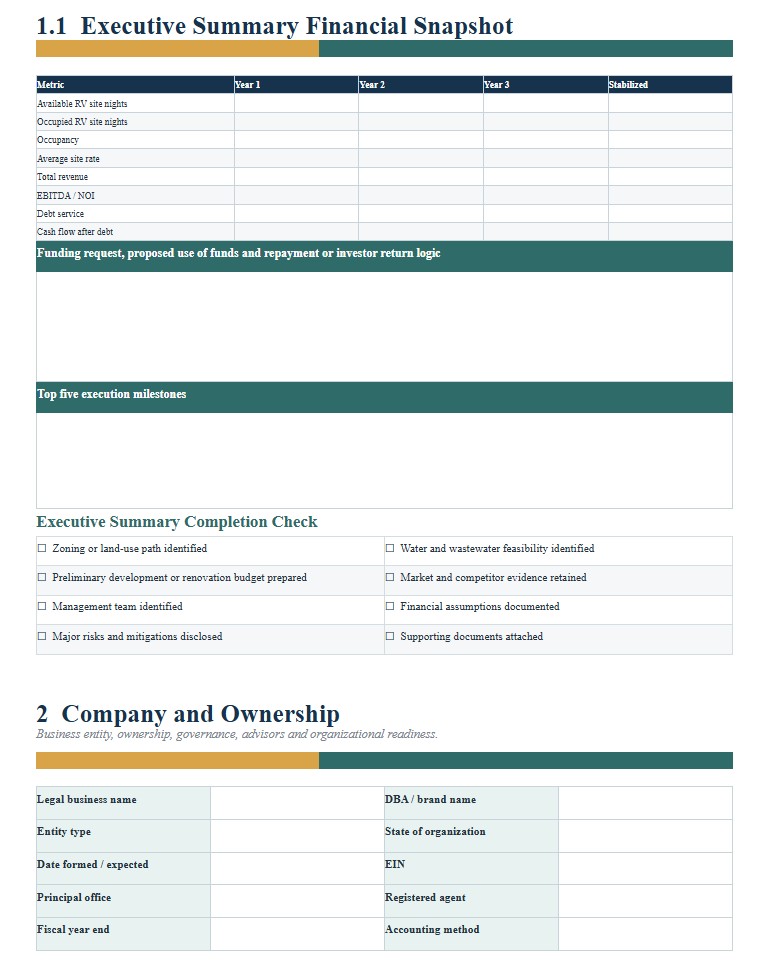
An RV Park Business Plan is a structured planning document for developing, purchasing, expanding, financing, or operating a recreational vehicle park or campground in the United States. It helps owners, developers, lenders, investors, business partners, and local reviewers understand the proposed property, target market, site capacity, utilities, amenities, operating model, development budget, revenue assumptions, staffing plan, and financial outlook. A detailed plan can also help identify zoning, environmental, infrastructure, accessibility, insurance, and permitting issues before significant money is committed. This page provides downloadable Word and PDF versions of the RV Park Business Plan, together with practical guidance for completing and adapting the document. The editable Word version is suitable for developing a lender-ready or investor-ready plan, while the fixed-layout PDF version is useful for printing, presenting, sharing, and archiving the completed plan with financial projections, property records, engineering reports, permits, maps, and supporting documents.
Download the RV Park Business Plan Word Template
The Word format is useful when the owner, developer, consultant, or project team wants to edit the business plan freely before printing, sharing, presenting it to lenders or investors, or adapting it to a new development, an existing park acquisition, a redevelopment project, or a planned expansion.

Download the RV Park Business Plan PDF Template
The PDF format is useful for printing, archiving, sharing, or presenting a fixed-layout version of the completed plan with lenders, investors, partners, property owners, contractors, consultants, and other project stakeholders.
How to Complete and Use This Document
Begin with a concise executive summary that identifies the business name, proposed location, ownership structure, development or acquisition concept, number and type of sites, target opening date, total project cost, funding request, owner investment, and expected competitive advantage. Although this section appears first, it is often easier to complete after the market, operations, development, and financial sections have been prepared.
Describe whether the project involves vacant-land development, the purchase of an operating RV park, redevelopment of an older campground, or expansion of an existing property. Include the legal entity, ownership percentages, management team, relevant experience, professional advisors, and responsibilities of each owner or manager. Business structure and tax treatment can affect liability, financing, payroll, succession, and federal and state filings, so the final structure should be reviewed with an attorney and CPA.
Provide a detailed property and site analysis. Record acreage, parcel numbers, access roads, surrounding land uses, visibility, topography, drainage, flood exposure, utility availability, easements, environmental conditions, and expansion potential. Attach maps, photographs, surveys, preliminary engineering documents, utility correspondence, and available property reports. Do not assume that land marketed as commercial, recreational, agricultural, or campground property can automatically be developed as an RV park.
Verify zoning and land-use requirements with the appropriate city or county before relying on the site. Relevant issues may include conditional-use approval, density, minimum site dimensions, setbacks, landscaping, lighting, signage, internal road standards, fire access, stormwater controls, length-of-stay restrictions, permanent occupancy, recreational amenities, cabins, tent camping, outdoor storage, and operating hours. Requirements vary substantially by jurisdiction.
Explain the planned site mix. Distinguish full-hookup, water-and-electric, electric-only, primitive, seasonal, monthly, premium, pull-through, back-in, accessible, group, cabin, and tent accommodations when applicable. Record the proposed utility capacity, site dimensions, electrical service, Wi-Fi, parking, roads, dump station, laundry, bathhouse, office, store, pool, dog park, playground, security, storage, propane service, and other amenities.
Water and wastewater feasibility should be addressed early. Identify whether the property will use municipal water and sewer, private wells, septic systems, package treatment, holding tanks, or another approved arrangement. A campground water system may be subject to public water system requirements depending on how many connections or people it serves and how often it operates. Septic, sewer, well, wastewater discharge, and dump-station approvals are commonly handled through state or local health, environmental, utility, or permitting authorities. Obtain capacity and cost estimates from qualified engineers and the applicable agencies.
Complete a market analysis using verifiable local information. Define customer segments such as overnight travelers, destination vacationers, seasonal guests, monthly guests, traveling workers, retirees, families, rally groups, and extended-stay customers. Evaluate traffic patterns, nearby attractions, event demand, employment projects, climate, seasonality, highway access, and competing parks. Compare competitor site counts, rates, amenities, guest reviews, reservation availability, operating season, and apparent occupancy without presenting estimates as confirmed facts.
Describe pricing and revenue strategy by site category and season. Include nightly, weekly, monthly, seasonal, storage, cabin, tent, pet, guest, reservation, cancellation, utility, laundry, retail, propane, equipment-rental, event, and other potential revenue. State the assumptions behind occupancy, average site rate, length of stay, cancellations, discounts, and annual growth. Use conservative, expected, and stronger-demand scenarios when the project is sensitive to seasonality or construction costs.
Prepare a complete development or acquisition budget. New developments may require land, surveys, engineering, environmental review, legal work, permitting, clearing, grading, drainage, roads, pads, electrical distribution, water, wastewater, buildings, landscaping, signs, furniture, equipment, software, marketing, pre-opening payroll, financing costs, contingency, and working capital. An acquisition plan should also address inspections, deferred maintenance, utility capacity, renovation, rebranding, reservation deposits, employee transition, existing contracts, and required capital improvements.
Develop monthly projections for the startup period and multi-year income statements, cash flow forecasts, and balance-sheet assumptions when required by the intended lender or investor. Separate fixed and variable expenses. Common operating costs include payroll, utilities, waste removal, repairs, grounds maintenance, property taxes, insurance, merchant processing, reservation software, internet service, advertising, supplies, professional services, licenses, and debt payments. Explain the break-even occupancy calculation and provide evidence for major assumptions.
Include an operating plan covering reservations, check-in, guest communication, site assignment, payment collection, refunds, quiet hours, pets, vehicles, emergencies, maintenance, utility monitoring, cleaning, pool operations, waste disposal, security, incident reporting, severe weather, and complaint handling. Identify staffing by season, job responsibilities, wage assumptions, contractor use, training, and management coverage.
Address accessibility, fire safety, emergency access, swimming pools, food sales, propane, alcohol, lodging units, employment, sales taxes, transient occupancy taxes, insurance, and environmental responsibilities when applicable. Federal, state, county, and city rules may apply differently depending on the facilities and services offered. Consult qualified legal, tax, engineering, environmental, insurance, accessibility, fire-safety, and campground professionals before finalizing a funding request or beginning construction.
Customize the template to its audience. A lender version should emphasize repayment capacity, collateral, owner investment, projections, permits, construction schedule, and management experience. An investor version should also explain ownership, distributions, exit strategy, valuation assumptions, governance, and risks. An internal operating plan can contain more detailed staffing, maintenance, marketing, and performance targets. Retain copies of all assumptions and supporting documents so the plan can be updated when costs, permits, financing terms, site counts, rates, or opening dates change.