
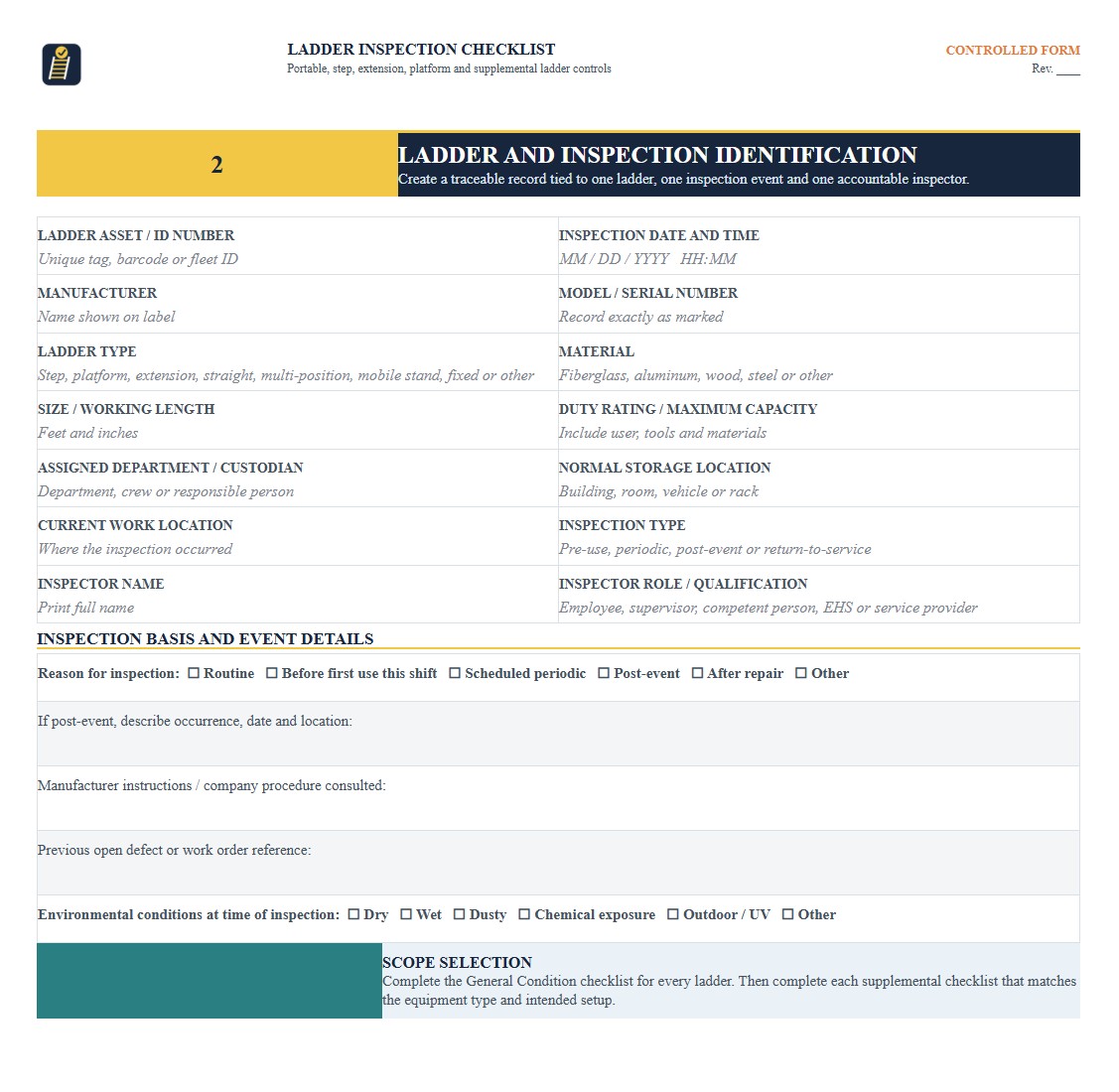
The Ladder Inspection Checklist is a practical safety document for recording the condition of portable, step, extension, platform, rolling, and other workplace ladders before they are used. It can help employers, contractors, maintenance departments, safety coordinators, competent persons, and equipment custodians identify visible defects, document corrective action, and remove unsafe equipment from service. A properly completed checklist creates traceability by linking the inspection to a specific ladder, work location, inspector, date, and final status. This page provides downloadable Word and PDF versions of the Ladder Inspection Checklist, together with practical guidance for completing, customizing, and retaining the document. The Word version can be adapted to an employer’s ladder inventory and safety procedures, while the PDF version provides a consistent format for printing, distribution, and recordkeeping. The checklist should be used together with manufacturer instructions, employee training, workplace procedures, and applicable federal, state, and local safety requirements.
Download the Ladder Inspection Checklist Word Template
The Word format is useful when you want to edit the checklist freely, add company branding, change inspection categories, include internal asset numbers, or adapt the document for a particular ladder type, facility, project, or approval process before printing, sharing, or signing it.

Download the Ladder Inspection Checklist PDF Template
The PDF format is useful for printing, archiving, sharing, or maintaining a fixed-layout inspection form. It can be kept in a safety binder, attached to an equipment record, or distributed to supervisors and employees who perform inspections in the field.
How to Complete and Use This Document
Begin by identifying the employer, department, project, facility, and work location. Enter the inspection date, time, and the name of the person performing the review. The inspector should be familiar with the ladder type, the manufacturer’s instructions, common defects, and the employer’s procedure for removing unsafe equipment from service. In construction work, OSHA requires periodic inspections by a competent person and additional inspection after an occurrence that could affect safe use. General industry rules require ladders to be inspected before initial use during each work shift and more frequently when necessary to identify visible defects. State-plan requirements, industry rules, and company procedures may be more specific.
Identify the ladder precisely so the inspection can be traced to the correct asset. Useful fields include the ladder identification number, manufacturer, model, serial number, ladder type, material, length or working height, duty rating, maximum rated capacity, purchase date, assigned area, and storage location. The ladder’s rated capacity should account for the user together with tools, equipment, and materials. Check that manufacturer labels, warnings, duty-rating information, and operating instructions are present and readable. Do not guess the capacity when the label is missing or illegible.
Inspect the entire ladder from top to bottom. Examine side rails for cracks, splits, bends, dents, distortion, exposed fiberglass, corrosion, deterioration, or unauthorized holes and modifications. Check every rung, step, cleat, platform, and standing surface for looseness, missing parts, excessive wear, deformation, contamination, or damage. Rungs and steps should be secure and free from oil, grease, mud, paint buildup, and other slipping hazards. Surfaces should not contain sharp edges, splinters, projections, or conditions that could cut a user or snag clothing.
Review all hardware and operating components. Depending on the ladder type, this may include bolts, rivets, screws, brackets, hinges, spreaders, locking devices, rung locks, guides, ropes, pulleys, cables, shoes, feet, casters, brakes, handrails, platforms, gates, hooks, and stabilizers. A stepladder’s spreaders or locking devices should hold the front and rear sections securely in the open position. Extension ladder ropes and pulleys should operate correctly, and rung locks should engage fully. Shoes and slip-resistant feet should be present, secure, and appropriate for the intended surface.
For fiberglass ladders, look for blooming, exposed fibers, cracks, burns, chemical damage, or signs of ultraviolet deterioration. Inspect metal ladders for bends, damaged welds, oxidation, and corrosion. Metal ladders require particular caution where the ladder or user could contact exposed energized electrical equipment. Wooden ladders should be checked for splits, decay, warping, loose parts, and coatings that might conceal structural damage. Any material-specific maintenance or inspection criteria provided by the manufacturer should be incorporated into the checklist.
Record each item as satisfactory, defective, not applicable, or requiring further evaluation. Describe defects clearly rather than writing only a general statement such as “damaged.” Note the exact component, location, severity, and circumstances in which the issue was found. Photographs, repair reports, incident records, and manufacturer correspondence may be attached when they help explain the condition. An inspection following a fall, impact, tip-over, chemical exposure, electrical event, excessive loading, or other unusual occurrence should reference that event.
If a structural or other safety defect is discovered, select the appropriate failed or out-of-service status. The ladder should be promptly tagged or marked with language such as “Do Not Use” and physically removed, isolated, or otherwise controlled so it cannot be returned to service unintentionally. Record the person notified, the date removed, the storage or quarantine location, and the planned disposition. Do not rely on the checklist alone to prevent reuse of defective equipment.
Repairs should restore the ladder to a condition that meets its original design criteria before it is returned to service. Consult the manufacturer or a qualified repair provider before drilling, welding, splicing, straightening, replacing structural components, or making other alterations. Some damaged ladders should be destroyed and replaced rather than repaired. After an authorized repair, document the work performed, repair provider, completion date, supporting invoice or report, and follow-up inspection.
Complete the final disposition as approved for service, approved with a documented limitation, removed for repair, or removed for disposal. The inspector should sign and date the form, and a supervisor or safety representative may provide a secondary review when required by company procedure. Retain completed checklists with the ladder inventory, corrective-action records, training documentation, and incident files according to the employer’s recordkeeping policy. Customize the template for fixed ladders, ladder safety systems, specialized industrial ladders, fire-service equipment, electrical work, telecommunications, maritime operations, or other regulated activities. When the applicable requirements are uncertain, consult a qualified safety professional and verify current federal OSHA, state-plan, county, city, project, manufacturer, and industry-specific requirements.