
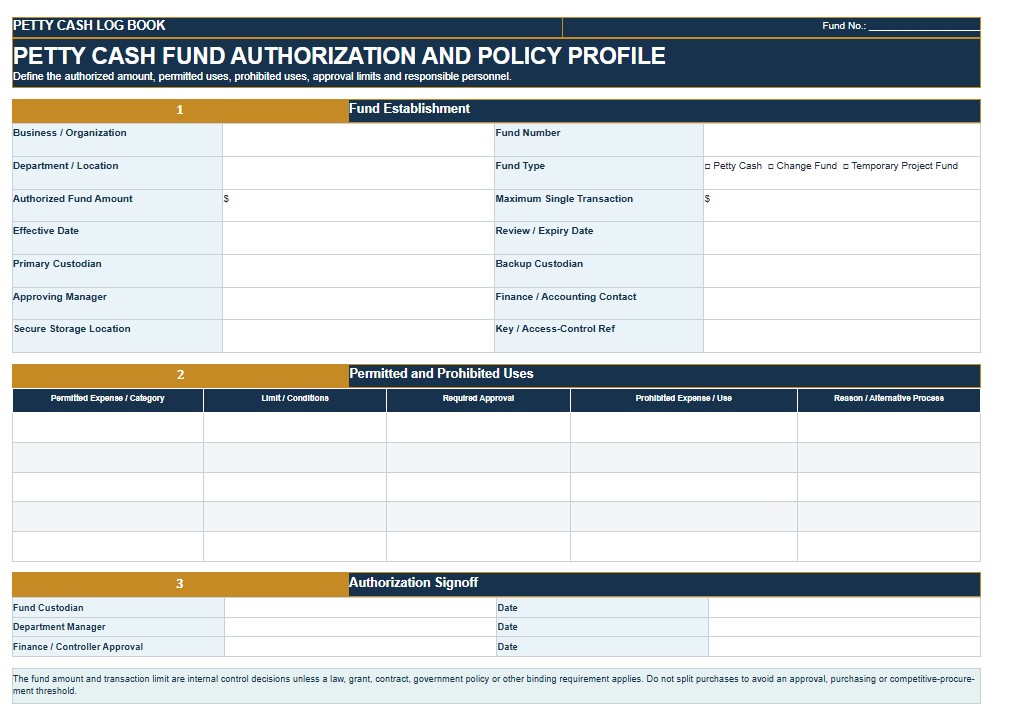
A Petty Cash Log Book provides a structured record of small cash payments made for legitimate business expenses when another payment method is impractical. It is commonly maintained by a petty cash custodian, office manager, bookkeeper, department administrator, nonprofit treasurer, school employee, project coordinator, or small business owner. The log helps track the fund’s opening balance, individual disbursements, supporting receipts, replenishments, cash counts, approvals, account codes, and remaining balance. Accurate records improve accountability, simplify reconciliation, support bookkeeping entries, and help demonstrate the business purpose of expenses for tax and audit purposes. This page provides downloadable Word, PDF, and Excel versions of the Petty Cash Log Book, together with practical guidance for establishing the record, entering transactions, reconciling the fund, protecting the cash, and retaining supporting documents. The template should be customized to match the organization’s purchasing policy, approval limits, accounting system, internal controls, and applicable federal, state, local, grant, or industry requirements.
Download the Petty Cash Log Book Word Template
The Word format is useful when you want to edit the log book freely before printing, sharing, signing, or adapting it to a specific business, department, school, nonprofit organization, construction project, retail location, or administrative procedure. You can add company branding, approval fields, expense categories, spending limits, and customized reconciliation instructions.

Download the Petty Cash Log Book PDF Template
The PDF format is useful for printing, archiving, sharing, or using a consistent fixed-layout version of the document. It can be stored with the cash box, completed as transactions occur, and retained with receipts, vouchers, reconciliation forms, and replenishment records.
Download the Petty Cash Log Book Excel Template
The Excel format is useful because a petty cash record contains repeatable transaction rows, dates, voucher numbers, expense categories, dollar amounts, replenishments, cash counts, and running balances. Formulas can calculate the current fund balance, total spending by category, reconciliation differences, and the amount required to restore the fund to its authorized level.
How to Complete and Use This Document
Begin by identifying the business or organization, department, location, petty cash fund number, authorized fund amount, accounting period, and designated custodian. The authorized amount is the fixed value that should normally be represented by the combination of cash on hand, valid receipts, approved petty cash vouchers, and documented reimbursements that have not yet been replenished. This arrangement is often described as an imprest fund.
Assign one primary custodian who is responsible for safeguarding the cash and maintaining the log. Record any temporary transfer of custody, including the names of the outgoing and incoming custodians, the date and time, the cash counted, outstanding vouchers, and both parties’ acknowledgments. Access to the cash box, safe, drawer, or locked cabinet should be limited to authorized personnel. Keys, combinations, and access credentials should not be left in an unsecured location.
Enter each transaction when the cash is issued rather than waiting until the end of the week or month. Record the transaction date, voucher or receipt number, name of the employee or payee, detailed business purpose, expense category, accounting code, project or grant code when relevant, amount paid, and new running balance. A description such as “office expense” is usually too vague. A more useful entry would identify the item purchased, the department or activity supported, and why petty cash was necessary.
Require the recipient to sign a petty cash voucher or equivalent acknowledgment when money is issued. The recipient should return the original itemized receipt and any unused cash promptly. The voucher, receipt, and log entry should use the same reference number so that a reviewer can trace the transaction from the cash payment to the accounting record. Credit card slips that show only the total may not provide enough detail when an itemized receipt is available.
Do not use petty cash for personal loans, employee advances, check cashing, payroll, recurring vendor payments, prohibited purchases, or transactions that should follow the organization’s normal purchasing process. Organizations frequently impose a maximum amount for each petty cash transaction. That limit is an internal policy choice unless a specific law, grant, contract, or agency rule applies. Transactions should not be divided into smaller payments to avoid an approval threshold or purchasing requirement.
Enter refunds, returned merchandise, reimbursements, and fund replenishments as separate transactions. A replenishment should restore the fund to its authorized amount, not increase the permanent fund balance unless management has formally approved a change. Record the replenishment date, check or payment reference, amount received, accounting period, person preparing the request, and approving manager.
Reconcile the petty cash fund regularly and whenever replenishment, transfer, closure, or a custodian change occurs. Count the actual currency and coins by denomination. Add the cash on hand to valid receipts, approved vouchers, and other documented items. The total should equal the authorized fund amount. Record any shortage or overage separately. Do not alter a transaction or create an unsupported receipt merely to force the reconciliation to balance.
Investigate every difference and document the result. Common causes include mathematical errors, duplicate entries, missing receipts, unrecorded change, transactions entered in the wrong amount, or cash returned without a corresponding log entry. Follow company policy for missing receipts, which may require a written explanation, supervisor approval, repayment by the employee, or another corrective action. Repeated shortages, altered receipts, unusual transactions, or unexplained differences should be reported to the controller, owner, finance department, internal auditor, or other responsible manager.
Good internal control generally separates custody, authorization, bookkeeping, and reconciliation responsibilities. The person holding the cash should not be the only person approving transactions and reviewing the reconciliation. A supervisor or independent employee should periodically review the log, count the fund, compare receipts with entries, and sign the reconciliation. Small organizations that cannot fully separate duties should use documented management review, individual accountability, and occasional unannounced cash counts.
Retain receipts, invoices, vouchers, approvals, cash-count sheets, replenishment requests, reconciliation reports, and correction records in an organized manner. These documents may support expense deductions, financial statements, grant reports, audits, insurance claims, or internal investigations. Federal tax records must be sufficient to substantiate business expenses, but the appropriate retention period depends on the type of record and the circumstances. State law, grant agreements, government contracts, nonprofit requirements, and company policy may require longer retention.
Customize the template when the organization needs separate tax categories, sales tax fields, job numbers, cost centers, restricted-fund codes, grant identifiers, receipt requirements, approval limits, or electronic attachment references. A CPA, bookkeeper, controller, tax professional, attorney, grant administrator, or qualified financial adviser should be consulted when the fund involves tax deductions, public money, federal awards, charitable funds, regulated activities, suspected fraud, repeated discrepancies, or uncertain recordkeeping obligations.