
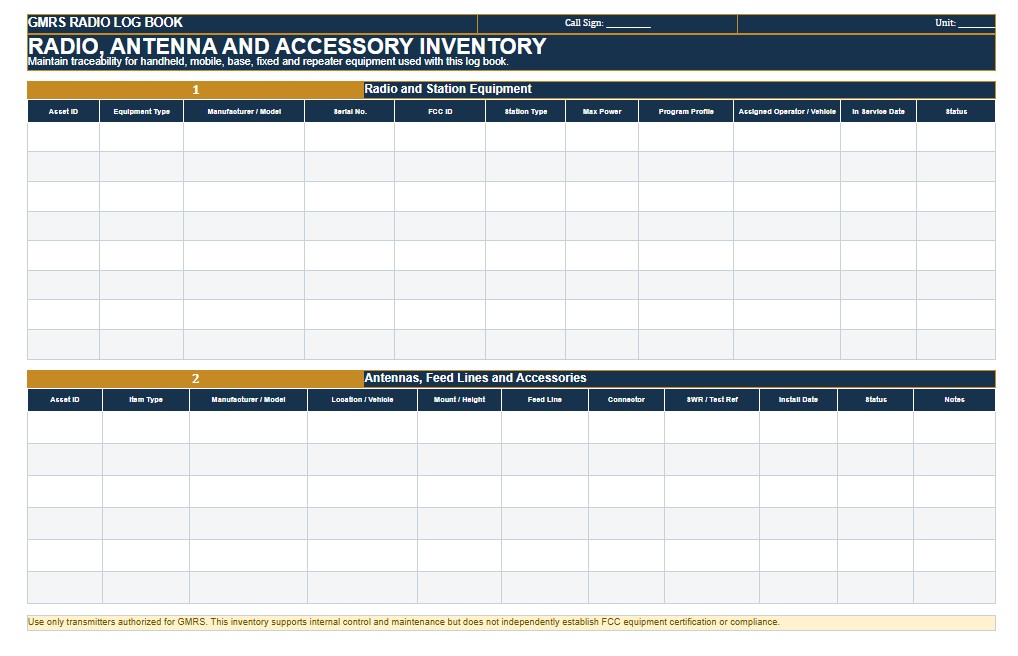
A GMRS Radio Log Book provides an organized record of General Mobile Radio Service contacts, repeater activity, radio tests, operating locations, equipment settings, signal reports, incidents, and scheduled communication exercises. It can be used by individual FCC licensees, family groups operating under a license, neighborhood communication teams, outdoor recreation groups, volunteer organizations, repeater users, and emergency-preparedness participants. A well-maintained log helps operators remember successful repeater configurations, compare radio performance, document coverage tests, track equipment problems, and review communications after an event or exercise. Routine GMRS contact logging is generally voluntary, but the log does not replace FCC licensing, station identification, equipment, or operating requirements. This page provides downloadable Word, PDF, and Excel versions of the GMRS Radio Log Book, together with practical guidance for recording contacts, identifying stations, PDF, and Excel versions of the GMRS Radio Log Book, together with practical, documenting channels and tones, protecting sensitive information, and adapting the template to a family, group, event, vehicle, base station, or repeater system.
Download the GMRS Radio Log Book Word Template
The Word format is useful when you want to edit the document freely before printing, sharing, or adapting it to a particular radio system. You can add your FCC call sign, preferred channel names, repeater information, operating procedures, equipment inventory, family unit identifiers, event details, or organization-specific fields.

Download the GMRS Radio Log Book PDF Template
The PDF format is useful for printing, archiving, sharing, or maintaining a fixed-layout record at a base station, communications desk, repeater site, vehicle, campsite, event command post, or emergency supply location.
Download the GMRS Radio Log Book Excel Template
The Excel format is useful for maintaining repeatable contact rows, filtering entries by date or channel, tracking multiple radios and repeaters, summarizing signal reports, reviewing coverage tests, calculating contact duration, and maintaining searchable lists of equipment, operators, locations, frequencies, tones, and maintenance activity.
How to Complete and Use This Document
Begin by completing the station profile. Record the FCC-assigned GMRS call sign, license holder’s name, license expiration date, primary operating location, and the type of station being logged, such as handheld, mobile, base, fixed, or repeater. When several family members or authorized operators use the same license, assign optional unit identifiers such as Base, Mobile 1, or Family Unit 2. A unit identifier can improve clarity, but it should be used together with the FCC call sign when station identification is required.
For each contact or operating session, enter the date, start time, end time, and time zone. Using a consistent time standard is important when comparing entries from different operators. Local time is practical for routine use, while coordinated exercises may use UTC. Clearly label whichever standard is selected. Do not mix time zones in the same log without identifying them.
Record the channel number or programmed channel name and, when useful, the actual transmit and receive frequencies. For simplex communication, the transmit and receive frequency may be the same. For repeater operation, identify the repeater output, input or offset, and the access tone or code used. Common radio displays and channel numbering systems are not always identical between manufacturers, so verify the actual programmed frequencies rather than relying only on a channel label.
The contact fields should identify the other station’s call sign or unit identifier, the operator’s location, the communication type, and a short summary of the exchange. Communication types may include routine contact, radio check, repeater test, coverage survey, family coordination, event support, weather observation, roadside assistance, training exercise, or emergency traffic. Keep descriptions objective and concise. Avoid placing unnecessary medical, personal, security, access-code, or precise residential information in a log that may be shared with other people.
Signal reports can be recorded using plain-language terms such as strong, readable, weak, noisy, intermittent, or unreadable. Operators may also use a consistent numeric reporting system. The log should explain the selected scale so that entries from different users can be compared. Additional fields may document transmit power, antenna type, antenna height, terrain, weather, vehicle position, radio model, battery condition, and whether the communication used simplex or a repeater. These details are especially useful during coverage testing and equipment evaluation.
GMRS stations must transmit the FCC-assigned call sign after a single transmission or series of transmissions. During a series lasting more than 15 minutes, the call sign must also be transmitted after 15 minutes and at least once every 15 minutes thereafter. Identification must be made by voice in English or by audible international Morse code. A log entry can include an identification check field, but checking the box does not replace transmitting the call sign over the air.
Do not treat CTCSS tones, DCS codes, or similar squelch settings as privacy or encryption. They help radios selectively open their receivers but do not prevent other properly configured receivers from hearing the transmission. Operators should assume that ordinary GMRS voice communications may be monitored. The log should not contain repeater access details that the repeater owner has asked users to keep restricted.
Before using a repeater, record its identification, coverage area, operating status, access requirements, permission conditions, emergency procedures, and any published usage rules. Confirm that the radio is programmed correctly and that the operator is authorized to use the system. Avoid interfering with ongoing communications, allow pauses between transmissions, and use clear, brief language during busy periods.
For an emergency, safety exercise, public event, workplace activity, or organized volunteer operation, customize the template with incident name, assignment, check-in time, net control station, message priority, message recipient, acknowledgment status, and action taken. GMRS should not be treated as a guaranteed substitute for 911, public-safety radio, cellular service, satellite communication, or an organization’s approved emergency plan.
Review completed logs periodically to identify weak coverage areas, radio failures, battery problems, incorrect programming, repeated interference, or unsuccessful repeater access. Preserve entries relating to incidents, complaints, equipment damage, organizational exercises, or official activities according to the applicable group, employer, insurer, property owner, or agency policy. Consult the current FCC rules or a qualified communications professional when questions involve licensing, repeater installation, antenna structures, interference, equipment authorization, business operations, tower or builing permits, or coordination with government and public-safety agencies.