
An HVAC Maintenance Checklist is a practical record used by homeowners, landlords, property managers, facility teams, and HVAC contractors to document routine heating, ventilation, and air conditioning inspections. In the United States, this type of checklist is commonly used to track equipment condition, filter changes, coil cleaning, thermostat checks, safety observations, refrigerant-related notes, electrical components, condensate drainage, airflow issues, corrective actions, and technician recommendations. A well-prepared checklist helps create a consistent maintenance history, supports warranty and service records, and makes it easier to identify recurring problems before they become expensive failures. This page provides downloadable Word, PDF, and Excel versions of the HVAC Maintenance Checklist, together with practical guidance for completing and using the document correctly. The template can be adapted for residential systems, rental properties, commercial buildings, seasonal inspections, preventive maintenance programs, or internal company service procedures.
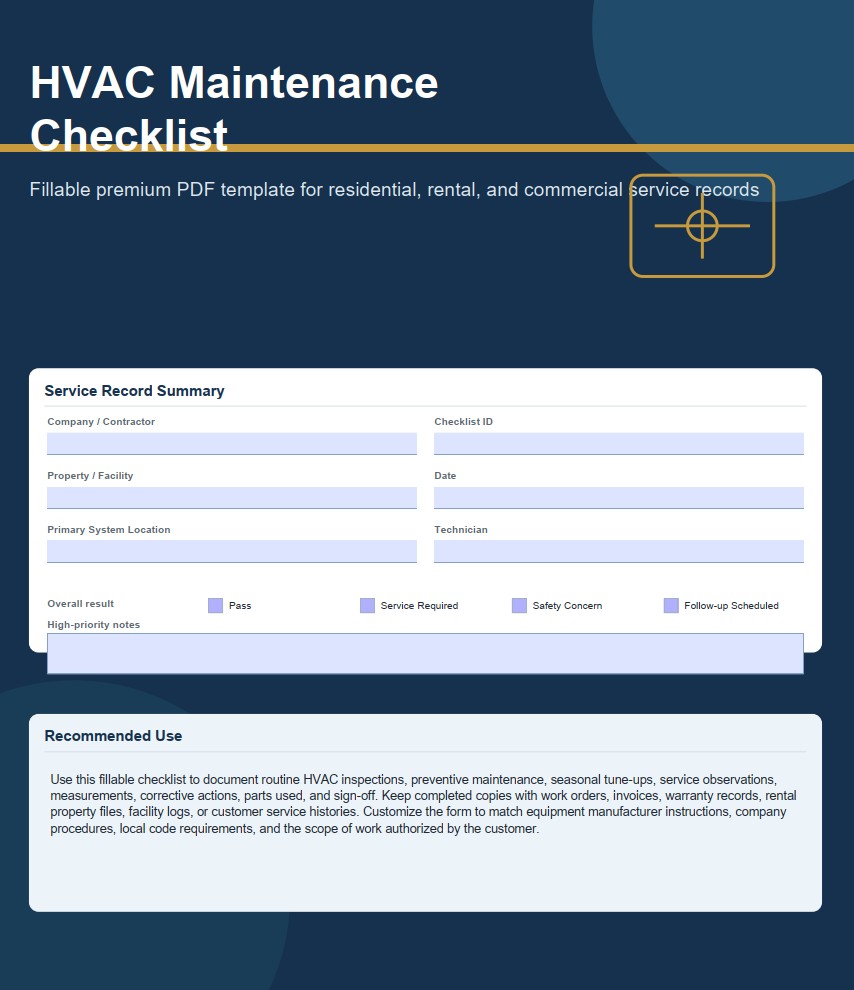
Download the HVAC Maintenance Checklist Word Template
The Word format is useful when you want to edit the HVAC Maintenance Checklist freely before printing, sharing, signing, or adapting it to a specific property, equipment type, contractor workflow, or company maintenance procedure.

Download the HVAC Maintenance Checklist PDF Template
The PDF format is useful when you need a fixed-layout HVAC maintenance form for printing, archiving, emailing, attaching to a service file, or using as a consistent checklist during field inspections.
Download the HVAC Maintenance Checklist Excel Template
The Excel format is useful when the HVAC Maintenance Checklist needs repeatable rows, maintenance logs, inspection dates, equipment lists, schedules, filter replacement tracking, service intervals, cost notes, or multiple assets across one property or facility.
How to Complete and Use This Document
Start the HVAC Maintenance Checklist by entering clear identification details. These usually include the property name, property address, unit or building number, customer or owner name, service company name, work order number, date of inspection, and the name of the technician or responsible person completing the form. For commercial properties or larger residential portfolios, it is also helpful to include the equipment tag number, asset ID, model number, serial number, manufacturer, system location, system type, tonnage or capacity if known, and whether the unit serves a specific floor, suite, apartment, zone, or tenant space.
The checklist should then document the actual maintenance activity performed. For a typical HVAC system, important items may include thermostat operation, air filter condition, blower components, evaporator and condenser coils, outdoor unit clearance, electrical connections, disconnects, capacitors, contactors, motors, belts where applicable, condensate drain lines, drain pans, refrigerant line insulation, duct condition, supply and return airflow, temperature split, unusual vibration, noise, odor, visible corrosion, water leakage, and signs of damage. For heating equipment, the form may also include ignition operation, burner condition, flue or venting observations, gas connection notes, heat exchanger concerns, carbon monoxide safety observations where appropriate, and combustion-related findings. The checklist should not be used as a substitute for the manufacturer’s service manual, but it can help ensure that routine steps are not missed.
When measurements are taken, record them carefully rather than writing vague comments. Useful entries may include indoor and outdoor temperature, supply and return air temperature, static pressure readings if measured, amperage, voltage, refrigerant pressure readings if applicable, thermostat set point, filter size, filter type, and any other readings required by the contractor’s procedure or facility policy. If the person completing the checklist is not qualified to evaluate a technical item, the form should say that the item was not checked or was referred to a licensed or qualified HVAC professional. Guessing on a maintenance record can create confusion later.
Safety notes are especially important. Before maintenance work is performed, the responsible person should follow applicable safety procedures for electrical energy, moving parts, hot surfaces, ladders, confined or restricted spaces, rooftop equipment, and any site-specific hazards. If employees are performing service work, the employer’s lockout and tagout procedures, training requirements, and workplace safety policies may apply. Refrigerant-related work should be handled only by properly qualified personnel. In the United States, technicians who maintain, service, repair, or dispose of equipment containing regulated refrigerants may need the appropriate EPA Section 608 certification, depending on the work being performed and the equipment involved.
Use the findings section to describe problems in plain, specific language. Instead of writing “bad unit,” write what was observed, such as “condenser coil heavily obstructed by debris,” “condensate drain partially clogged,” “filter missing,” “blower wheel dirty,” “unusual compressor noise,” or “thermostat not responding to cooling call.” The corrective action area should explain whether the issue was fixed during the visit, whether parts are needed, whether a follow-up appointment is recommended, or whether the equipment should be evaluated before continued operation. If photos, invoices, permits, manufacturer documents, or test reports support the work, note them as attachments or related records.
The completed checklist should be reviewed before it is filed or shared. Confirm that dates are correct, equipment information is consistent with prior records, required fields are not left blank, and any urgent safety concerns are clearly marked. For landlords, property managers, and commercial facility teams, consistent recordkeeping can help document preventive maintenance, tenant requests, contractor performance, warranty support, and capital planning. For homeowners, the checklist can help compare service visits and track recurring problems across heating and cooling seasons.
Customize the template when the property, equipment, or maintenance program requires more detail. A single-family home checklist may be brief, while a commercial building may need separate sections for rooftop units, air handling units, chillers, boilers, exhaust fans, controls, pumps, economizers, humidification, and indoor air quality components. Requirements can vary by state, county, city, lease, warranty, insurer, employer policy, industry standard, and local code authority. For technical compliance questions, safety concerns, refrigerant work, combustion equipment, commercial building requirements, or disputes over responsibility for maintenance, it is better to consult a licensed HVAC contractor, qualified safety professional, attorney, insurer, or the relevant local authority before relying on a generic template alone.