
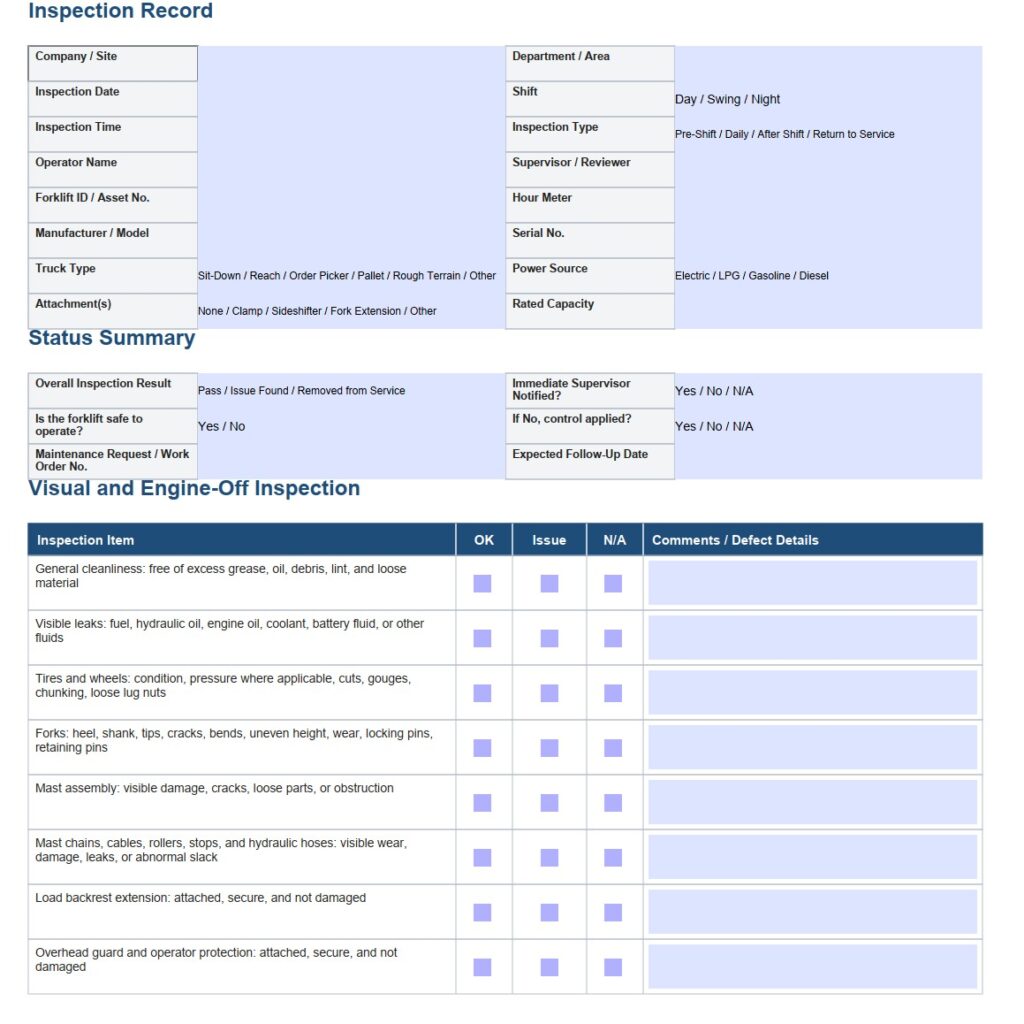
A forklift inspection checklist is a practical safety template used by warehouses, distribution centers, construction sites, manufacturers, retailers, and other U.S. workplaces that operate powered industrial trucks. This document helps operators complete a consistent pre-use inspection before a forklift is placed in service, document visible defects, confirm basic operating functions, and report problems that could affect safe operation. A well-structured forklift inspection checklist can support OSHA-aligned workplace safety practices, internal maintenance procedures, supervisor review, and equipment traceability. On this page, you can download the forklift inspection checklist template in Word, PDF, and Excel formats. The Word version is useful for editing, the PDF version is useful for printing and fixed-layout use, and the Excel version is useful for logs, shift records, equipment lists, and repeatable inspection entries. The guidance below explains how to complete and use the checklist in a practical U.S. workplace setting.
Download the Forklift Inspection Checklist Word Template
The Word format is useful when you want to edit the forklift inspection checklist freely before printing, sharing, signing, or adapting it to a specific workplace, forklift type, department, shift, or company safety procedure.

Download the Forklift Inspection Checklist PDF Template
The PDF format is useful when you need a fixed-layout forklift inspection checklist for printing, archiving, posting near equipment, distributing to operators, or keeping consistent paper records for each inspection period.
Download the Forklift Inspection Checklist Excel Template
The Excel format is useful when the forklift inspection checklist needs repeatable rows, dates, operator names, equipment numbers, shift records, defect logs, corrective action notes, supervisor review, or multiple forklifts tracked in one file.
How to Complete and Use This Document
A forklift inspection checklist should be completed before the forklift is placed in service. In a workplace where forklifts are used continuously or across multiple shifts, the checklist should be tied to the shift or inspection period so the company can identify when the truck was checked, who checked it, and what condition it was in before use. The first part of the form should normally capture basic identification details, including the company or location name, department, date, shift, operator name, forklift ID or asset number, truck type, hour meter reading, and the area where the equipment will be used. These details make the inspection record easier to trace if a defect, maintenance issue, near miss, or incident is reviewed later.
The inspection items should reflect the actual forklift and workplace. A general checklist may include tires, wheels, forks, fork pins, mast, lift chains, hydraulic hoses, cylinders, fluid leaks, overhead guard, load backrest, seat belt, data plate, warning labels, mirrors, lights, horn, backup alarm if equipped, steering, service brake, parking brake, lift and lower controls, tilt controls, gauges, battery condition, fuel system, propane cylinder condition, or other items relevant to the truck. Electric forklifts, propane forklifts, diesel forklifts, pallet trucks, order pickers, reach trucks, and rough terrain forklifts may require different checks. The employer should compare the template with the operator manual, manufacturer recommendations, attachments used on the truck, and site-specific hazards.
When completing the checklist, the operator should inspect the truck carefully and mark each item as acceptable, not acceptable, not applicable, or requiring attention, depending on the format used by the company. Defects should not be described vaguely. Instead of writing “bad tire” or “leak,” the operator should record practical details such as the tire location, visible damage, fluid location, unusual noise, brake issue, warning light, missing label, cracked fork, damaged chain, or hydraulic problem. If the form includes a comments field, it should be used to explain what was found and whether the issue was reported to a supervisor, maintenance department, or designated responsible person.
If an inspection shows a condition that may affect safe operation, the forklift should not be used until the issue is evaluated and corrected according to company procedure. Unsafe trucks should be removed from service, and repairs should be handled by authorized personnel. Operators should not try to bypass a safety defect just to keep production moving. A checklist is only useful when it leads to action. For that reason, the form should include space for reporting defects, documenting corrective action, identifying who reviewed the issue, and recording when the truck was returned to service if applicable.
The template should also be used consistently. A completed checklist should not be treated as a casual note. It is a workplace safety record that may support maintenance planning, training verification, equipment accountability, supervisor review, and internal audits. Many employers keep inspection records as part of their broader safety and maintenance program, even when a specific retention period depends on company policy, insurance expectations, contractual requirements, or applicable federal, state, local, or industry rules. The safest approach is to store completed checklists in a predictable location, whether that means a binder, shared drive, maintenance software, or safety management system.
Before using the forklift inspection checklist, customize it to match your equipment, site, and operating conditions. Add fields for attachments, battery charging areas, propane exchange procedures, pedestrian traffic zones, dock work, ramps, cold storage, outdoor work, or other hazards that apply to your operation. Remove items that do not apply only after confirming that the checklist still covers the truck correctly. For complex operations, high-risk environments, recurring defects, or uncertainty about OSHA requirements, training duties, equipment modifications, or repair procedures, the employer should consult a qualified safety professional, forklift service provider, legal advisor, or the applicable regulatory authority before relying on the template alone.