
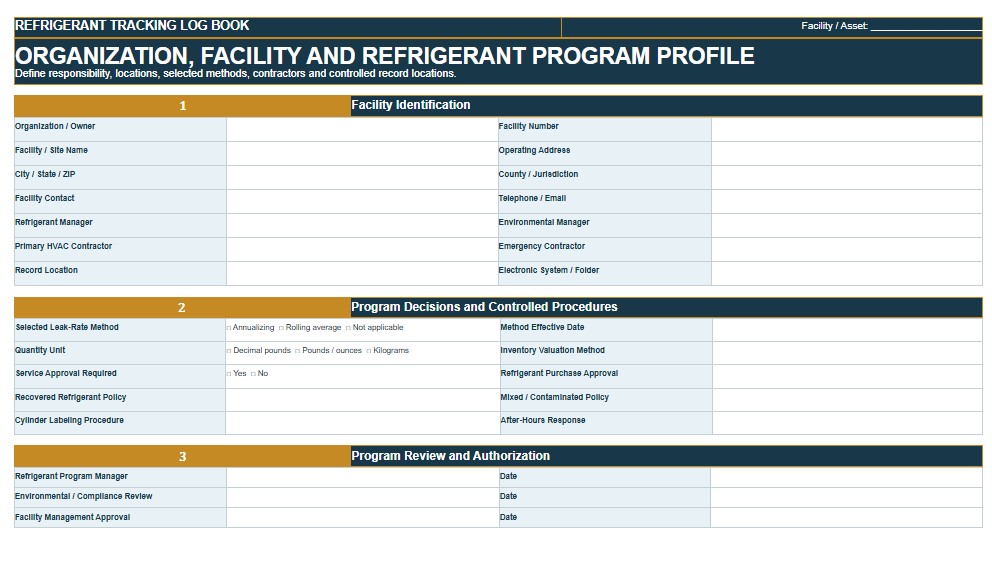
A Refrigerant Tracking Log Book provides an organized record of refrigerant purchases, cylinder inventory, equipment charges, refrigerant additions, recovery, recycling, reclamation, leak inspections, repairs, verification tests, and final disposal. It can be used by HVAC and refrigeration contractors, Section 608 certified technicians, facility managers, property owners, supermarkets, cold-storage operators, industrial plants, schools, hospitals, and other organizations responsible for stationary refrigeration or air-conditioning equipment. Accurate tracking helps a business reconcile refrigerant inventory, document technician activity, calculate appliance leak rates, investigate unexplained losses, support service invoices, and maintain records required by company policy or environmental regulations. Requirements may differ according to refrigerant type, equipment category, full charge, service activity, and jurisdiction. This page provides downloadable Word, PDF, and Excel versions of the Refrigerant Tracking Log Book, together with practical guidance for completing equipment, cylinder, service, recovery, leak-repair, and recordkeeping sections.
Download the Refrigerant Tracking Log Book Word Template
The Word format is useful when you want to edit the document freely before printing, sharing, signing, or adapting it to a particular facility, HVAC company, refrigeration system, technician workflow, refrigerant inventory process, or compliance program.

Download the Refrigerant Tracking Log Book PDF Template
The PDF format is useful for printing, archiving, sharing, or maintaining a fixed-layout record in a mechanical room, service vehicle, facility compliance file, equipment folder, refrigerant storage area, or technician work-order package.
Download the Refrigerant Tracking Log Book Excel Template
The Excel format is useful for repeatable service rows, refrigerant quantities, cylinder balances, appliance inventories, leak-rate calculations, inspection schedules, repair deadlines, purchase records, recovered amounts, reclaimed refrigerant, disposal records, costs, and technician activity. It also allows records to be filtered by facility, appliance, refrigerant type, cylinder, technician, service date, or compliance status.
How to Complete and Use This Document
Begin by creating a separate equipment profile for each refrigeration, air-conditioning, chiller, heat-pump, or process-cooling appliance. Record the facility name, physical location, internal asset number, manufacturer, model, serial number, equipment category, installation date, refrigerant type, and full refrigerant charge. For a system with multiple independent refrigerant circuits, track each circuit separately when required by the applicable rule or company procedure. Confirm the full charge from reliable information such as the equipment nameplate, manufacturer documentation, engineering records, commissioning data, or an approved charge-determination method.
Identify the regulatory category carefully. Stationary refrigeration and air-conditioning work is generally addressed under Clean Air Act Section 608 and related EPA regulations. Motor vehicle air-conditioning service is primarily subject to Section 609 and should normally be tracked through an MVAC-specific process. Beginning January 1, 2026, additional federal leak-repair, recordkeeping, and reporting provisions apply under 40 CFR Part 84 to certain refrigerant-containing appliances with a full charge of 15 pounds or more that contain HFCs or specified substitutes. Applicability depends on the equipment sector, refrigerant, global warming potential, charge size, and any exclusions. Do not assume that one threshold applies to every appliance.
Complete a transaction entry whenever refrigerant enters or leaves company custody or an appliance. Record the date, transaction type, refrigerant designation, quantity, unit of measure, cylinder identification, supplier or recipient, purchase or shipment document, technician, and related appliance or work-order number. Distinguish virgin, recovered, recycled, reclaimed, contaminated, mixed, and waste refrigerant. Do not combine unlike refrigerants in one inventory balance unless an approved recovery or waste procedure specifically permits it.
For each service visit, document the technician’s name, Section 608 certification type or company credential reference, service date, appliance identification, reason for service, refrigerant present, quantity recovered, quantity added, quantity returned to the cylinder, and final operating charge when known. Record pressure, temperature, superheat, subcooling, weight, or other diagnostic measurements only when they are relevant and taken with appropriate instruments. The log should link to the service invoice, work order, recovery record, repair report, and customer authorization.
When refrigerant is added because of a leak, record the amount added and calculate the applicable leak rate using the method required for that appliance. Document the date on which the threshold was exceeded, the suspected and confirmed leak locations, the inspection method, repair attempts, components replaced, and the technician performing the work. Where federal leak-repair rules apply, the record may also need to show repair deadlines, initial verification tests, follow-up verification tests, periodic leak inspections, retrofit or retirement plans, extensions, automatic leak-detection activity, and reports submitted to EPA.
Do not mark a repair as successful merely because the appliance was recharged or temporarily returned to operation. Record the test method, test date, operating conditions, result, person performing the test, and any additional leak found. If the system cannot be repaired within the applicable period, escalate the entry to the responsible facility manager or compliance officer rather than changing the original service date or quantity.
Maintain a cylinder register for every recovery, storage, transfer, and supply cylinder. Useful fields include cylinder number, refrigerant type, tare weight, gross weight, calculated net contents, owner, storage location, condition, last inspection, received quantity, issued quantity, returned quantity, and current balance. Reconcile physical cylinder weights with purchase, service, recovery, reclamation, and disposal records. Investigate negative balances, unexplained gains, unidentified mixtures, damaged valves, incorrect labels, or quantities that do not agree with supporting documents.
Recovered refrigerant should be linked to its final disposition. Record whether it was returned to the same owner’s equipment, recycled for permitted reuse, transferred to another authorized location, sent to an EPA-certified reclaimer, or managed as waste. Include the receiving company, shipment date, manifest or bill-of-lading reference, refrigerant type, quantity, cylinder numbers, and certificate or reclamation document when available.
Before relying on the log, verify that all quantities use the same unit, commonly pounds and ounces or decimal pounds. Check arithmetic, cylinder tare weights, appliance charge data, dates, technician certification references, invoice numbers, and supporting attachments. Preserve original entries and document corrections through a revision or audit trail rather than deleting prior information.
Customize the template when the organization operates large commercial refrigeration systems, industrial process refrigeration, automatic leak-detection equipment, multiple facilities, leased cylinders, refrigerant banks, reclaimed-refrigerant purchasing programs, or systems subject to state-specific greenhouse-gas rules. State and local requirements may impose additional registration, reporting, technician licensing, disposal, fire-code, hazardous-material, or record-retention obligations.
Consult a qualified HVAC or refrigeration professional, EPA-certified technician, environmental compliance specialist, engineer, safety professional, attorney, or responsible regulatory agency when the correct refrigerant, charge, leak rate, repair deadline, reporting duty, retrofit requirement, cylinder handling method, or disposal procedure is uncertain.