
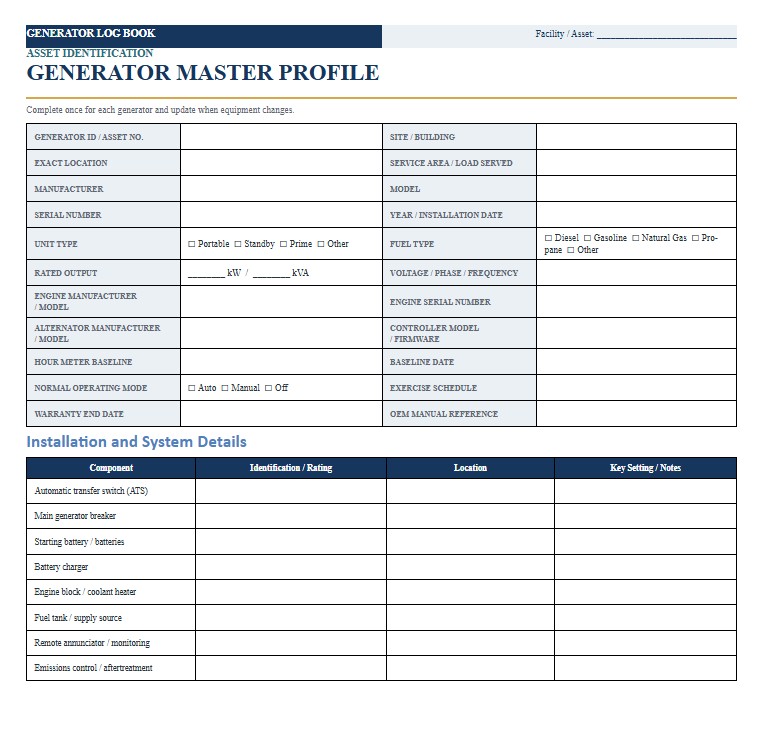
A generator log book provides an organized record of generator inspections, operating hours, test runs, fuel usage, maintenance work, faults, repairs, and corrective actions. It can be used for portable generators, commercial standby generators, emergency power systems, construction equipment, rental fleets, residential backup units, and generators installed at healthcare, industrial, retail, agricultural, or public facilities. Accurate logs help owners and maintenance teams identify recurring problems, document completed work, plan preventive maintenance, and confirm that the generator is ready when normal electrical service fails. This page provides downloadable Word, PDF, and Excel versions of the generator log book, together with practical guidance for completing and maintaining the record. The template should be adapted to the generator manufacturer’s instructions, the facility’s operating procedures, and any applicable federal, state, county, city, fire-code, environmental, insurance, or industry-specific requirements.
Download the Generator Log Book Word Template
The Word version is useful when you want to edit the generator log book freely before printing, sharing, or adapting it to a particular generator, facility, maintenance program, or company procedure. You can add a business logo, revise inspection items, insert approval fields, and remove sections that do not apply.

Download the Generator Log Book PDF Template
The PDF version is suitable for printing, archiving, sharing with technicians, or maintaining a fixed-layout record at the generator location. It can help standardize handwritten or electronic entries and preserve a consistent format across inspection and maintenance periods.
Download the Generator Log Book Excel Template
The Excel version is especially useful for repeatable entries, operating-hour calculations, fuel records, maintenance schedules, fault tracking, inventory lists, service dates, and multi-generator fleets. It can also support filtering, sorting, status monitoring, and review of recurring maintenance issues.
How to Complete and Use This Document
Begin by creating a clear identification record for each generator. Enter the owner or facility name, equipment location, asset number, manufacturer, model, serial number, generator type, rated output, voltage, fuel type, installation date, and normal service provider. For a stationary standby system, it may also be useful to identify the automatic transfer switch, connected emergency load, fuel tank, battery system, and the building or circuit served. Portable units should be identified individually so records are not accidentally assigned to the wrong machine.
Each log entry should include the date, start time, stop time, hour-meter reading, reason for operation, and the name or initials of the person completing the inspection or test. Distinguish routine exercises from actual power outages, maintenance runs, load-bank tests, commissioning activities, and troubleshooting sessions. This distinction makes the history easier to review and prevents an emergency operation from being mistaken for a scheduled test.
Before starting the generator, record the condition of the equipment using the manufacturer’s recommended inspection procedure. Common checks include engine oil, coolant, fuel level, battery condition, battery charger, belts, hoses, wiring, terminals, enclosure, ventilation openings, exhaust components, visible leaks, warning indicators, and the area surrounding the unit. Do not mark an item as satisfactory unless it was actually examined. Any leak, damaged cable, unusual odor, blocked ventilation opening, loose connection, active alarm, or missing guard should be described clearly.
During a test run, record only measurements that can be obtained safely and that are relevant to the specific generator. These may include operating hours, voltage, frequency, amperage, oil pressure, coolant temperature, battery voltage, load percentage, fuel level, and run duration. When an automatic transfer switch is tested, note whether the generator started, the load transferred, the system remained stable, and normal power was restored correctly. Compare readings with the manufacturer’s operating limits rather than assuming that one set of values applies to every generator.
Use the findings and corrective-action fields to document unusual noise, smoke, vibration, unstable output, hard starting, low fluid levels, alarm conditions, transfer failures, excessive temperature, fuel contamination, leaks, or damaged components. Record the immediate action taken, the person responsible for follow-up, any work-order or service-ticket number, and the date the issue was closed. A generator with a safety defect or unreliable output should be handled under the organization’s out-of-service and escalation procedures rather than simply noted for later review.
Maintenance entries should identify the work performed, parts and fluids used, hour-meter reading, technician or contractor, service date, and next recommended service point. Attach or cross-reference invoices, inspection reports, warranty documents, fuel-quality reports, load-bank results, repair records, and photographs when they provide useful supporting evidence. Entries should be made promptly, written legibly, and corrected without concealing the original information.
Operate and maintain the generator according to the manufacturer’s instructions. Portable generators present carbon monoxide, electrical, fire, and refueling hazards. They should not be operated indoors or near openings where exhaust can enter an occupied space. Connections to building wiring generally require properly installed transfer equipment to prevent dangerous backfeeding. Servicing may also require lockout/tagout or other hazardous-energy controls, depending on the workplace and task. Electrical, fuel-system, transfer-switch, and internal engine work should be performed by qualified personnel.
Required inspection intervals and records can vary significantly. Healthcare facilities, emergency power systems, regulated workplaces, rental fleets, construction sites, and facilities with underground fuel tanks may be subject to additional rules. State or local air-quality, fire-code, fuel-storage, spill-prevention, licensing, and permitting requirements may also apply. Review the current requirements for the generator’s location and intended use, and consult a qualified electrician, generator technician, environmental professional, safety professional, engineer, fire-code official, or other appropriate specialist when the applicable standard is unclear.
Keep completed log pages in a secure and accessible location, whether in a binder near the equipment or in an approved electronic record system. Retention periods should follow company policy, warranty conditions, insurance requirements, contractual obligations, and any rules that apply to the facility. Review the log periodically to identify missed inspections, overdue maintenance, recurring alarms, increasing fuel consumption, battery problems, or repeated failures that require a more comprehensive evaluation.