
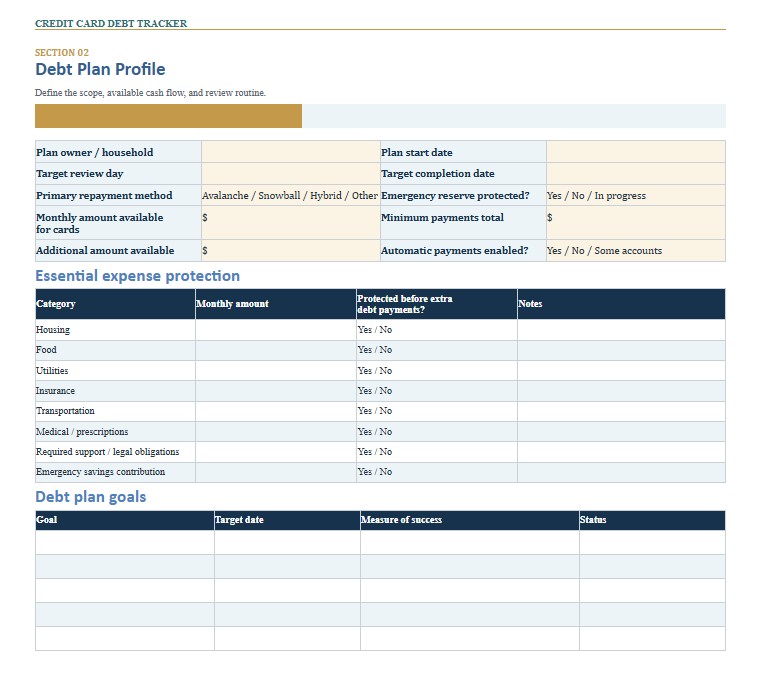
A credit card debt tracker is a personal financial planning tool used to organize card balances, annual percentage rates, minimum payments, due dates, credit limits, promotional offers, and payment progress in one place. It can help individuals and households compare accounts, avoid missed due dates, plan additional payments, estimate payoff priorities, and monitor whether total revolving debt is increasing or decreasing. The tracker should be updated from current credit card statements because interest rates, minimum payments, fees, and promotional terms may change over time. It is not a replacement for an issuer’s statement, account agreement, credit report, or professional financial advice. This page provides downloadable Word, PDF, and Excel versions of a credit card debt tracker, together with practical guidance for completing, reviewing, securing, and using the document. The templates can be adapted for a single card, multiple creditors, household debt planning, a hardship plan, or a structured payoff strategy.
Download the Credit Card Debt Tracker Word Template
The Word format is useful when you want to edit the tracker freely, add notes or account-specific fields, remove unnecessary sections, and adapt the document before printing, sharing with a financial counselor, or using it as part of a personal debt repayment plan.

Download the Credit Card Debt Tracker PDF Template
The PDF format is useful for printing, archiving monthly snapshots, maintaining a fixed-layout record, or completing the same fields consistently during regular debt reviews.
Download the Credit Card Debt Tracker Excel Template
The Excel format is useful for repeatable account rows, payment histories, dollar amounts, due dates, interest rates, balance changes, payoff calculations, totals, progress percentages, and comparisons between different repayment strategies.
How to Complete and Use This Document
Begin by creating one entry for each credit card account. Record the creditor or issuer, a recognizable card nickname, and no more than the last four digits of the account number. Do not place a full card number, security code, online banking password, Social Security number, personal identification number, or security-answer information in the tracker.
Enter Current Account Information
Use the most recent statement or the issuer’s current account information to enter the statement date, payment due date, statement balance, current balance, credit limit, available credit, minimum payment, and annual percentage rate. The statement balance and current balance may differ because of payments, purchases, credits, interest, or fees posted after the billing cycle closed.
A card may have more than one interest rate. Purchases, balance transfers, cash advances, penalty balances, and promotional balances can be subject to different terms. When this applies, record each balance category separately or add a clear note identifying the applicable rate and expiration date. Do not rely on a single blended rate when that would make the tracker misleading.
Record annual fees, late fees, cash-advance fees, balance-transfer fees, and interest charged during the billing period when those amounts are relevant to the repayment plan. Promotional financing should include the offer type, promotional rate, promotional balance, and expiration date. A minimum payment may not be enough to eliminate a promotional balance before the offer ends, particularly when deferred interest may apply.
Plan and Record Payments
Enter the amount you plan to pay, the scheduled payment date, the actual payment amount, the date submitted, and the confirmation or reference number. Continue to verify the payment directly with the issuer. A tracker entry does not prove that a payment was received, credited on time, or applied to the expected balance category.
At a minimum, the required payment shown on the current statement should be addressed by the due date. Paying more than the minimum can generally reduce the time and interest required to repay a balance, but the result depends on the account terms, new transactions, fees, rate changes, and payment allocation rules. Avoid entering payments that the household budget cannot support after essential housing, food, utilities, insurance, transportation, and medical expenses are considered.
Select a Repayment Priority
The tracker may be customized for a highest-interest-first approach, often called the debt avalanche method, or a smallest-balance-first approach, commonly called the debt snowball method. The first approach generally prioritizes the highest annual percentage rate, while the second focuses on closing smaller balances for visible progress. The most appropriate method depends on cash flow, account status, promotional deadlines, motivation, and financial risk.
Whichever method is selected, continue making required payments on every account. Add a priority number, planned extra payment, target payoff date, and reason for the priority. A card with an expiring promotional offer, past-due status, penalty rate, legal collection issue, or essential recurring charge may require separate treatment.
Reconcile the Tracker Regularly
Update the document after every statement cycle and after significant payments or charges. Compare the opening balance, purchases, payments, credits, interest, fees, and ending balance with the issuer’s statement. Investigate unexplained differences rather than changing the tracker merely to force the totals to match.
Maintain a monthly snapshot so that progress can be measured over time. Useful summary fields include total card debt, total minimum payments, total planned payments, interest and fees paid, balances eliminated, and the change in debt from the previous month. Payoff projections should be treated as estimates unless they fully account for the issuer’s actual interest calculation, payment allocation, changing minimums, fees, and future transactions.
Protect the Record and Seek Help When Needed
Store the tracker in a secure location, restrict access, and use password protection or encrypted storage for electronic copies. Be especially careful when sharing the document by email or with another household member, counselor, attorney, or financial professional.
If payments are becoming difficult, contact the card issuer promptly to ask about available hardship options. A qualified nonprofit credit counselor may help review a budget and repayment plan. Debt settlement and credit repair offers should be evaluated carefully, particularly when a company promises guaranteed reductions, demands advance payment, or advises stopping communication with creditors.
Consult a qualified financial adviser, credit counselor, consumer attorney, bankruptcy attorney, or tax professional when the debt involves collection activity, litigation, disputed accounts, possible insolvency, settlement, forgiven debt, bankruptcy, or other significant legal or tax consequences. Federal protections apply in many situations, but collection procedures, statutes of limitation, exemptions, licensing rules, and available remedies may vary by state.