
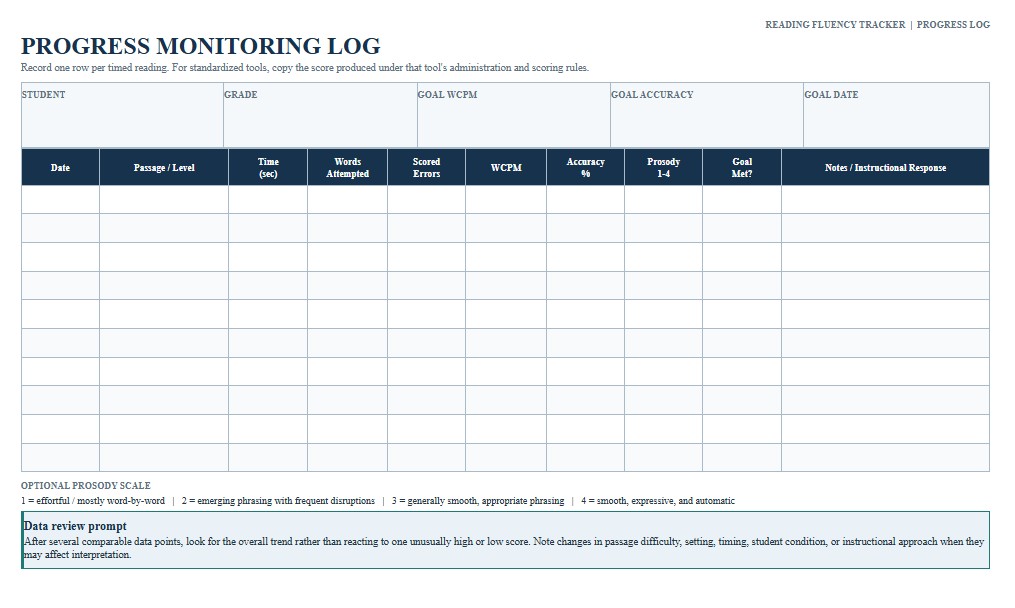
A reading fluency tracker is a practical record used by teachers, reading specialists, interventionists, tutors, homeschool educators, and parents to document changes in a student’s oral reading performance over time. A well-designed tracker can record reading dates, passage information, words read, errors, words correct per minute, accuracy, fluency observations, goals, and instructional notes. Keeping these results in one place makes it easier to identify trends, review the effectiveness of reading instruction, and decide when additional practice or assessment may be appropriate. This page provides downloadable Reading Fluency Tracker Word, PDF, and Excel templates, together with practical guidance for completing and using the record. The Word version is designed for customization, the PDF offers a consistent printable layout, and the Excel version is useful for maintaining repeated measurements and reviewing progress across multiple reading sessions.
Download the Reading Fluency Tracker Word Template
The Word version is useful when you want to edit the tracker freely before printing or sharing it. Teachers and other educators can customize headings, add school or classroom information, adjust reading goals, create additional observation fields, or adapt the document to match an existing reading intervention or progress-monitoring procedure.

Download the Reading Fluency Tracker PDF Template
The PDF version is suitable when you need a fixed-layout reading fluency record that can be printed, archived, shared with appropriate school personnel, or completed during individual reading sessions. Its consistent format can be particularly convenient when the same information is collected repeatedly throughout a school term or intervention period.
Download the Reading Fluency Tracker Excel Template
The Excel version is especially useful for ongoing progress monitoring because reading results can be entered in repeatable rows by date. It can help organize passage information, reading times, words attempted, errors, words correct per minute, accuracy percentages, goals, and notes, making it easier to review changes in performance across multiple sessions.
How to Complete and Use This Document
A reading fluency tracker is most useful when entries are made consistently and the scoring method remains comparable from one session to the next. Begin with basic identification information such as the student’s name, grade, teacher or assessor, school year, and monitoring period. If the tracker is being used as part of a formal intervention program, you may also want to identify the intervention group, instructional level, or specific reading goal.
For each reading session, record the date and the passage or text used. Include enough information to identify the material later, such as the passage title, grade level, difficulty level, curriculum source, or assessment form. Passage selection matters because oral reading fluency results can be affected substantially by text difficulty. Scores produced from passages of noticeably different difficulty should not automatically be treated as directly comparable. When a school uses a standardized progress-monitoring system, use the passages and administration procedures required by that system rather than substituting unrelated texts.
A common oral reading fluency measure is words correct per minute, often abbreviated WCPM. In a one-minute reading, the assessor generally follows the text while the student reads aloud and identifies reading errors according to the scoring rules being used. The number of correctly read words during the timed interval can then be recorded as the WCPM score. The tracker may include fields for total words attempted, errors, self-corrections, and correct words.
Do not assume that every assessment counts errors in exactly the same way. Commercial and standardized reading assessments can have specific rules covering substitutions, omissions, skipped lines, repetitions, inserted words, hesitations, and self-corrections. If you are administering a particular assessment, follow its current administration and scoring manual. A generic tracker should document the results of the procedure being used rather than replace those instructions.
Reading accuracy can also provide useful information. When appropriate under the chosen assessment procedure, accuracy may be calculated by dividing the number of words read correctly by the total number of words attempted and multiplying the result by 100. For example, rate and accuracy together can help distinguish a student who reads slowly but accurately from one who reads quickly while making frequent decoding errors.
Fluency involves more than speed. Depending on the purpose of the tracker, consider recording observations about phrasing, expression, appropriate pauses, attention to punctuation, automatic word recognition, and overall smoothness. A notes field can also document recurring difficulties such as vowel patterns, multisyllabic words, high-frequency words, or loss of place while reading. If comprehension is part of the instructional activity, a separate field can be used for a brief retell, comprehension check, or teacher observation. Avoid treating reading rate alone as a complete measure of reading ability.
When using the tracker for progress monitoring, establish a clearly defined goal and enter results on a regular schedule appropriate to the instructional program. Look for trends across several measurements rather than drawing major conclusions from a single unusually high or low score. Changes in passage difficulty, testing conditions, instructions, timing procedures, or scoring practices can affect results and should be noted when relevant.
The template can be customized to match a district assessment system, Response to Intervention or Multi-Tiered System of Supports process, tutoring program, individualized instructional plan, or classroom routine. However, a generic reading fluency tracker is not a substitute for a validated screening or diagnostic assessment. It should not by itself be used to diagnose a reading disability, determine special education eligibility, or make other high-stakes educational decisions. Schools should follow applicable district procedures and current federal, state, and local requirements when formal assessment or special education decisions are involved.
Finally, handle completed trackers appropriately because they may contain identifiable student performance information. Records maintained by a U.S. school or educational agency can be subject to student privacy requirements, including FERPA where applicable. Store paper and electronic copies securely, limit access according to school policy, and follow district rules before sharing identifiable results with individuals or outside services. When the tracker becomes part of an official student record, educators should follow their school or district requirements for recordkeeping, retention, access, and disclosure.