
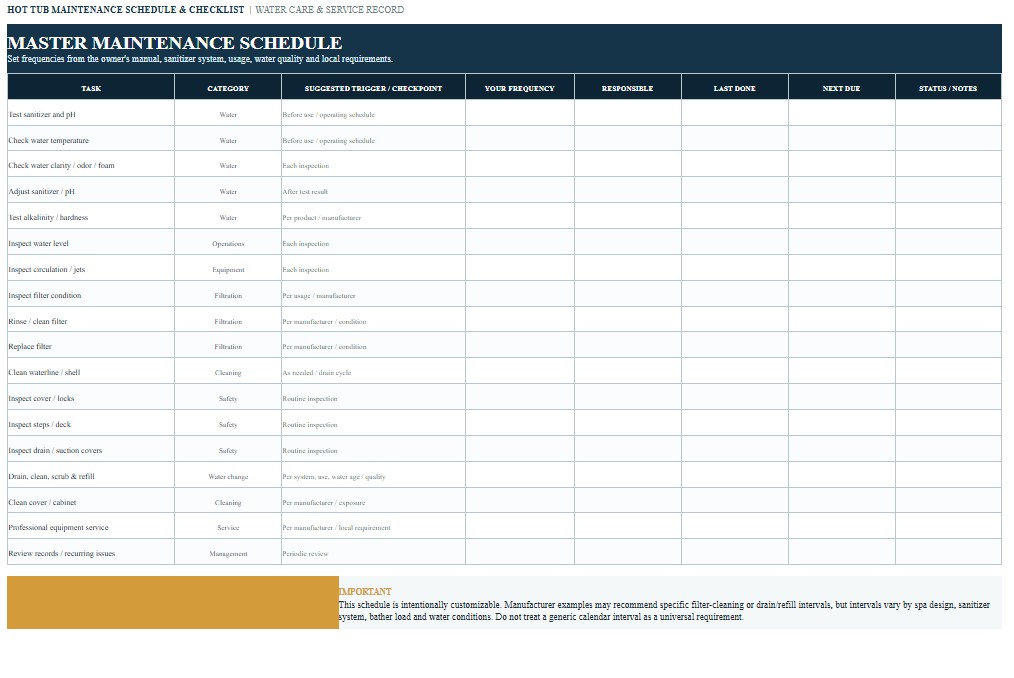
A Hot Tub Maintenance Schedule and Checklist is a practical tool for organizing routine water testing, sanitation, filtration, cleaning, inspections, water changes, and equipment maintenance. It can be used by homeowners, vacation rental operators, property managers, hospitality facilities, maintenance personnel, and hot tub service companies to document what was checked, when maintenance was performed, who completed the work, and whether corrective action is needed. Consistent recordkeeping is especially useful because hot tubs combine warm water, relatively low water volume, recirculation equipment, and changing bather loads. Proper maintenance therefore involves both water chemistry and physical equipment. This page provides downloadable Hot Tub Maintenance Schedule and Checklist Word, PDF, and Excel templates together with practical guidance for using them. The Word version can be customized for a specific spa, the PDF provides a convenient printable checklist, and the Excel version is useful for recurring schedules, test results, maintenance history, service dates, and follow-up tracking.
Download the Hot Tub Maintenance Schedule and Checklist Word Template
The Word version is useful when you want to edit the maintenance checklist freely before printing or sharing it. You can customize water-testing fields, equipment information, maintenance frequencies, approved products, service procedures, responsible persons, and inspection items according to the hot tub manufacturer’s instructions and the way the spa is used.

Download the Hot Tub Maintenance Schedule and Checklist PDF Template
The PDF version provides a fixed-layout checklist that is convenient for printing, keeping near maintenance records, distributing to responsible personnel, or archiving completed inspections. It can also provide a consistent format for documenting water tests, filter maintenance, cleaning, water changes, equipment observations, and corrective actions.
Download the Hot Tub Maintenance Schedule and Checklist Excel Template
The Excel version is particularly useful for ongoing hot tub maintenance because it can organize repeated water-test results, inspection dates, filter cleaning, water changes, chemical additions, service records, responsible persons, due dates, and corrective actions. It can also be adapted to flag overdue maintenance or maintain a historical record for several hot tubs.
How to Complete and Use This Document
Begin by identifying the hot tub covered by the schedule. Record the property or facility name, hot tub location, manufacturer, model, serial number, water capacity, installation date, sanitizer system, filter type, and responsible person. If a property contains multiple spas, assign each one a unique asset or unit number so maintenance records cannot be confused.
Next, customize the maintenance schedule using the hot tub owner’s manual, water-care system instructions, chemical product labels, and service recommendations. Do not assume that every spa requires identical filter-cleaning intervals, drain-and-refill schedules, chemical products, or equipment procedures. Water volume, bather load, sanitizer system, water source, filter design, climate, and manufacturer requirements can all affect the appropriate maintenance routine.
A central part of the checklist should be the water testing log. Record the date and time, water temperature, sanitizer reading, pH, and any other parameters required by the system being used, such as total alkalinity or calcium hardness. For general hot tub health guidance, the CDC recommends a pH of 7.0 to 7.8, free chlorine of at least 3 ppm, or bromine between 4 and 8 ppm. Water temperature should not exceed 104°F. Product and equipment instructions may provide additional operating ranges that should also be followed.
Do not simply record a reading and move on when it is outside the intended range. Include a field for corrective action and retest results. Record the chemical or treatment used, quantity when appropriate, person completing the adjustment, and subsequent test result. Chemical products should be added according to their labels. Avoid mixing chemicals together, and store and handle them according to manufacturer safety instructions.
The physical inspection portion should cover the water level, water clarity, filter condition, skimmer or intake areas, jets, pumps, heater, visible plumbing, controls, lights, cover, cabinet, steps, and surrounding deck or walking surface. Note unusual noises, leaks, error messages, poor circulation, damaged drain covers, loose components, deteriorated electrical equipment, or other conditions requiring service. Electrical, heating, pump, or control-system problems should be referred to a qualified service professional when they are outside routine owner maintenance.
Filter maintenance deserves a separate record. Note the filter identification, inspection date, cleaning method, condition, and replacement date when applicable. The correct cleaning and replacement frequency varies by manufacturer, filter type, water condition, and usage. A heavily used vacation rental or commercial spa can require attention more frequently than a lightly used private hot tub.
The schedule should also provide space for draining, cleaning, and refilling. Record the date, reason, interior cleaning performed, filter service, refill source, start-up chemicals, and initial water-test results. Do not set a universal drain-and-refill interval unless it is supported by the manufacturer’s guidance and actual operating conditions. Local rules may also affect where spa water may be discharged, especially for commercial properties or properties connected to particular stormwater or wastewater systems.
Include checks for the hot tub cover and surrounding area. Verify that the cover is clean, structurally sound, and functioning as designed. Where locking or safety features are provided, confirm that they operate correctly. Keep the area around the hot tub free of slip, trip, electrical, and access hazards, and address damaged surfaces or equipment promptly.
For a public, hotel, fitness center, apartment, vacation rental, or other shared-use hot tub, do not rely on a residential checklist alone. Public and semi-public spas may be subject to state or local health codes, operator training requirements, testing frequencies, recordkeeping procedures, equipment standards, and inspection requirements. Those rules vary by jurisdiction and can be substantially more demanding than residential maintenance recommendations. The responsible operator should verify the current requirements of the applicable state, county, or city health authority.
Finally, retain completed maintenance records so recurring problems can be identified. Repeated sanitizer loss, cloudy water, unusual chemical demand, persistent leaks, circulation problems, or repeated equipment faults may indicate a condition that cannot be corrected through ordinary routine maintenance. In those situations, stop using the hot tub when appropriate and consult the manufacturer, a qualified pool and spa professional, or the relevant public health authority before returning the spa to normal operation.