
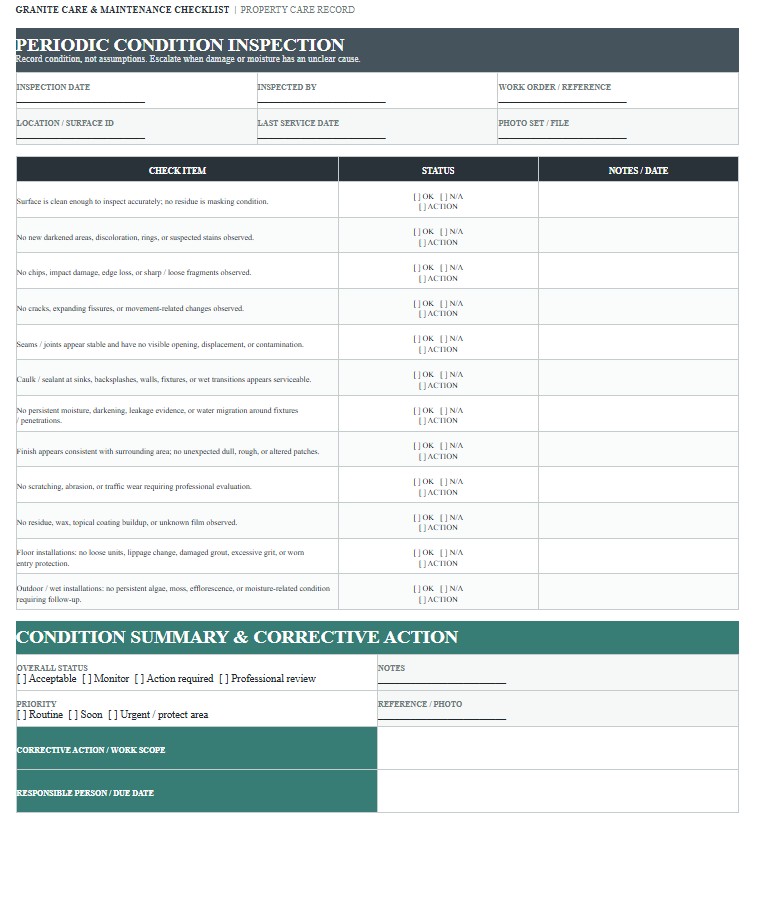
A Granite Care and Maintenance template provides a structured way to document how granite countertops, vanities, floors, wall surfaces, and other natural-stone installations should be cleaned, protected, inspected, and maintained. It can be used by homeowners, property managers, cleaning companies, stone fabricators, installers, maintenance teams, and commercial facilities to establish consistent care procedures and keep a record of cleaning, sealing, staining, repairs, and periodic inspections. Because granite varies in mineral composition, porosity, finish, installation, and previous treatment, maintenance should be based on the specific stone and manufacturer or installer recommendations rather than a universal schedule. This page provides downloadable Granite Care and Maintenance Word, PDF, and Excel templates, together with practical instructions for completing and using the document. The Word version is easy to customize, the PDF provides a consistent printable guide and record, and the Excel version is useful for maintenance schedules, inspection logs, treatment records, and recurring tasks.
Download the Granite Care and Maintenance Word Template
The Word version is useful when you want to customize the care and maintenance document before printing or sharing it. You can add property information, identify specific granite surfaces, record installer or fabricator recommendations, modify cleaning procedures, include approved products, and adapt inspection or maintenance schedules for a home, rental property, office, hospitality facility, or other location.

Download the Granite Care and Maintenance PDF Template
The PDF version is useful when you need a fixed-layout granite care guide and maintenance record for printing, archiving, providing to occupants or cleaning personnel, or keeping with property and warranty documentation. A consistent format also makes it easier to record inspections, treatments, stains, damage, and maintenance activity over time.
Download the Granite Care and Maintenance Excel Template
The Excel version is particularly useful when several granite surfaces must be maintained or when recurring work needs to be tracked. It can organize surface locations, inspection dates, cleaning tasks, sealer information, treatment dates, stain or damage records, responsible persons, service providers, follow-up dates, and maintenance history in repeatable rows.
How to Complete and Use This Document
Begin by identifying the property and granite surface covered by the document. Useful information includes the property or facility name, room or location, type of installation, approximate installation date, fabricator or installer, stone name if known, finish, and any manufacturer or supplier information. If several surfaces are present, assign each one a clear identifier such as Kitchen Island, Primary Bathroom Vanity, Lobby Floor, or Reception Counter. Different stones or finishes should not automatically be assumed to require identical maintenance.
Record any available information about the surface’s existing treatment and sealer. Include the sealer product, manufacturer, application date, person or contractor who applied it, and any instructions supplied with the stone or installation. Granite does not necessarily require resealing according to a fixed annual schedule. Some granite is relatively resistant to absorption, while other installations may benefit from an appropriate penetrating sealer. The need for treatment depends on the stone, its finish, previous sealing, exposure, and the product used. Follow the stone supplier, fabricator, installer, or sealer manufacturer’s recommendations rather than entering an arbitrary recurring date.
The routine cleaning section should specify the products and procedure approved for the surface. For ordinary cleaning, natural-stone guidance generally favors a neutral cleaner, stone soap, or a small amount of mild liquid dishwashing detergent with warm water. Use a soft cloth, sponge, or appropriate mop, rinse when necessary, and dry the surface to reduce streaks or residue. Excess cleaner can leave a film, so more product is not necessarily better.
Document products or practices that should be avoided. Acidic cleaners can damage some natural stones and may also affect surrounding materials, grout, sealants, or finishes. Abrasive powders, aggressive scouring pads, and unapproved chemicals can alter the appearance of a polished or honed surface. Do not assume that a household cleaner that works on ceramic tile, engineered quartz, laminate, or another countertop material is appropriate for natural granite. When using a new product, check its label for natural-stone compatibility and consider testing it in an inconspicuous area.
The maintenance document should also explain how spills and stains are handled. Blot spills promptly instead of spreading them over a larger area. Record the type of substance involved when a stain develops because treatment depends on the stain source. Oil, food, organic material, metal, paint, and other contaminants may require different procedures. Avoid repeatedly applying random stain removers, acids, solvents, bleach, or abrasive products without identifying the problem first. For persistent discoloration, consult the stone supplier or a qualified natural-stone professional.
Add a periodic inspection section covering stains, chips, cracks, loose seams, failing caulk, damaged edges, dull areas, surface wear, water absorption, and changes around sinks, faucets, cooktops, showers, or other high-use areas. Enter the inspection date, condition found, responsible person, corrective action, and completion date. Photographs can be referenced in the record when documenting significant damage or professional repair.
If evaluating whether an existing sealer is still performing adequately, follow the method recommended by the installer, stone professional, or sealer manufacturer. A simple water-absorption observation may provide useful information for some surfaces, but it should not be treated as a universal certification test. Record the test date, method, observation, and resulting action rather than automatically applying another coat of sealer.
Repairs deserve their own maintenance entry. Chips, cracks, damaged seams, substantial staining, loss of polish, or questionable installation conditions may require a qualified stone restoration professional, fabricator, or installer. Improper grinding, polishing, chemical treatment, or sealing can make a localized problem more difficult to correct. If the installation remains under a product or workmanship warranty, review the warranty conditions before performing or authorizing treatments that could affect coverage.
For commercial properties, rental units, hotels, restaurants, offices, or managed facilities, customize the template to identify the responsible employee or contractor, inspection frequency, approved cleaning products, work order number, service provider, completion date, and supervisor review. Keep receipts, product information, invoices, photographs, and service reports with the maintenance record when appropriate. If workplace procedures involve chemical products or occupational hazards, follow the applicable product safety information and the employer’s safety procedures.
Finally, treat the template as a maintenance management tool rather than a universal technical specification. Granite characteristics and installation conditions vary significantly. Manufacturer instructions, installer recommendations, warranty terms, product labels, and professional stone-care advice should take priority whenever they provide requirements specific to the actual surface. A complete and consistent maintenance history can help preserve appearance, identify recurring problems, support warranty discussions, and provide future owners, tenants, contractors, or maintenance personnel with a clear record of how the granite has been cared for.