
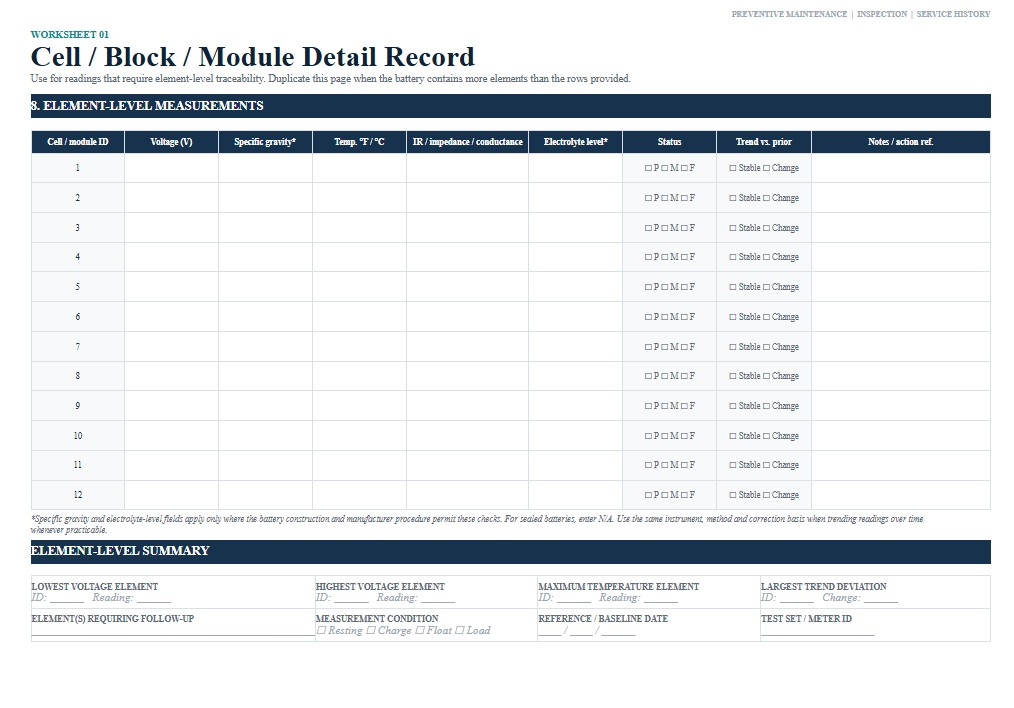
A Battery Maintenance Checklist and Log provides a structured way to document routine battery inspections, test results, maintenance work, and corrective actions over the life of a battery or battery bank. It can be used for industrial equipment, forklifts, backup power systems, fleet vehicles, material-handling equipment, facility batteries, and other applications where battery condition and service history need to be tracked. A well-maintained log helps technicians identify deterioration, compare readings over time, document completed work, and determine when further testing, repair, or replacement may be necessary. Battery maintenance procedures differ significantly between flooded lead-acid, AGM, VRLA, lithium-ion, and other battery technologies, so the checklist should always be used together with the battery and equipment manufacturer’s instructions. This page provides downloadable Word, PDF, and Excel versions of the Battery Maintenance Checklist and Log, along with practical guidance for completing, customizing, and maintaining accurate service records.
Download the Battery Maintenance Checklist and Log Word Template
The Word version is useful when you want to customize the checklist before use. You can add company information, equipment-specific inspection items, battery specifications, approval fields, or maintenance procedures, then print the completed form or share it electronically with technicians and supervisors.

Download the Battery Maintenance Checklist and Log PDF Template
The PDF version provides a consistent fixed layout that is convenient for printing, completing during scheduled inspections, sharing with maintenance personnel, and archiving as part of an equipment or facility maintenance record.
Download the Battery Maintenance Checklist and Log Excel Template
The Excel version is particularly useful for recurring battery maintenance because it allows multiple inspections, dates, measurements, corrective actions, and battery assets to be recorded in repeatable rows. It can also make it easier to sort maintenance history, compare readings, identify overdue work, and manage batteries across a fleet or facility.
How to Complete and Use This Document
Begin by identifying the battery accurately. Record the company or facility name, equipment or asset number, battery identification number, location, manufacturer, model, serial number when available, battery chemistry, rated voltage, rated capacity, and the equipment powered by the battery. For organizations maintaining multiple batteries, a consistent asset ID is especially important because it allows each inspection and repair to be traced to the correct unit. The inspection date, time, technician’s name, and relevant meter or test equipment may also be recorded when required by company procedures.
Before completing the maintenance portion of the checklist, identify the battery technology and review the manufacturer’s current instructions. Maintenance that is appropriate for a flooded lead-acid battery may be inappropriate or unsafe for an AGM, valve-regulated lead-acid, or lithium-ion battery. For example, flooded batteries may require electrolyte-level checks and, when specified by the manufacturer, water addition. Sealed AGM batteries generally should not be opened or watered. Trojan Battery, for example, specifically states that water should not be added to its AGM batteries. :contentReference[oaicite:0]{index=0} The template should therefore be customized so technicians are not asked to perform procedures that do not apply to the battery being serviced.
A routine inspection commonly begins with a visual condition check. Record whether the battery case, cover, terminals, connectors, cables, venting components, hold-downs, racks, and surrounding area appear satisfactory. Note corrosion, contamination, loose or damaged connections, electrolyte leakage, cracks, unusual swelling, heat damage, damaged cables, or other abnormal conditions. For lithium-ion batteries, signs of physical damage or abnormal heating should be treated seriously because damaged cells can present fire and chemical hazards. OSHA recommends inspecting lithium-ion batteries and devices and safely addressing damaged batteries rather than continuing normal use without evaluation. :contentReference[oaicite:1]{index=1}
Where testing is part of the maintenance program, provide fields for the measurements actually required by the manufacturer or facility procedure. These may include overall battery voltage, individual cell or block voltage, charge status, temperature, charger readings, and other diagnostic measurements. Specific-gravity readings can be useful for appropriate flooded lead-acid batteries, but they should not be treated as a universal battery test. Manufacturer instructions should determine the correct measurement method, acceptable range, temperature correction, and action limits. Routine voltage and specific-gravity readings can help reveal charging problems or differences between cells in flooded batteries. :contentReference[oaicite:2]{index=2}
For flooded batteries, include electrolyte-level and watering fields only when applicable. Record the inspection result and any water added according to the manufacturer’s procedure. Do not use the checklist itself to establish an electrolyte level, watering interval, terminal torque, charging voltage, equalization schedule, or acceptable test value. Those specifications can vary by battery design and manufacturer. If connections are checked or tightened, record the result and use the manufacturer’s specified procedure and torque value rather than an arbitrary value printed on a generic form.
The log should also capture the maintenance action taken. Examples include cleaning, correcting a connection problem, watering an applicable flooded battery, replacing a damaged cable or connector, performing an authorized charging procedure, conducting additional testing, or removing a battery from service for evaluation. Describe the finding and corrective action clearly enough that another technician can understand what was observed and what was done. If no immediate repair was completed, record the recommended follow-up, responsible person or department, target date when appropriate, and current equipment status.
Workplace battery servicing also requires attention to the hazards associated with the particular system. OSHA requirements apply to certain battery charging and material-handling operations and address matters such as designated charging areas, ventilation, protection of charging equipment, electrolyte spill precautions, and emergency flushing facilities in applicable circumstances. :contentReference[oaicite:3]{index=3} These requirements should not be assumed to apply identically to every battery or workplace. Employers should evaluate the equipment, battery chemistry, work activity, applicable OSHA standards, manufacturer instructions, safety data, and company procedures before establishing a maintenance program.
At the end of each inspection, the technician should record the battery’s status, such as satisfactory, requires monitoring, corrective action required, or removed from service. Include the technician’s signature or initials and, where the organization’s maintenance process requires it, a supervisor or reviewer approval. Keep completed logs with the relevant equipment maintenance records so trends can be compared over time. When batteries reach end of life, damaged and waste batteries should be handled through appropriate recycling or waste-management procedures. Federal requirements can differ depending on battery type and how the battery is managed, and state requirements may also apply. :contentReference[oaicite:4]{index=4}
This template is best treated as a recordkeeping framework rather than a substitute for a manufacturer’s maintenance manual, qualified electrical or battery-service expertise, or an employer’s safety program. Customize inspection intervals, measurement fields, acceptance criteria, and approval procedures for the battery system being maintained. For industrial battery rooms, critical backup systems, high-voltage battery installations, hazardous work environments, or unfamiliar battery technologies, maintenance procedures should be established or reviewed by appropriately qualified personnel and checked against current federal, state, local, industry, and company-specific requirements.