
A Golf Course Equipment Maintenance Log is a practical recordkeeping tool used to track inspections, preventive maintenance, repairs, operating hours, parts replacement, and service history for the equipment required to maintain a golf course. It can be used for greens mowers, fairway and rough mowers, utility vehicles, aerators, bunker equipment, sprayers, tractors, rollers, blowers, topdressers, and other turf maintenance machinery. Consistent records help golf course superintendents, equipment managers, mechanics, and technicians plan preventive maintenance, identify recurring problems, document labor and parts, and keep equipment available during critical maintenance periods. Because service requirements vary considerably by manufacturer, model, engine, hydraulic system, and operating conditions, the log should be customized to match the course’s actual fleet and approved maintenance procedures. This page provides downloadable Word, PDF, and Excel versions of the Golf Course Equipment Maintenance Log, together with practical guidance for completing and using the document.
Download the Golf Course Equipment Maintenance Log Word Template
The Word version is useful when you want complete flexibility to edit the maintenance log before use. Equipment managers can add course information, asset-specific inspection items, approval fields, maintenance intervals, or internal procedures, then print the document or distribute it to mechanics and maintenance personnel.

Download the Golf Course Equipment Maintenance Log PDF Template
The PDF version is suitable for printing, archiving, sharing, and maintaining a consistent fixed-layout record for each piece of golf course equipment. It can be used in the maintenance shop or stored with the equipment’s service documentation.
Download the Golf Course Equipment Maintenance Log Excel Template
The Excel version is especially useful for managing an equipment fleet because it supports repeatable maintenance records, dates, operating-hour readings, service intervals, parts, labor, costs, corrective actions, and equipment lists. It can also be adapted to help identify upcoming preventive maintenance and review service history over time.
How to Complete and Use This Document
Start by creating a clear identification record for each piece of equipment. Useful fields include the golf course or facility name, department, equipment description, asset or unit number, manufacturer, model, serial number, year, engine or power source, and assigned operating location if relevant. Equipment managers may also record purchase or lease information, warranty details, and the manufacturer’s service manual reference. A unique asset number is particularly valuable when several similar mowers or utility vehicles are in the fleet because maintenance entries can then be traced to the correct machine.
For every maintenance event, enter the service date, equipment hour-meter reading or other appropriate usage measure, and the name or initials of the technician. The hour reading is often important for turf equipment because many manufacturer maintenance schedules are based on operating hours rather than calendar dates alone. Record the type of service performed, such as a daily inspection, scheduled preventive maintenance, lubrication, oil and filter change, reel or bedknife service, blade replacement, hydraulic service, tire maintenance, battery service, repair, seasonal preparation, or post-repair inspection.
The checklist should be customized for the equipment being maintained rather than applying exactly the same inspection to every machine. A riding greens mower may require attention to reels, bedknives, cutting-unit adjustment, rollers, hydraulic components, tires, safety interlocks, and fluid levels. A tractor or utility vehicle will have a different maintenance profile. Sprayers may require additional attention to pumps, hoses, fittings, nozzles, agitation components, calibration-related equipment, and contamination control. Always use the applicable manufacturer’s manual to determine the correct maintenance procedures, intervals, fluids, lubricants, filters, adjustment specifications, torque values, and replacement criteria.
During an inspection, document the actual condition rather than simply marking every item as completed. Typical checks can include fluid levels and leaks, engine condition, air intake components, cooling system, belts, hoses, electrical connections, battery condition, tires, wheels, brakes, steering, hydraulic lines, guards, shields, controls, warning devices, cutting units, attachments, and safety features. For mower equipment, recording reel, bedknife, blade, roller, and cutting-unit condition can be particularly useful because cutting quality directly affects turf presentation and performance.
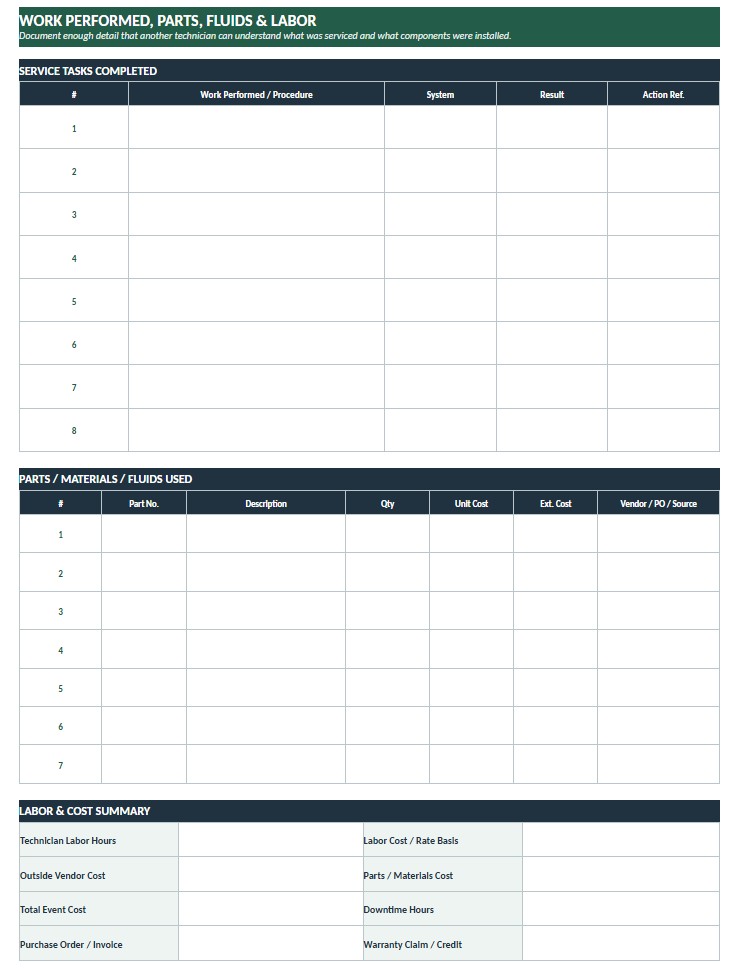
If a defect is found, describe it clearly and record the corrective action. Include parts installed, quantities where useful, labor time, outside service vendor information, work-order number, and any follow-up that remains open. Avoid entries such as “fixed” when a more specific description can establish what failed and what was repaired. Detailed records allow equipment managers to recognize repeated component failures, unusually high maintenance costs, or machines that may be approaching replacement.
A useful log should also distinguish between equipment that is ready for service and equipment that requires further action. Consider adding status options such as Ready for Service, Monitor, Repair Required, and Out of Service. The technician should not return equipment to operation when an unresolved condition makes its use unsafe or conflicts with the manufacturer’s instructions or the employer’s procedures. Where maintenance work exposes employees to unexpected startup, movement, electrical energy, hydraulic pressure, or other hazardous energy, applicable workplace energy-control and safety procedures should be followed before servicing begins.
Preventive maintenance records are most useful when they are reviewed rather than simply filed. Equipment managers can periodically compare service dates, meter readings, repair frequency, downtime, parts consumption, and labor costs. This information can support annual maintenance budgets, parts inventory decisions, winter overhaul planning, replacement recommendations, and discussions with course management about fleet condition. Golf course equipment is specialized and can represent a significant operational investment, so a consistent maintenance history can also help explain why a particular machine requires major repair or replacement.
Before adopting the template, compare it with the golf course’s existing preventive maintenance program, manufacturer recommendations, warranty requirements, insurance or lease conditions, and internal approval procedures. Add fields for purchase orders, vendor invoices, photographs, inspection reports, or computerized maintenance management system references when these records are part of the course’s workflow. Employers should also verify any federal, state, or local occupational safety, environmental, fuel-storage, chemical-handling, waste-management, or other requirements that apply to their particular operations. Complex repairs involving electrical systems, hydraulics, engines, pressurized components, specialized cutting equipment, or safety systems should be performed or reviewed by personnel qualified for the work.