
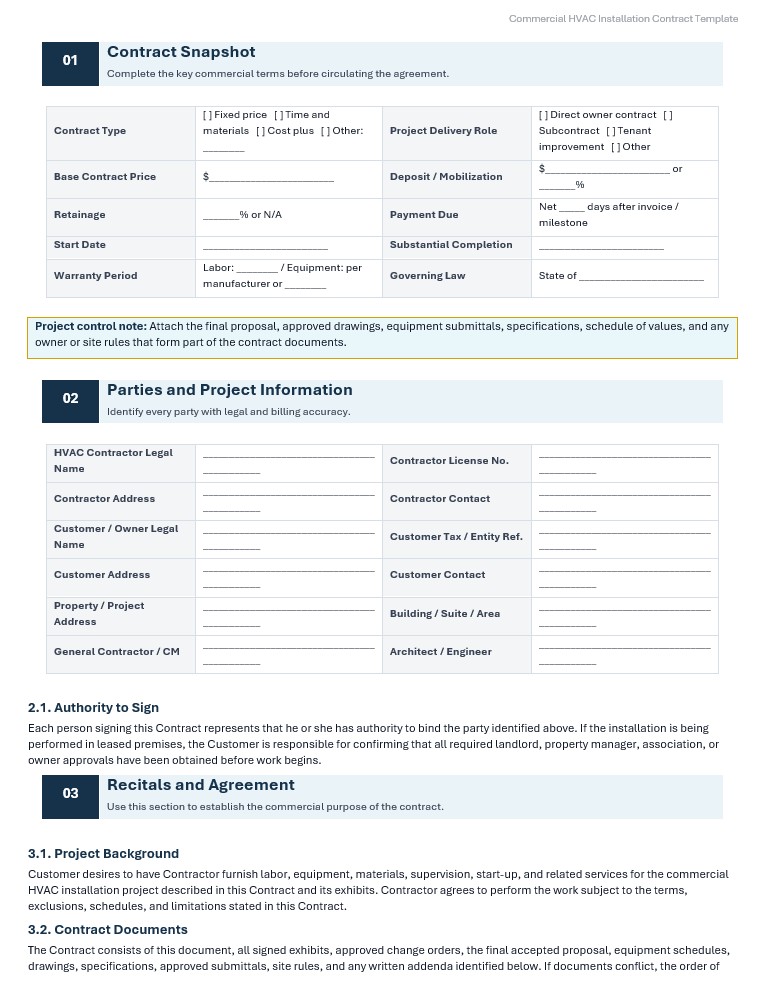
A commercial HVAC installation contract is a written agreement used by building owners, property managers, tenants, general contractors, and HVAC contractors to define the terms for installing heating, ventilation, air conditioning, refrigeration, controls, ductwork, and related commercial mechanical systems. In the United States, this type of contract is commonly used for office buildings, retail spaces, restaurants, warehouses, schools, medical offices, industrial facilities, multifamily properties, and tenant improvement projects. The document helps clarify the parties, project site, equipment to be installed, scope of work, drawings and specifications, permitting responsibilities, schedule, pricing, payment milestones, change orders, warranties, safety obligations, insurance, and closeout documentation. This page provides downloadable Word and PDF versions of the commercial HVAC installation contract, together with practical guidance for completing and using the document before work begins, during installation, and at project closeout.
Download the HVAC Installation Contract Word Template
The Word format is useful when you want to edit the commercial HVAC installation contract freely before printing, sharing, signing, or adapting it to a specific project, building, contractor, proposal, bid package, or construction schedule.

Download the HVAC Installation Contract PDF Template
The PDF format is useful for printing, archiving, sharing with owners or project managers, attaching to a construction file, or using a fixed-layout version once the installation terms have been reviewed.
How to Complete and Use This Document
Start the commercial HVAC installation contract by entering the full legal names and contact details of the parties. This usually includes the HVAC contractor, the customer, the property owner if different, the tenant if the work is for leased premises, and any general contractor or construction manager involved in the project. Include the project name, service address, billing address, effective date, anticipated start date, substantial completion target, and the person authorized to approve changes. For leased commercial space, confirm whether the landlord, tenant, or property manager has authority to approve HVAC work and whether the lease requires prior written consent.
The scope of work is the most important part of the contract. It should describe exactly what the contractor will furnish and install, including rooftop units, split systems, air handling units, boilers, chillers, pumps, ductwork, diffusers, thermostats, controls, economizers, refrigeration piping, condensate piping, insulation, electrical connections within the contractor’s scope, demolition, start-up, balancing support, and commissioning assistance if included. Refer to drawings, specifications, equipment schedules, bid documents, approved submittals, and manufacturer data sheets when available. If the project requires engineering, load calculations, shop drawings, building automation integration, crane service, roof curb modifications, structural supports, firestopping, controls programming, or coordination with other trades, state clearly whether those items are included, excluded, or handled by others.
Equipment details should be precise. List the manufacturer, model number, capacity, voltage, phase, efficiency rating where relevant, accessories, warranty information, and location for each unit. Commercial HVAC sizing and design should not be guessed from rule-of-thumb estimates alone. Depending on the project, proper load calculations, ventilation requirements, energy code compliance, duct design, refrigerant piping requirements, and manufacturer installation instructions may need to be reviewed by a licensed professional, engineer, architect, or qualified HVAC contractor. Requirements can vary by state, county, city, occupancy type, building code, energy code, health department rule, and local authority having jurisdiction.
Define the contract price and payment terms before work begins. The form should state whether the price is fixed, time and materials, cost plus, allowance-based, or subject to unit pricing. Include deposit requirements, progress payments, retainage if any, payment due dates, tax treatment, lien waiver procedures, late fees if allowed, and how disputed amounts will be handled. For larger projects, attach a schedule of values that breaks down equipment, labor, materials, permits, crane or lift rental, controls, ductwork, demolition, start-up, testing, and closeout documentation.
The contract should also include a written change order process. Commercial HVAC installations often change when hidden conditions, existing ductwork conflicts, roof conditions, electrical capacity issues, code comments, owner revisions, equipment substitutions, or schedule impacts are discovered. State that changes must be documented in writing, priced, approved by an authorized representative, and added to the contract before the extra work is performed, except where emergency safety action is necessary.
Permits, inspections, and compliance responsibilities should be addressed directly. The contract should identify who will apply for permits, pay permit fees, schedule inspections, provide drawings, respond to correction notices, and coordinate with the building department or other authority. It should also clarify contractor licensing, insurance, workers’ compensation, subcontractor use, site access, working hours, parking, storage, protection of existing property, cleanup, disposal of removed equipment, and responsibility for damage caused during the work.
Safety and environmental provisions are important. HVAC installation can involve electrical energy, rooftop work, lifting operations, ladders, hot work, confined or restricted spaces, refrigerants, pressurized systems, and coordination with occupied buildings. Contractors and employers should follow applicable OSHA workplace safety requirements and company safety procedures. Refrigerant work should be performed only by properly qualified personnel, and federal refrigerant handling rules may apply when regulated refrigerants are installed, recovered, charged, serviced, or disposed of.
Before signing, review warranties, exclusions, closeout documents, and dispute terms. Common closeout items include operation manuals, warranty certificates, start-up reports, inspection approvals, as-built information, owner training, equipment registrations, test reports, and punch list completion. The agreement should state governing law, termination rights, suspension for nonpayment, limitations of liability, indemnity, insurance requirements, notice procedures, and signature authority. Because construction contract rules, contractor licensing, mechanic’s lien rights, permit requirements, and commercial warranty rules vary by jurisdiction, a high-value or complex project should be reviewed by a qualified attorney, licensed HVAC professional, insurance advisor, or construction consultant before the document is signed.