
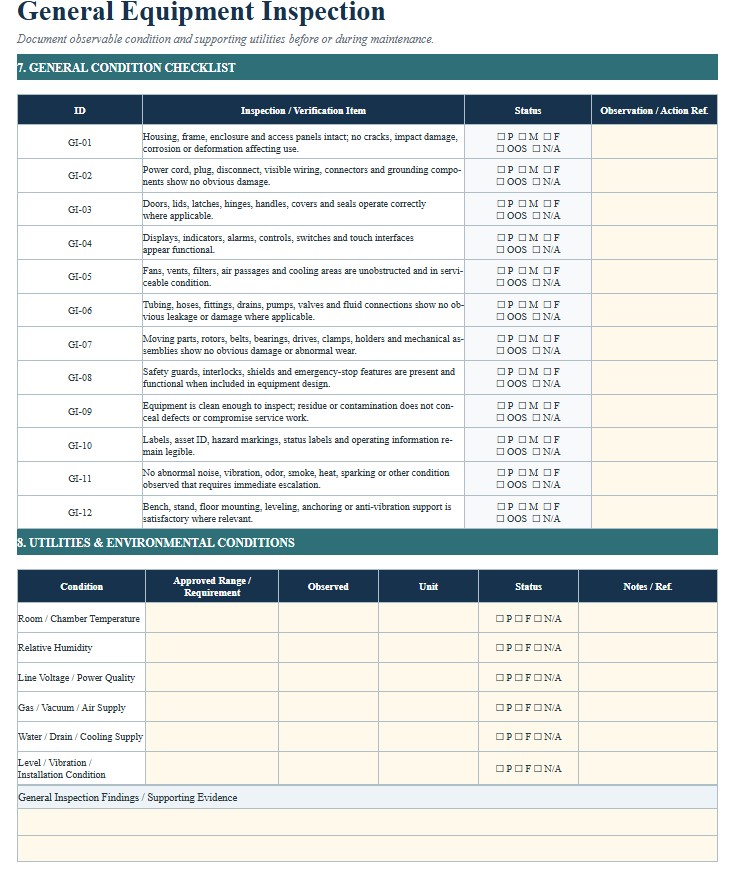
A Laboratory Equipment Maintenance Log Book is used to document inspections, preventive maintenance, calibration-related activities, repairs, equipment failures, corrective actions, and service history for laboratory instruments and supporting equipment. It can be adapted for balances, centrifuges, incubators, refrigerators, freezers, pipettes, microscopes, spectrophotometers, autoclaves, water systems, analyzers, environmental chambers, and other laboratory assets. Laboratory managers, technicians, quality personnel, researchers, and service contractors can use the log to maintain traceability and identify equipment that is approaching scheduled service or requires further evaluation. Recordkeeping requirements depend heavily on the type of laboratory and its regulatory environment, so a research laboratory, clinical laboratory, pharmaceutical facility, and FDA-regulated laboratory may have different obligations. This page provides downloadable Word, PDF, and Excel versions of the Laboratory Equipment Maintenance Log Book, together with practical guidance for completing, customizing, reviewing, and retaining the document.
Download the Laboratory Equipment Maintenance Log Book Word Template
The Word version is useful when a laboratory needs to customize the document before printing, sharing, approving, or placing it into a controlled documentation system. Fields can be adapted to particular instruments, SOPs, calibration programs, maintenance schedules, approval workflows, and quality-system requirements.

Download the Laboratory Equipment Maintenance Log Book PDF Template
The PDF version is useful for maintaining a consistent fixed-layout record that can be printed, completed during maintenance activities, shared with laboratory or quality personnel, and archived with equipment history files, service reports, calibration certificates, and related documentation.
Download the Laboratory Equipment Maintenance Log Book Excel Template
The Excel version is particularly useful when managing multiple laboratory assets because it can accommodate equipment inventories, recurring maintenance rows, calibration dates, service schedules, instrument status, vendors, costs, corrective actions, and upcoming due dates. It can also be adapted for filtering and reviewing maintenance history across a laboratory or facility.
How to Complete and Use This Document
Begin by creating an unambiguous identification record for the equipment. Typical fields include the laboratory or organization name, department, equipment name, asset or instrument ID, manufacturer, model, serial number, physical location, responsible department or equipment owner, installation or acquisition date, and applicable operating manual or standard operating procedure reference. Where the laboratory uses controlled documents, it can also be useful to record the form revision and equipment file or computerized maintenance system reference.
For each maintenance event, enter the service date, activity type, technician or service provider, and the reason for the work. Distinguish routine preventive maintenance from corrective repair, inspection, calibration, performance verification, qualification, cleaning, software or firmware service, relocation, decommissioning, and other activities. These terms should not be treated as interchangeable. For example, cleaning an instrument does not necessarily establish that its measurement performance remains acceptable, and a calibration event may require information that an ordinary maintenance record does not capture.
Describe the work performed with enough detail to reconstruct the service history. Depending on the equipment, this may include cleaning components, replacing filters or seals, checking belts or moving parts, inspecting electrical connections, servicing pumps, replacing lamps, adjusting mechanisms, performing manufacturer-prescribed tests, installing parts, or recording environmental conditions relevant to the service. When measurements or performance checks are required, provide fields for the applicable specification, observed result, units, method, and final status. Avoid inserting generic tolerances into a universal template. Acceptance limits should come from the instrument manufacturer, validated method, approved SOP, quality system, or other controlling requirement.
If the activity includes calibration or verification, record the information necessary for traceability under the laboratory’s procedure. Depending on the program, useful fields can include the calibration date, as-found result, adjustment performed, as-left result, reference standard or test equipment used, certificate or report number, calibration status, technician, reviewer, and next due date. When an instrument is found outside an established acceptance criterion, the laboratory may also need to evaluate whether previously generated data or samples could have been affected. The appropriate investigation depends on the laboratory’s quality system and regulatory environment.
Regulatory requirements should be applied carefully. FDA Good Laboratory Practice requirements for covered nonclinical laboratory studies include provisions concerning inspection, cleaning, maintenance, testing, calibration, written procedures, and equipment records. Those requirements should not automatically be applied to every academic or general research laboratory. Clinical laboratories testing human specimens may instead be subject to CLIA requirements and applicable accreditation or state requirements. Pharmaceutical, biologics, medical-device, environmental, forensic, and other regulated laboratories may operate under different quality systems. Customize the log only after determining which requirements actually apply to the facility and activity.
Record equipment condition after every significant service event. Practical status categories may include Available for Use, Restricted Use, Calibration or Verification Required, Out of Service, and Decommissioned. If a problem remains unresolved, document the finding, action owner, work-order or deviation reference, target completion date, and any restrictions placed on the equipment. Labels or electronic status controls used in the laboratory should remain consistent with the maintenance record.
Safety should also be considered before maintenance begins. Laboratory equipment can contain electrical, mechanical, thermal, pressure, vacuum, chemical, biological, radiation, laser, cryogenic, or other hazards. When servicing could expose an employee to unexpected energization, startup, or release of stored energy, the employer should determine whether applicable hazardous-energy control procedures are required. Specialized equipment should be serviced only by personnel qualified for the work and in accordance with manufacturer and facility safety procedures.
Finally, retain supporting documentation with or traceable from the log. Relevant records can include service reports, calibration certificates, test results, parts records, invoices, photographs, deviation or investigation records, qualification documents, and vendor reports. Before adopting the template as an official laboratory record, compare it with current SOPs, equipment manuals, quality-system procedures, accreditation requirements, contracts, and applicable federal, state, or local requirements. In a regulated laboratory, quality assurance, laboratory management, compliance personnel, or another qualified professional should review the customized format before it becomes a controlled record.