
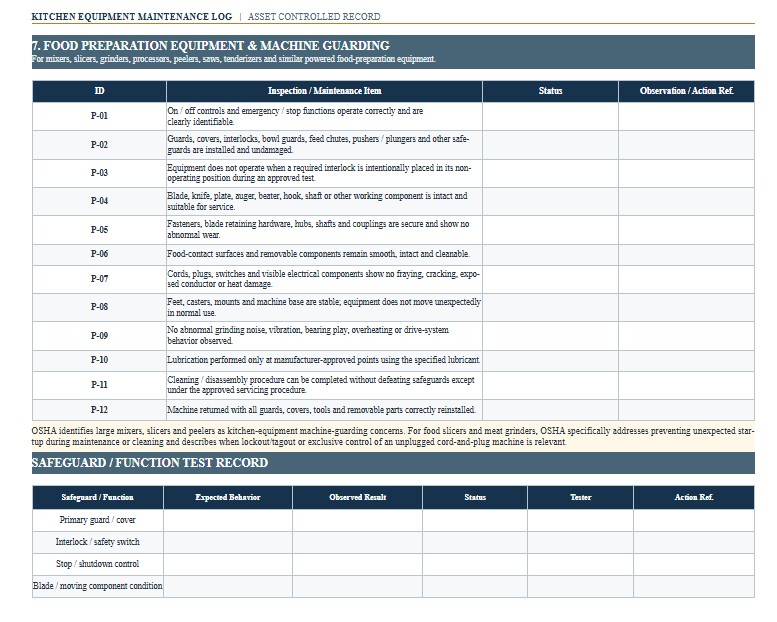
A Kitchen Equipment Maintenance Log is a structured record used to document inspections, preventive maintenance, repairs, service dates, equipment condition, and corrective actions for commercial kitchen equipment. Restaurants, cafeterias, hotels, schools, healthcare facilities, catering operations, institutional kitchens, and other food-service businesses can use the log to track refrigerators, freezers, ovens, ranges, fryers, grills, dishmachines, ice machines, mixers, slicers, holding equipment, and other assets. Consistent maintenance records help managers organize scheduled service, identify recurring failures, document equipment downtime, and determine when repair or replacement may be necessary. They can also support food-safety and workplace-safety procedures when equipment condition affects temperature control, sanitation, or safe operation. This page provides downloadable Word, PDF, and Excel versions of the Kitchen Equipment Maintenance Log, together with practical guidance for completing, customizing, reviewing, and retaining the document in a U.S. commercial kitchen.
Download the Kitchen Equipment Maintenance Log Word Template
The Word version is useful when you want to customize the maintenance log before printing, sharing, or using it internally. A restaurant or facility can add equipment-specific inspection points, company approval fields, service procedures, vendor information, or maintenance intervals appropriate to its kitchen and equipment inventory.

Download the Kitchen Equipment Maintenance Log PDF Template
The PDF version is useful for maintaining a consistent fixed-layout record that can be printed for the kitchen or maintenance department, completed during inspections and service visits, shared with managers or contractors, and archived with other equipment records.
Download the Kitchen Equipment Maintenance Log Excel Template
The Excel version is particularly useful for facilities managing multiple kitchen assets because it can accommodate repeatable service rows, equipment inventories, dates, temperature readings, maintenance schedules, parts, labor costs, vendor information, corrective actions, and upcoming service requirements.
How to Complete and Use This Document
Begin by assigning each piece of kitchen equipment a clear identification record. Useful fields include the business or facility name, department or kitchen area, asset ID, equipment type, manufacturer, model, serial number, installation location, purchase or installation date when known, and the service manual or specification reference. A unique asset number is especially useful in kitchens that operate several similar refrigerators, fryers, ovens, or prep units because each service entry can be traced to the correct machine.
For every inspection or maintenance event, record the date, technician or contractor, type of service, and reason for the work. Common entries may include preventive maintenance, routine inspection, cleaning-related service, temperature verification, calibration, lubrication where permitted, filter replacement, adjustment, troubleshooting, repair, parts replacement, or manufacturer-authorized service. Include a work-order or vendor reference when the business uses a computerized maintenance system or outside service company.
The inspection fields should be adapted to the particular equipment. For refrigeration equipment, useful checks may include operating temperature, door seals and gaskets, hinges, drain condition, condenser or ventilation areas, fans, controls, alarms, and evidence of unusual frost, leakage, or heat. Cooking equipment may require inspection of controls, burners or heating elements, thermostatic functions, electrical cords or connections, gas-related components that can be visually checked safely, doors, seals, handles, and structural condition. Dishmachines and other warewashing equipment may require checks of operating condition, spray components, doors, racks, dispensers, drains, temperature or pressure indicators, and other manufacturer-specified operating parameters.
Food-contact equipment deserves particular attention. The FDA Food Code, which serves as a model for retail and food-service requirements and is adopted or modified by jurisdictions across the United States, addresses maintaining equipment in good repair and keeping components such as doors, seals, hinges, and fasteners intact and properly adjusted. The log can therefore include fields for damaged surfaces, broken components, corrosion, cracks, loose hardware, worn seals, or conditions that prevent effective cleaning and sanitizing. Because state and local jurisdictions may adopt different versions or provisions, the establishment should verify the requirements enforced by its applicable health department.
Where temperature-measuring devices are part of the operation, record calibration or accuracy checks when appropriate. Do not enter arbitrary temperature tolerances or calibration intervals into a generic template. Use the equipment manufacturer’s specifications, the establishment’s food-safety procedures, and applicable regulatory requirements. If a thermometer, thermostat, display, probe, or temperature-control system produces an abnormal reading, document both the observation and the follow-up action rather than merely marking the item as completed.
When maintenance involves powered machinery such as mixers, slicers, grinders, conveyors, dishmachines, or other equipment capable of unexpected startup or release of stored energy, the employer should determine whether applicable hazardous-energy control procedures are required before servicing begins. Employees should not rely on the maintenance log itself as a safety procedure. Lockout/tagout requirements, machine guarding, electrical safety procedures, manufacturer instructions, and company policies should be addressed separately by qualified personnel.
Every defect should lead to a clear disposition. Record what was found, the corrective action performed, replacement parts, labor, outside contractor information, and whether additional work remains open. Useful equipment status categories include Ready for Service, Monitor, Repair Required, and Out of Service. If an equipment problem could compromise food safety or safe operation, the unit should remain out of normal use until the responsible person determines that appropriate corrective action has been completed.
For equipment connected to specialized systems, additional records may be appropriate. Commercial exhaust hoods, fire-suppression systems, refrigeration systems, gas equipment, electrical systems, and similar installations can involve requirements outside the scope of an ordinary kitchen maintenance log. Inspection or service requirements may depend on the equipment, manufacturer, adopted fire or building codes, environmental rules, local authority having jurisdiction, and qualified service contractor. These items should be incorporated into the template only after the applicable requirements have been confirmed.
Finally, retain completed logs with related work orders, invoices, service reports, warranties, calibration records, photographs, and other supporting documents used by the business. Periodic review of service frequency, downtime, recurring failures, repair costs, and equipment condition can help management identify assets that require additional preventive maintenance or may be approaching replacement. Before adopting the template as an official company record, customize it to the actual kitchen and confirm applicable federal, state, county, city, health-department, fire-safety, manufacturer, insurance, and company-specific requirements.