
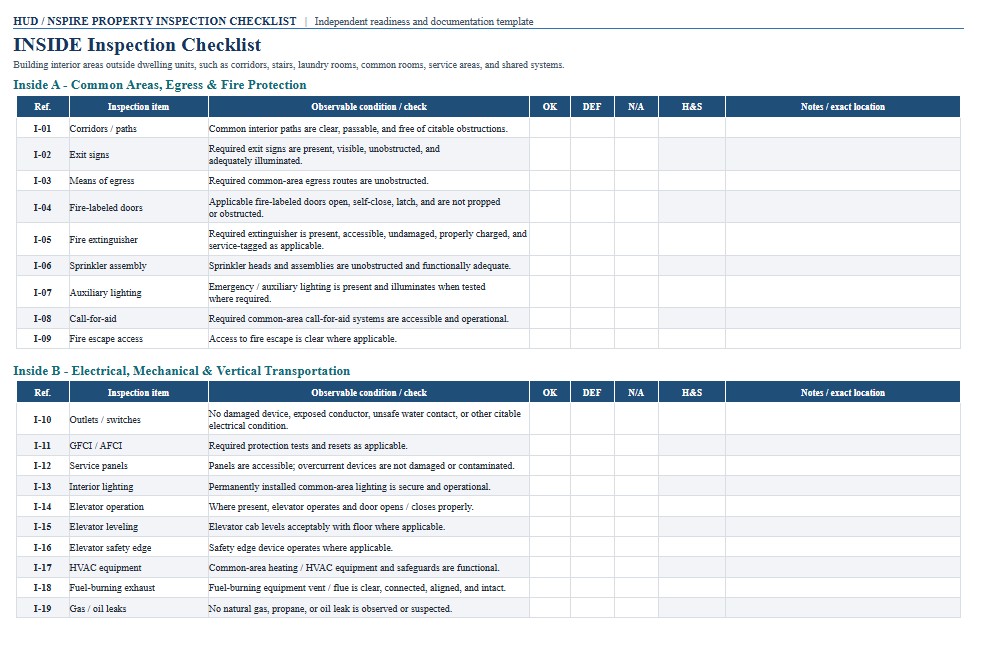
A HUD inspection checklist is used to organize a physical review of housing that participates in, or is being prepared for, a U.S. Department of Housing and Urban Development housing program. Depending on the program and inspection date, the applicable inspection framework may involve HUD’s National Standards for the Physical Inspection of Real Estate (NSPIRE) or Housing Quality Standards (HQS). A practical checklist can help property owners, managers, maintenance teams, housing professionals, and inspectors document conditions, identify deficiencies, assign corrective work, and maintain a clear inspection record. It should not, however, be treated as a substitute for an official HUD or Public Housing Agency inspection form when a particular form or procedure is required. This page provides a downloadable HUD inspection checklist in Word, PDF, and Excel formats, together with practical guidance for completing the checklist, documenting findings, and adapting it to the applicable housing program and inspection requirements.
Download the HUD Inspection Checklist Word Template
The Word version is useful when you want to edit the checklist freely before an inspection. You can add property-specific items, remove sections that do not apply, insert company information, expand notes fields, or adapt the document to your organization’s inspection and maintenance procedures before printing or sharing it.

Download the HUD Inspection Checklist PDF Template
The PDF version provides a consistent fixed layout that is convenient for printing, sharing with property personnel, archiving with inspection records, or completing during a walkthrough. It can also be retained alongside photographs, repair documentation, work orders, and other supporting records associated with the inspection.
Download the HUD Inspection Checklist Excel Template
The Excel version is particularly useful for inspections because findings can be organized in repeatable rows and tracked over time. Property managers can record inspection dates, individual deficiencies, locations, responsible persons, corrective actions, target completion dates, and follow-up results while maintaining a searchable inspection and maintenance log.
How to Complete and Use This Document
Start by identifying exactly what property and inspection the checklist covers. Record the property address, building or project name if applicable, unit number, inspection date, inspector or staff member, property owner or management company, and the HUD-assisted housing program involved. This distinction matters because there is not one universal checklist that automatically satisfies every HUD program. HUD uses the NSPIRE framework for covered HUD housing, while implementation for Housing Choice Voucher, Project-Based Voucher, and Section 8 Moderate Rehabilitation programs has been subject to separate compliance dates. As of 2026, PHAs and other users should verify the standards currently applicable to their specific program before relying on a checklist for an official inspection.
A useful inspection record should identify each item being evaluated and its location. Under NSPIRE, HUD organizes inspections around three broad inspectable areas: the Unit, the Inside of the building, and the Outside. A customized checklist can therefore separate dwelling-unit conditions from common interior areas and exterior or site conditions. Individual checks may address items such as smoke alarms, carbon monoxide alarms, electrical components, doors, windows, walls, ceilings, plumbing fixtures, water heaters, cooking appliances, ventilation, stairs, trip hazards, structural components, drainage, fire-related components, and other items relevant to the property.
For every item, record the observed condition instead of simply checking a box without explanation. A practical format can include fields such as satisfactory, deficient, not applicable, location, description of the problem, corrective action required, responsible person, and completion date. If measurements, photographs, testing, or equipment are relevant, identify them in the notes or supporting documentation. Clear descriptions improve traceability. For example, recording “damaged outlet cover in bedroom 2, east wall” is considerably more useful for maintenance personnel than writing only “electrical problem.”
When a deficiency is found, document what was observed before repairs are made and create a reliable link between the inspection finding and the corrective action. Maintenance work orders, invoices, photographs, contractor reports, and follow-up inspection records can be retained with the checklist when appropriate. HUD inspection standards may classify deficiencies according to their health and safety significance and may establish specific correction requirements or timeframes. A generic template should therefore not be used to invent a repair deadline. Check the current HUD standard, applicable program guidance, and instructions issued by the responsible Public Housing Agency or other administering authority.
Owners and managers preparing for an inspection should also avoid using a pre-inspection checklist as proof that a unit has officially passed. For the Housing Choice Voucher program, for example, inspection determinations are made through the applicable PHA inspection process. HUD has historically provided forms such as the HUD-52580 Inspection Checklist for inspections conducted under HQS, and HUD also provides NSPIRE inspection tools for relevant programs. A privately prepared or downloadable checklist can be valuable for readiness reviews and internal records, but it does not replace an official inspection when one is required.
Before completing the document, use the most current standards rather than relying on an older checklist copied from a previous inspection. HUD’s inspection model has changed, and requirements may also depend on the program, property type, local PHA procedures, and the date of inspection. State and local housing, building, fire, electrical, health, or property-maintenance codes may impose additional requirements beyond the federal housing inspection framework.
Finally, have the person performing the review identify themselves and date the completed checklist. If your organization requires supervisory approval, add reviewer and approval fields. Keep the final version with related inspection and maintenance records according to your organization’s recordkeeping practices and any applicable program requirements. When the checklist will be used to prepare for an official HUD or PHA inspection, resolve uncertainty by consulting the administering housing agency, current HUD guidance, or a qualified housing compliance professional rather than assuming that a generic checklist establishes compliance.