
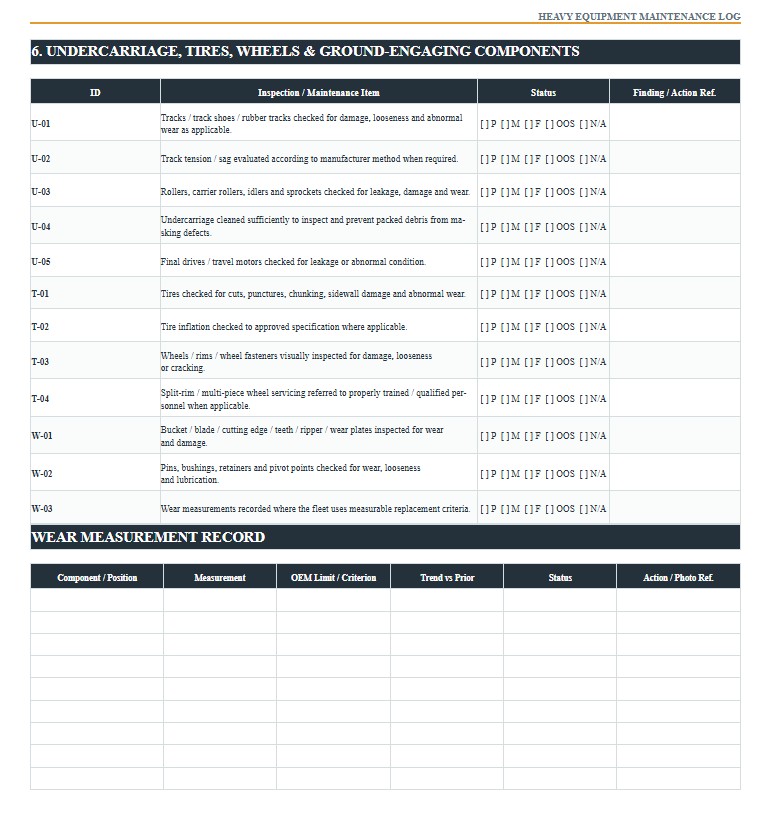
A Heavy Equipment Maintenance Log is used to document inspections, preventive maintenance, repairs, service intervals, operating hours, parts replacement, and equipment condition throughout the working life of construction and industrial machinery. The log can be used for excavators, loaders, bulldozers, backhoes, skid steers, graders, cranes, dump trucks, compactors, telehandlers, and other heavy equipment. Contractors, fleet managers, equipment owners, mechanics, maintenance supervisors, and service technicians can use the record to organize scheduled maintenance, identify recurring defects, document downtime, and maintain an equipment-specific service history. Maintenance intervals and procedures should be based on the manufacturer’s operation and maintenance manual rather than generic schedules because requirements can differ substantially among makes and models. This page provides downloadable Word, PDF, and Excel versions of the Heavy Equipment Maintenance Log, together with practical instructions for customizing, completing, reviewing, and retaining the document.
Download the Heavy Equipment Maintenance Log Word Template
The Word version is useful when the maintenance department needs to modify the document freely before printing or distributing it. You can add company information, equipment-specific inspection points, internal approval fields, manufacturer service intervals, work-order references, or additional maintenance procedures.

Download the Heavy Equipment Maintenance Log PDF Template
The PDF version is useful when a consistent fixed-layout record is preferred for shop use, field inspections, archiving, sharing with supervisors, or maintaining a service file for an individual machine. It is also convenient when maintenance records are printed and completed as part of an established equipment service process.
Download the Heavy Equipment Maintenance Log Excel Template
The Excel version is particularly useful for fleet management because heavy equipment maintenance involves repeatable service rows, dates, hour-meter readings, maintenance intervals, parts, labor, costs, work orders, and upcoming service requirements. The spreadsheet can be adapted to track multiple machines and review maintenance history over time.
How to Complete and Use This Document
Start by identifying the machine precisely. Record the company or contractor name, equipment description, internal asset or unit number, manufacturer, model, serial number, year, equipment location or assigned project, and any other identifier used by the company’s fleet-management system. If the equipment has an hour meter or odometer, record the current reading for every significant maintenance event. Manufacturers commonly establish many heavy-equipment service intervals according to operating hours, so an accurate meter history makes the maintenance record considerably more useful.
Each entry should identify the date, technician or mechanic, type of service, meter reading, and reason for the work. Useful service classifications include preventive maintenance, scheduled inspection, lubrication, engine service, hydraulic service, cooling-system maintenance, electrical repair, undercarriage service, tire or wheel service, attachment maintenance, troubleshooting, warranty work, and unscheduled repair. When work originates from an operator complaint or pre-operation inspection, record the reported condition so that the original symptom can be compared with the technician’s findings.
Document what was actually inspected or serviced instead of recording only a generic statement such as “maintenance completed.” Depending on the machine, relevant items may include engine oil, coolant, fuel system components, air filters, hydraulic oil and filters, hoses, cylinders, fittings, belts, batteries, electrical connections, brakes, steering, tires, tracks, rollers, sprockets, cutting edges, buckets, attachments, lights, alarms, mirrors, cameras, guards, steps, handholds, and safety devices. Pre-operation inspection checklists published by major equipment manufacturers likewise emphasize checking machine condition and identifying problems before operation.
Do not use the template to create arbitrary maintenance intervals. Enter the interval required for the specific machine according to its current operation and maintenance manual, approved company maintenance program, warranty conditions, and actual operating environment. Caterpillar, for example, directs equipment owners to the machine’s Operation and Maintenance Manual for recommended procedures and service intervals. Severe-duty operation, dust, temperature extremes, frequent idling, attachments, or other operating conditions may affect the maintenance strategy, so the log should be customized for the equipment and application rather than treated as a universal schedule.
When a defect is found, describe the condition clearly and connect it to a corrective action. Record the repair performed, parts replaced, quantities, part numbers when useful, labor hours, outside vendor information, work-order number, and supporting documents such as invoices or inspection reports. Maintenance records can help establish whether preventive maintenance has occurred regularly and provide a history of previous major and minor repairs. If work cannot be completed immediately, identify the responsible person, required follow-up, target date, and machine status.
The final status of the equipment should be stated clearly. Practical classifications may include Ready for Service, Monitor, Restricted Use, Repair Required, and Out of Service. Equipment with a condition that could make operation unsafe should not simply be returned to the job because the maintenance form has been completed. NIOSH safety guidance recommends inspecting construction equipment before use and not using damaged equipment.
Maintenance personnel should also address hazardous energy before servicing equipment whenever the work presents a risk from unexpected startup, movement, hydraulic or pneumatic pressure, electrical energy, gravity, or other stored energy. OSHA’s hazardous-energy requirements apply in circumstances covered by the relevant standard, and OSHA has specifically addressed lockout and tagout considerations for vehicle-type mobile equipment such as front-end loaders during maintenance. Particular equipment can create additional hazards. For example, OSHA notes that dump trucks used in construction require positive support for dump bodies during certain maintenance or inspection work.
Keep completed logs with the machine’s maintenance records and link them to related work orders, parts records, inspection forms, vendor documentation, photographs, and warranty claims when appropriate. For a larger fleet, consistent asset numbers and service categories make it easier to compare downtime, repair frequency, operating cost, and maintenance spending. Before adopting the template as a company procedure, verify applicable OSHA requirements, manufacturer instructions, contractual or warranty conditions, and any federal, state, county, city, industry, or company-specific requirements relevant to the equipment and work being performed.