
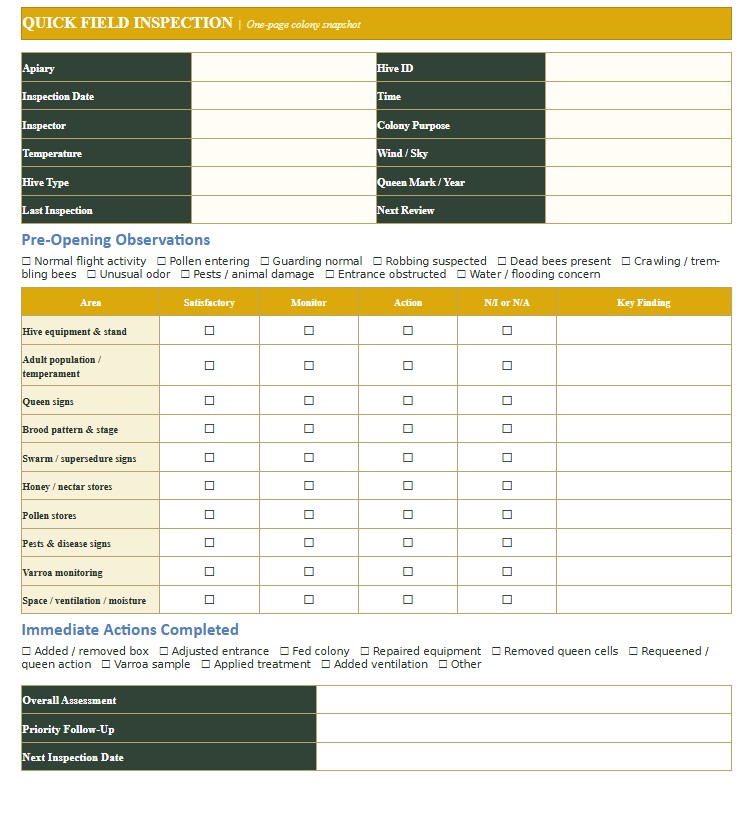
A Hive Inspection Checklist is a practical recordkeeping tool for monitoring the condition, health, productivity, and management needs of a honey bee colony. Beekeepers, apiary managers, agricultural businesses, inspectors, educators, and beekeeping organizations can use the checklist during routine seasonal visits, queen assessments, swarm-prevention checks, pest monitoring, feeding decisions, and pre-winter evaluations. A consistent inspection record makes it easier to compare colony development over time, identify changes in brood pattern or food reserves, track Varroa mite monitoring, document treatments, and schedule follow-up work. This page provides downloadable Word, PDF, and Excel versions of the Hive Inspection Checklist, together with practical instructions for completing and using the document. The template can be customized for hobby, sideline, commercial, educational, or research apiaries, but users should adapt it to local conditions, current product labels, veterinary guidance when applicable, and any federal, state, county, city, tribal, or apiary-specific requirements.
Download the Hive Inspection Checklist Word Template
The Word format is useful when you want to edit inspection categories, add an apiary name or logo, modify seasonal questions, create space for additional observations, or adapt the document before printing, sharing, signing, or using it within a specific beekeeping operation.

Download the Hive Inspection Checklist PDF Template
The PDF format provides a fixed-layout version that is convenient for printing, carrying into the apiary, sharing with another beekeeper, attaching to a colony record, or archiving with treatment, feeding, production, and equipment documentation
Download the Hive Inspection Checklist Excel Template
The Excel format is useful for maintaining repeatable inspection rows, recording dates and measurements, comparing multiple colonies, calculating mite percentages, monitoring queen status, tracking feeding and treatments, filtering open actions, and creating a long-term apiary management log.
How to Complete and Use This Document
Start each record by identifying the apiary and colony clearly. Enter the apiary name or location, hive identification number, inspection date, start time, inspector name, and hive type. Record weather conditions such as temperature, wind, cloud cover, and recent rainfall when they may affect bee activity or the scope of the inspection. Note whether the colony is being used for honey production, pollination, queen rearing, nucleus production, education, research, or another purpose. Consistent identification is essential when several colonies are located in the same yard.
Before opening the hive, observe the entrance and surrounding area. Record flight activity, pollen being carried into the hive, dead bees, crawling bees, fighting, robbing behavior, unusual odors, blocked entrances, damaged equipment, animal disturbance, or excessive vegetation. Entrance activity can provide useful context, but it does not replace an internal inspection. A quiet entrance may be caused by weather, time of day, season, reduced colony strength, queen problems, pesticide exposure, or other conditions that require further evaluation.
Document the condition of the hive components as they are opened. Check the cover, inner cover, boxes, frames, foundation, bottom board, entrance reducer, feeder, queen excluder, landing board, and hive stand as applicable. Note moisture, mold, excessive propolis, damaged comb, cross-combing, wax moth evidence, small hive beetles, ants, mice, or other pests. Record the number and position of brood boxes and honey supers so the hive configuration can be reconstructed later.
Evaluate colony population and behavior using a consistent method. Estimate the number of frames covered by adult bees or use another clearly defined unit. Describe the temperament as calm, defensive, unusually agitated, disorganized, or otherwise noteworthy. Record whether the colony population appears to be increasing, stable, or declining compared with the previous inspection. Avoid relying only on general impressions. Specific observations make later comparisons more useful.
Assess queen status carefully. Record whether the queen was seen, whether eggs were present, and whether young larvae were observed. A queen does not have to be physically located during every inspection if reliable signs of recent laying are present. Examine the brood pattern and note whether it appears solid, spotty, irregular, scattered, drone-heavy, or otherwise abnormal. Record the approximate number of frames containing eggs, open brood, capped worker brood, and capped drone brood. Queen cells should be documented by type, number, location, and stage because swarm, supersedure, and emergency cells may indicate different colony conditions.
Estimate food reserves by recording frames or areas of capped honey, nectar, and stored pollen. Note whether stores appear adequate for the colony’s population, season, weather, and local forage conditions. When supplemental feeding is provided, record the feed type, amount, date, delivery method, and reason. Do not feed unidentified honey or pollen from questionable sources, since contaminated material may spread pests or disease. Also consider whether feeding could stimulate robbing or interfere with honey intended for harvest.
Pest and disease monitoring should be recorded in detail. Note visible Varroa mites, deformed wings, unusual brood appearance, perforated or sunken cappings, chalkbrood mummies, foul odors, small hive beetles, wax moth damage, or other suspected problems. When a formal Varroa monitoring method is used, identify the method, sample size, mite count, calculated infestation level, and action taken. Alcohol washes, sugar rolls, sticky boards, drone brood checks, and visual observations do not provide identical information, so the method must always be stated. Treatment decisions should be based on current regional guidance, colony conditions, season, treatment history, and reliable monitoring rather than on visual inspection alone.
Record every medication, pesticide, miticide, organic acid, essential-oil product, biological product, or other pest-control treatment accurately. Include the product name, active ingredient when available, application date, dose or amount, application method, hive configuration, person responsible, planned removal date, and required follow-up. Use only products that are lawful for the intended use, and follow the current label exactly. The label may contain restrictions involving dose, temperature, protective equipment, colony condition, application interval, honey supers, food-contact materials, disposal, and reentry. Do not assume that a treatment recommended in an older book, video, forum, or checklist is currently permitted.
Use the action section to state what must happen next. Examples include adding space, reducing space, replacing damaged equipment, feeding, requeening, combining a weak colony, installing a robbing screen, repeating a mite test, checking queen cells, removing a treatment, or requesting assistance from an experienced beekeeper, state apiary inspector, veterinarian, diagnostic laboratory, or other qualified professional. Assign a target date and responsible person to each action. At the next visit, review the earlier record before opening the colony and document whether the issue improved, remained unchanged, or became more serious.
Inspect colonies with suitable protective clothing and equipment, and consider allergies, heat, lifting hazards, fire risk from smokers, uneven terrain, aggressive colonies, and nearby members of the public. Avoid opening colonies when conditions make an inspection unnecessarily disruptive or unsafe. Clean tools and equipment when disease transmission is a concern, and avoid moving questionable comb, honey, brood, or hive components between colonies until the condition has been assessed.
Before adopting the checklist as an official operating form, customize it for the beekeeper’s climate, management system, equipment, seasonal calendar, treatment program, and recordkeeping needs. Registration, inspection, movement, disease reporting, pesticide use, veterinary oversight, food production, honey processing, and commercial pollination requirements can vary by state, county, city, tribe, and operation type. Beekeepers should verify current requirements with the appropriate U.S. authority and obtain qualified assistance when a serious disease, unexplained colony loss, suspected pesticide incident, treatment question, or public safety concern is identified.