
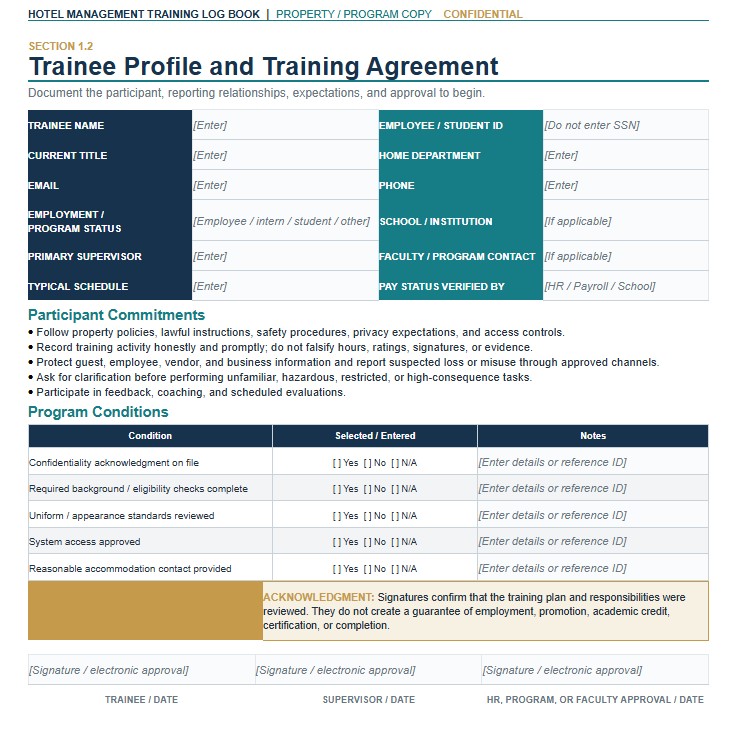
A hotel management training log book is a structured record used to document the practical development of hotel managers, supervisors, management trainees, interns, and employees preparing for greater operational responsibility. It can track department rotations, training hours, assigned duties, management competencies, observations, supervisor feedback, corrective coaching, and progress toward defined learning objectives. Hotels may use the log during onboarding, leadership development programs, cross-training, internships, promotions, or succession planning. Typical subjects include front office operations, housekeeping, reservations, guest service, food and beverage, revenue management, sales, maintenance coordination, emergency procedures, employee supervision, and financial controls. This page provides downloadable Word, PDF, and Excel versions of a hotel management training log book, together with practical guidance for completing, reviewing, approving, and retaining the record. The template can be customized for an independent hotel, resort, franchise property, management company, college internship, or department-specific training program.
Download the Hotel Management Training Log Book Word Template
The Word format is useful when the hotel, training provider, supervisor, or trainee needs to edit the document freely before printing, sharing, signing, or adapting it to a particular property, department, position, or management development program.

Download the Hotel Management Training Log Book PDF Template
The PDF format is useful for printing, archiving, sharing with supervisors or educational institutions, and maintaining a fixed-layout version that can be completed consistently throughout the training period.
Download the Hotel Management Training Log Book Excel Template
The Excel format is useful for recording repeatable training entries, department rotations, dates, scheduled activities, completed hours, competency ratings, assessment results, outstanding tasks, and progress totals across an extended training program.
How to Complete and Use This Document
Begin by entering the hotel or management company name, property address, department, training program title, and the dates covered by the log. Identify the trainee by name, employee or student identification number when appropriate, current position, assigned department, direct supervisor, and training coordinator. Avoid recording Social Security numbers, payment card data, system passwords, guest identification documents, medical information, or other sensitive personal data that is not necessary for the training record.
Define the Training Plan
Before daily entries begin, describe the purpose of the program and the competencies the trainee is expected to develop. Objectives should be specific enough to evaluate. Examples may include completing check-in and checkout procedures, resolving guest complaints, preparing staffing schedules, inspecting guestrooms, reviewing occupancy reports, understanding revenue controls, coordinating maintenance requests, conducting shift briefings, or applying the property’s emergency procedures.
For a rotational program, identify each department, the scheduled start and completion dates, the assigned department trainer, and the activities to be observed or performed. Common rotations include front office, reservations, housekeeping, food and beverage, sales, events, accounting, revenue management, human resources, security, and engineering. Customize the departments to match the hotel’s actual operation rather than including areas that the property does not have.
Complete Each Training Entry
For every session or shift, record the date, department, scheduled and actual hours, trainer or supervisor, topic, activity completed, and level of participation. The trainee should explain what was learned, which systems or procedures were used, any problem encountered, and how the issue was handled. Entries should be factual and concise. Do not place confidential guest names, room access details, payment information, personnel complaints, or active security procedures in a broadly accessible training log.
The supervisor should review entries regularly and indicate whether the activity was observed, practiced with assistance, completed independently, or requires additional training. A rating scale should be defined so that all supervisors apply it consistently. When performance does not meet the expected standard, document the competency requiring improvement, the coaching provided, the responsible person, and the planned reassessment date. The log should not be used to replace the hotel’s formal disciplinary, incident reporting, or employee evaluation procedures.
Verify Hours and Required Training
Managers should compare recorded training time with schedules, timekeeping records, and program requirements. Under federal wage and hour principles, attendance at job-related or employer-required training may count as compensable working time depending on the circumstances. Employers should review current federal and state wage rules before treating training as unpaid. Internship programs should also be reviewed against applicable employment law and any requirements established by the participating school or educational institution.
Safety topics should reflect the hazards associated with the employee’s duties. Depending on the assignment, this may include chemical handling, hazard communication, lifting and ergonomics, emergency evacuation, personal protective equipment, workplace violence prevention, blood or sharps response, electrical safety, and safe equipment operation. Required safety instruction should be delivered in a language and vocabulary the employee can understand. A general training log does not replace any specific record, certificate, roster, or documentation required by an applicable OSHA standard.
If the trainee works in a hotel restaurant, bar, banquet kitchen, or other food operation, record relevant food safety instruction while separately maintaining any permits or certifications required by the state, county, city, or tribal regulatory authority. Food handler, allergen, alcohol service, harassment prevention, fire safety, pool operation, and security training requirements can vary by location and job responsibility.
Approve and Retain the Completed Log
At the end of each rotation or review period, the trainee and supervisor should confirm the entries, summarize strengths and development needs, and sign or electronically approve the record. A final assessment may include completed competencies, outstanding training, recommended next steps, and authorization for independent duties. Supporting documents may include attendance sheets, certificates, assessment results, department checklists, project reports, or supervisor evaluations.
Store the completed log according to the hotel’s recordkeeping and privacy policies, with access limited to personnel who have a legitimate business need. Before adopting the template, verify current federal, state, county, city, franchise, insurance, educational, and company-specific requirements. Human resources counsel, a qualified safety professional, food safety specialist, payroll adviser, or employment attorney should be consulted when the program involves regulated training, unpaid internships, wage questions, sensitive personnel matters, or uncertainty about required documentation.