
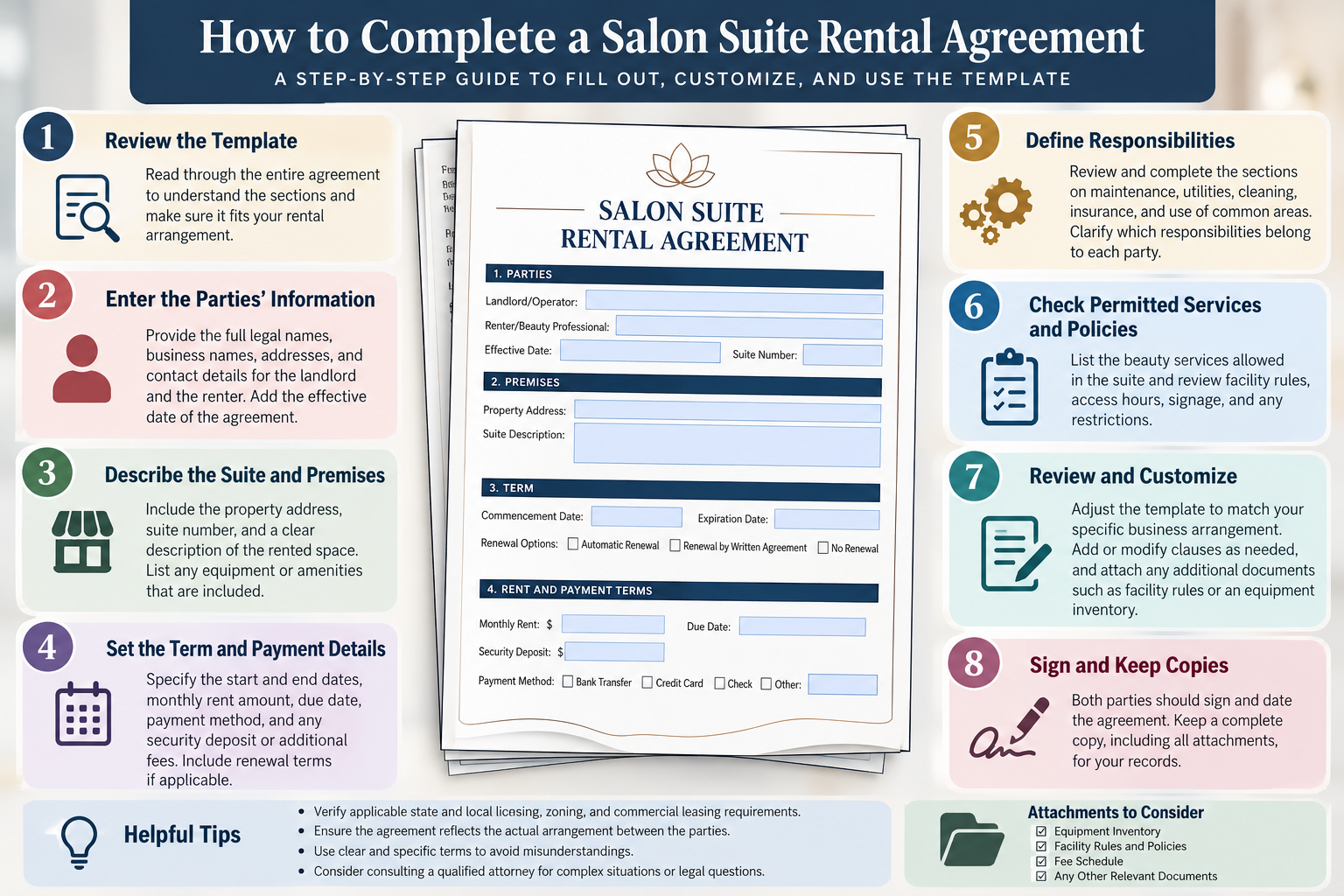
A Salon Suite Rental Agreement is a written contract used when a beauty professional rents a private salon suite from a property owner, salon operator, or management company. It establishes the terms of the rental arrangement, including rent payments, access to the premises, maintenance responsibilities, permitted services, and conditions for ending the agreement.
Salon suite agreements are commonly used by hairstylists, barbers, estheticians, nail technicians, lash artists, and other beauty professionals who operate their own businesses within a larger salon facility. A written agreement helps both parties understand their rights and responsibilities, reduces the possibility of misunderstandings, and provides a record of the agreed rental conditions. This page provides a free Salon Suite Rental Agreement template in Word and PDF formats, together with practical guidance for completing, customizing, and using the document. The templates can be adapted to different commercial rental arrangements throughout the United States. Before signing, both parties should verify applicable state and local commercial leasing, business licensing, and cosmetology regulations.
Download the Salon Suite Rental Agreement Word Template
The Word version is suitable for salon owners, suite operators, and independent beauty professionals who want to edit the agreement before using it. You can customize the rental amount, payment schedule, lease duration, suite description, operating conditions, and other contractual provisions. The editable format also makes it convenient to add specific clauses, review changes with the other party, and prepare the document for printing, sharing, or signing.

Download the Salon Suite Rental Agreement PDF Template
The PDF version provides a consistent document layout for printing, sharing, reviewing, and archiving. It is useful when the rental terms have already been agreed upon and the parties need a fixed-layout document for completion and signature. A standard PDF may require printing and handwritten entries unless editable fields have been included.
How to Complete and Use This Document
A Salon Suite Rental Agreement should reflect the actual arrangement between the salon suite operator and the professional renting the space. Before completing the template, confirm the rental conditions, inspect the premises, and determine whether the intended beauty services are permitted at the location. The document should distinguish the renter’s responsibilities from those retained by the landlord or facility operator.
Enter the Parties’ Information
Start with the full legal names, business names, mailing addresses, and contact information of the landlord and renter. Identify the effective date and the individuals authorized to sign the contract. If either party operates through an LLC or corporation, use the appropriate legal entity name rather than relying only on a trade name.
If the suite operator is not the property owner, verify that the underlying commercial lease permits subleasing or granting occupancy rights. Obtain any required written authorization before the rental begins.
Identify the Suite and Permitted Activities
Enter the complete property address, suite number, and a clear description of the rented space. Specify whether the renter has exclusive possession of the suite and whether the arrangement includes access to waiting rooms, restrooms, laundry facilities, storage areas, or other shared amenities.
List any equipment provided with the suite, such as styling chairs, shampoo bowls, mirrors, sinks, cabinets, or treatment beds. An equipment inventory can be attached to document its condition when the renter takes possession.
Describe the services the renter is authorized to provide. Hair styling, nail services, esthetics, and other beauty activities may have different licensing, sanitation, and facility requirements.
Specify Rental Payments and Additional Fees
Enter the agreed rental amount and indicate whether payments are due weekly, monthly, or according to another schedule. Specify the due date, accepted payment methods, and any applicable late-payment provisions.
Clarify whether utilities, internet access, cleaning services, laundry, parking, and shared equipment are included in the rent. If the renter must pay additional charges, identify those costs and explain how they are calculated.
When a security deposit is required, record its amount, permitted deductions, and return conditions. Commercial rental rules differ by state, so deposit and fee provisions should be checked against applicable law.
Define the Lease Term and Termination Procedures
Specify the commencement date and whether the agreement has a fixed expiration date or continues on a periodic basis. Include renewal conditions and the notice requirements for ending the arrangement.
Explain what happens if the renter leaves early, fails to pay rent, violates facility policies, or damages the property. The agreement should also address the removal of personal belongings, return of access devices, final cleaning, and inspection of the suite.
Avoid assuming that residential landlord-tenant rules apply to commercial salon rentals. Termination rights and enforcement procedures depend on the agreement and applicable state law.
Allocate Maintenance, Insurance, and Operating Responsibilities
Identify who is responsible for routine cleaning, sanitation, repairs, plumbing problems, equipment maintenance, and damage caused by the renter or clients. Address access hours, security procedures, signage, alterations, chemical storage, waste disposal, and the use of common areas.
State any agreed insurance requirements, including professional liability, general liability, or business property coverage. The parties should confirm the policies and coverage limits appropriate to their activities.
Verify Licensing and Independent Business Requirements
Before using the agreement, contact the relevant state cosmetology or barbering board to confirm establishment and practitioner licensing requirements. For example, Texas regulates certain independently operated salon suites as mini-establishments, while other states use different licensing structures. City or county business permits, zoning restrictions, and local health requirements may also apply.
If the renter operates independently, clarify responsibility for business expenses, appointment scheduling, client payments, supplies, and recordkeeping. However, calling someone an independent contractor in a rental agreement does not automatically establish their employment or tax status. Federal and state classification rules consider the actual working relationship.
Review the Agreement and Obtain Signatures
Before signing, check all dates, amounts, names, permitted uses, and responsibilities. Identify the governing state law where appropriate. Attach any relevant facility rules, equipment inventories, fee schedules, or other supporting documents, and ensure that both parties agree to their contents.
Include dated signatures from the landlord or authorized representative and the renter. Each party should retain a complete signed copy, together with attachments, payment records, and subsequent amendments. Notarization is not automatically required for every salon suite agreement, although particular circumstances or applicable requirements may call for additional formalities.
Consult a qualified attorney when the arrangement involves substantial financial obligations, complicated subleasing terms, unusual restrictions, disputed provisions, or uncertainty about commercial tenancy and worker classification. A Salon Suite Rental Agreement template is a useful starting point, but it should be tailored to the specific business arrangement and the requirements of the state where the suite is located.