
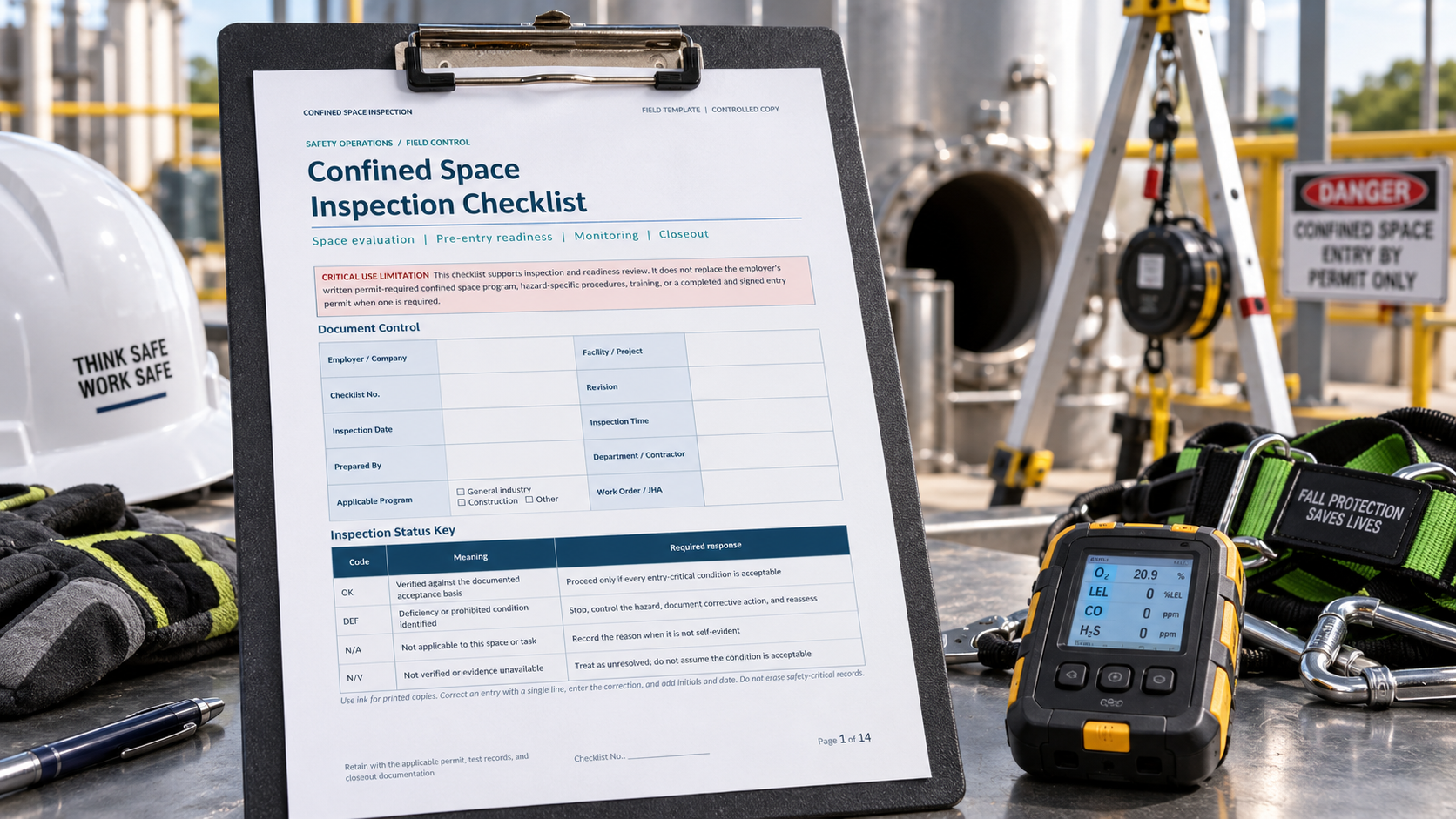
A confined space inspection checklist helps U.S. employers evaluate a tank, vault, pit, silo, manhole, crawlspace, vessel, or similar area before employees enter or work nearby. Safety managers, competent persons, entry supervisors, contractors, maintenance teams, and environmental health and safety personnel can use the checklist to document the space classification, potential hazards, atmospheric test results, isolation controls, ventilation, equipment, personnel, communications, and rescue arrangements. It can also create a traceable record of deficiencies and corrective actions. This page provides a downloadable confined space inspection checklist in Word, PDF, and Excel formats, together with practical guidance for completing and using the document. Because a general checklist does not automatically satisfy every OSHA entry-permit requirement, employers should adapt it to their written confined space program, the work being performed, and the applicable federal or state-plan standard. The completed form should support, rather than replace, hazard assessment, employee training, an authorized entry permit when required, and qualified safety review.
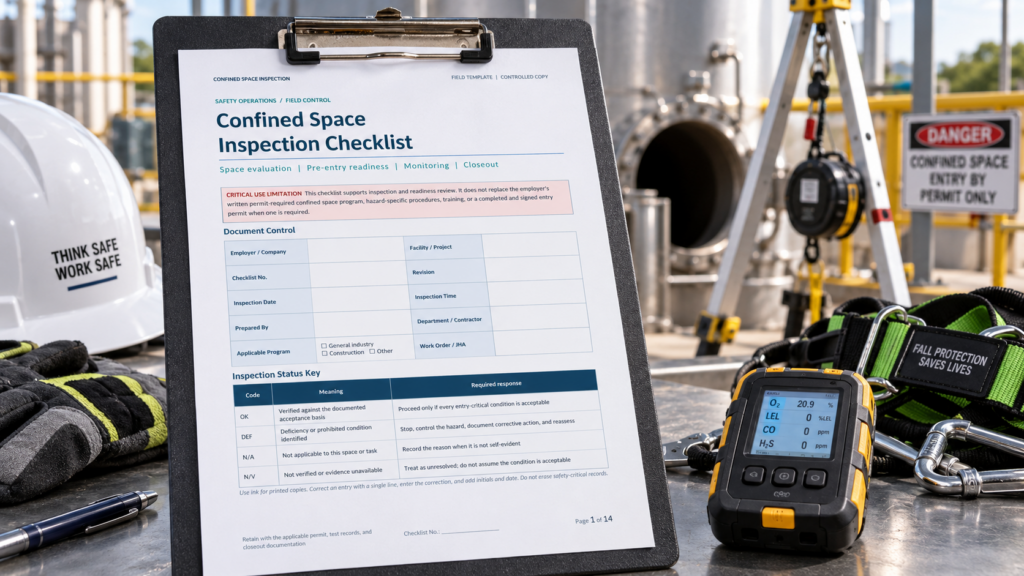
Download the Confined Space Inspection Checklist Word Template
The Word format is useful when you need to edit the checklist freely before printing, sharing, signing, or adapting it to a particular facility, confined space, contractor procedure, or company safety program.

Download the Confined Space Inspection Checklist PDF Template
The PDF format is suitable for printing, archiving, sharing with employees or contractors, and maintaining a consistent fixed-layout inspection record at the jobsite or facility.
Download the Confined Space Inspection Checklist Excel Template
The Excel format is useful for maintaining repeatable inspection rows, recording atmospheric measurements, tracking corrective actions and dates, managing multiple spaces, and filtering open deficiencies by location, priority, responsible person, or status.
How to Complete and Use This Document
Begin by identifying the employer, facility or project, exact location, inspection date and time, checklist number, and the person performing the evaluation. Describe the space precisely, including its asset identification number, normal function, dimensions, access points, internal configuration, and work to be performed. Avoid relying on a general description such as “tank” or “pit” when several similar spaces exist. The record should allow another authorized person to determine exactly which space was assessed and which entry operation the findings cover.
Next, determine whether the area meets the definition of a confined space and whether it is a permit-required confined space. Under federal OSHA rules, this evaluation depends on the space configuration, access limitations, intended occupancy, and hazards. A permit space may contain or potentially contain a hazardous atmosphere, engulfment material, a trapping or asphyxiation configuration, or another recognized serious safety or health hazard. For construction work, the evaluation should be performed by a competent person. General industry and construction activities are governed by different OSHA provisions, and shipyard or other specialized work may be subject to additional standards. Record the classification, the basis for it, and the name of the qualified person making the determination.
Inspect and document every relevant hazard. These may include oxygen deficiency or enrichment, flammable gases or vapors, toxic contaminants, combustible dust, engulfment, inwardly converging walls, sloping floors, energized equipment, moving machinery, pressurized lines, hazardous chemicals, heat stress, noise, biological hazards, electrical exposure, traffic, falling objects, restricted movement, and difficult rescue access. Mark each item as acceptable, deficient, not observed, or not applicable, and explain any result that is not clearly acceptable. Do not treat a blank box as approval.
Record how hazards have been eliminated, isolated, or controlled. Appropriate entries may address lockout or tagout, line blanking or disconnection, blocking moving parts, draining, purging, flushing, forced-air ventilation, barriers, traffic control, fall protection, lighting, communications, personal protective equipment, and retrieval systems. The checklist should identify who verified each control and when. Use the employer’s written program, energy-control procedures, safety data sheets, project documents, and approved work methods to establish the applicable criteria.
For atmospheric testing, identify the instrument, model, serial number, calibration or functional-check status, person conducting the test, sampling locations, and test times. Record actual readings rather than writing only “safe.” Federal OSHA procedures generally require testing for oxygen first, followed by combustible gases and vapors, and then potential toxic contaminants. The gases selected, acceptable limits, sampling levels, frequency, and need for continuous monitoring must reflect the hazards of the particular space and applicable standard. If conditions change, alarms activate, ventilation fails, or a prohibited condition develops, entrants should leave according to the employer’s procedures and the entry must be reevaluated.
Confirm that authorized entrants, attendants, and the entry supervisor are identified and trained for their assigned duties. Document the communication method, entrant accountability process, evacuation signals, rescue service, emergency contact procedure, and required rescue or retrieval equipment. Rescue planning must be completed before entry. The form should never suggest that an untrained coworker may enter a hazardous space to attempt an improvised rescue.
List every deficiency with a corrective action, responsible person, priority, target date, and closeout evidence. The entry supervisor should review the completed inspection and sign the applicable entry permit before entry begins. A generic inspection checklist is not necessarily an entry permit and should not be used as authorization unless it contains all required information and has been formally incorporated into the employer’s compliant permitting process. Cancel the permit when work is completed or when conditions require termination. Federal OSHA rules generally require canceled confined space entry permits to be retained for at least one year, but a standalone checklist may follow a different company retention schedule.
Customize the template for the industry, space inventory, monitoring equipment, chemical hazards, contractor relationships, and approval flow. Construction projects may require information exchange and coordination among the host employer, controlling contractor, and entry employers. Consult a qualified safety professional, industrial hygienist, engineer, or rescue specialist when hazards, classifications, monitoring methods, ventilation controls, or rescue capabilities are uncertain. Employers should also verify current federal OSHA requirements, applicable OSHA-approved state-plan rules, local emergency-service limitations, contract requirements, and company procedures before using the checklist.