
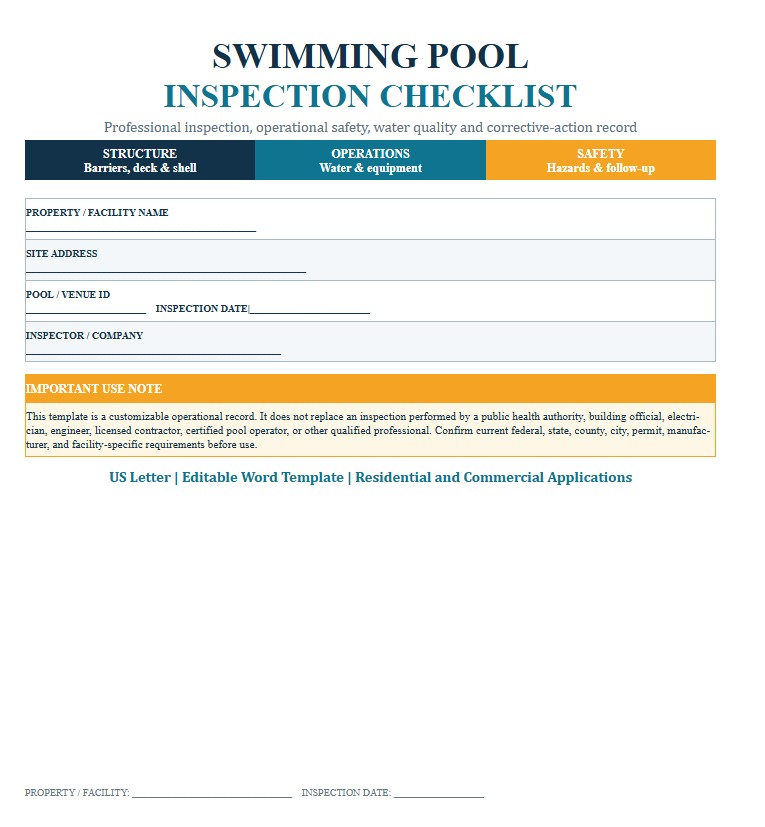
The Swimming Pool Inspection Checklist is a structured form for documenting the condition, operation, and safety of a residential, commercial, community, hotel, apartment, school, or public swimming pool. It can be used by pool owners, property managers, maintenance technicians, service contractors, facility operators, home inspectors, and safety personnel to identify hazards, record water-quality readings, confirm that equipment is operating, and track corrective actions. This page provides downloadable Word, PDF, and Excel versions of the checklist together with practical guidance for completing and using the document. The Word template can be customized for a specific property or inspection program, the PDF version provides a consistent layout for printing and archiving, and the Excel version supports recurring inspections, measurements, maintenance schedules, and follow-up tracking. Inspection criteria should be adapted to the pool type, manufacturer instructions, applicable building and health codes, and current federal, state, county, and city requirements.
Download the Swimming Pool Inspection Checklist Word Template
The Word format is useful when you want to edit inspection categories, add company or property information, include local compliance items, change status options, or adapt the checklist for a residential pool, public aquatic facility, spa, wading pool, or other specific installation before printing, sharing, or signing it.

Download the Swimming Pool Inspection Checklist PDF Template
The PDF format is useful for printing, archiving, emailing, or maintaining a fixed-layout inspection record. It can be stored with maintenance reports, water-testing logs, photographs, repair invoices, permits, and other pool documentation.
Download the Swimming Pool Inspection Checklist Excel Template
The Excel format is useful for recording repeatable inspection rows, water-quality measurements, service dates, equipment conditions, maintenance schedules, corrective actions, responsible persons, estimated costs, and completion dates. It can also support filtering, calculations, status tracking, and inspection history for one or multiple pools.
How to Complete and Use This Document
Begin by identifying the property and pool accurately. Enter the facility name, address, owner or operator, inspection date and time, inspector, weather conditions, pool type, approximate dimensions, capacity, construction material, and any internal asset or permit number. Indicate whether the inspection is a routine opening check, periodic safety review, seasonal opening or closing inspection, post-repair evaluation, property inspection, or follow-up after a reported problem.
Define the inspection status categories before using the checklist. Practical options may include satisfactory, needs attention, immediate action required, not inspected, and not applicable. The inspector should provide written details whenever an item is not satisfactory. A check mark alone may not show the location, severity, measurement, or corrective action needed.
Inspect the pool enclosure and access controls carefully. Record the condition of fences, walls, gates, doors, locks, latches, alarms, and other barriers intended to restrict unsupervised entry. Check whether gates close and latch properly and whether openings, damage, stored objects, landscaping, or nearby furniture could reduce the effectiveness of the barrier. Barrier dimensions and hardware requirements vary by jurisdiction, so compare the installation with current state and local building, residential, property-maintenance, and swimming-pool codes.
Review the deck, coping, steps, ladders, handrails, ramps, diving equipment, starting platforms, slides, and accessible-entry equipment. Look for loose components, sharp edges, cracks, settlement, slippery surfaces, standing water, trip hazards, corrosion, unstable anchors, missing covers, and damaged nonslip surfaces. Record depth markings, warning signs, rules, emergency information, and restricted-use notices where required. Diving boards, slides, and other features should be evaluated against their manufacturer instructions and the pool configuration.
Check water clarity and visible pool conditions before assessing other systems. The bottom, drains, and other required reference points should be visible as required by the applicable operating standard. Note cloudiness, algae, discoloration, debris, foam, unusual odor, contamination, or evidence of inadequate circulation. A pool should not remain open when conditions prevent safe observation of swimmers or indicate a potentially unsafe water-quality problem.
Record actual water-test results rather than simply marking chemistry as acceptable. Depending on the pool and local requirements, relevant fields may include disinfectant residual, pH, water temperature, alkalinity, calcium hardness, stabilizer, salt level, oxidation-reduction potential, and other system-specific readings. Enter the testing method, sample location, time, and person performing the test. Acceptable ranges and testing frequency should be taken from the applicable health code, operating permit, manufacturer instructions, and facility procedures rather than from a universal value inserted into the template.
Inspect circulation and treatment equipment, including pumps, motors, filters, strainers, skimmers, gutters, inlets, valves, flow meters, pressure gauges, heaters, chemical feeders, controllers, and automated monitoring systems. Record leaks, unusual noise, vibration, corrosion, damaged wiring, blocked flow, abnormal pressure, missing labels, or equipment that is not operating as intended. Note filter pressure and flow readings when applicable so changes can be compared over time.
Examine drain covers, suction outlets, equalizer lines, and anti-entrapment equipment without entering the pool or disturbing components unless the inspector is qualified to do so. Loose, broken, missing, expired, or incompatible drain covers require prompt attention. Public pools and spas may be subject to federal anti-entrapment requirements in addition to state and local rules. Verification of drain-cover compliance, hydraulic design, secondary protection, or installation may require a licensed contractor, engineer, or other qualified professional.
Review electrical equipment from a safe location. Note damaged lights, exposed conductors, open junction boxes, missing covers, corrosion, improperly located cords, or evidence of water entering electrical components. Testing grounding, bonding, ground-fault protection, underwater lighting, and electrical clearances should be performed only by a person qualified under applicable electrical requirements. Do not use the checklist as authorization for an unqualified inspector to open energized equipment.
Confirm the availability and condition of required safety equipment, which may include reaching poles, rescue hooks, life rings, first-aid supplies, emergency communication equipment, personal protective equipment, and lifeguard equipment. Public and commercial facilities should also review staffing records, emergency procedures, incident forms, employee training, chemical safety information, and required operating logs.
Document chemical storage conditions, container labels, ventilation, spill controls, separation of incompatible products, access restrictions, and housekeeping. Chemical leaks, damaged containers, strong fumes, or unsafe mixing practices should be treated as urgent hazards. Personnel handling pool chemicals should follow product labels, safety data sheets, employer procedures, and applicable occupational safety requirements.
Finish the checklist by describing every deficiency, assigning a responsible person, setting a target completion date, and recording whether the pool must be restricted or closed. Attach photographs, laboratory reports, service tickets, invoices, permits, and repair documentation when relevant. The inspector and property representative should sign and date the completed record. Retain it according to company policy and applicable law, and verify current federal, state, county, city, public-health, building, electrical, accessibility, and facility-specific requirements before relying on the checklist as a compliance document.