
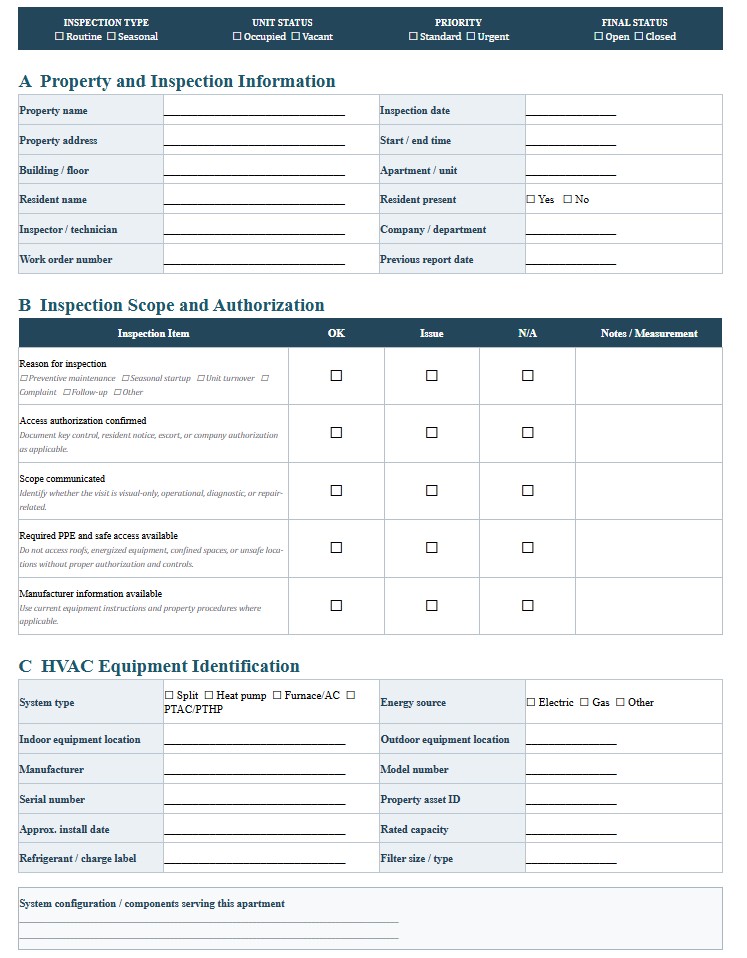
An Apartment HVAC Inspection Checklist is a practical record for evaluating heating, ventilation, and air-conditioning equipment serving an individual rental unit. Property managers, landlords, maintenance teams, apartment inspectors, and HVAC contractors can use the checklist during preventive maintenance, seasonal inspections, unit turnover, resident service calls, or due diligence reviews. A well-organized inspection record helps identify damaged components, restricted airflow, drainage problems, unusual operating conditions, safety concerns, and repairs that require follow-up. It also creates a traceable history for each apartment and its associated equipment. This page provides downloadable Word, PDF, and Excel versions of the Apartment HVAC Inspection Checklist, together with practical guidance for documenting equipment details, inspection findings, measurements, corrective actions, and technician approval. The template should be customized to match the HVAC system, property procedures, manufacturer instructions, and any applicable federal, state, county, city, licensing, housing, or workplace safety requirements.
Download the Apartment HVAC Inspection Checklist Word Template
The Word format is useful when you need to edit inspection categories, add property branding, revise equipment fields, include building-specific procedures, or adapt the checklist before printing, sharing, signing, or assigning it to maintenance personnel.

Download the Apartment HVAC Inspection Checklist PDF Template
The PDF format provides a consistent fixed layout that is convenient for printing, distributing to technicians, attaching to work orders, sharing with property owners, or archiving as part of an apartment maintenance record.
Download the Apartment HVAC Inspection Checklist Excel Template
The Excel format is useful for maintaining repeatable inspection rows, recording dates and measurements, filtering units by inspection status, tracking deficiencies, assigning corrective actions, monitoring completion dates, and creating an ongoing HVAC maintenance log for multiple apartments.
How to Complete and Use This Document
Begin by identifying the property and the apartment being inspected. Record the property name, street address, building number, apartment number, inspection date, inspection type, and the name of the person performing the inspection. Indicate whether the visit is part of routine preventive maintenance, a seasonal startup, a unit turnover, a resident complaint, a repair follow-up, or another property procedure. This information allows the completed checklist to be matched with work orders, lease records, service invoices, and earlier inspection reports.
Document the equipment serving the apartment as precisely as possible. Depending on the property, this may include a furnace, heat pump, packaged terminal air conditioner, mini-split system, fan coil, air handler, condensing unit, thermostat, exhaust fan, or components connected to a central building system. Enter the manufacturer, model number, serial number, equipment location, fuel or energy source, approximate installation date, refrigerant information when available, filter size, and any property asset identification number. Do not assume that every apartment has the same configuration, even when the units appear similar.
Inspect the thermostat and accessible controls for secure mounting, visible damage, legible settings, normal display operation, and an appropriate response when heating, cooling, or fan modes are selected. Record the temperature setting and observed room temperature when these measurements are relevant. A significant difference between the requested temperature and actual performance may justify further diagnostic testing, but the checklist alone should not be used to determine the technical cause.
Evaluate accessible indoor components for excessive dust, corrosion, water staining, loose panels, unusual vibration, abnormal noise, damaged insulation, obstructed airflow, and visible deterioration. Check the air filter for correct size, proper installation, cleanliness, and an appropriate fit within the filter compartment. Any replacement filter should be compatible with the equipment and the manufacturer’s specifications. Installing a filter with greater resistance than the system can accommodate may reduce airflow and affect performance.
Review supply registers, return grilles, and accessible ventilation openings for blockage, damage, contamination, or indications that residents or furniture are restricting airflow. Where the apartment has bathroom or kitchen exhaust equipment, verify its apparent operation and note unusual noise, weak airflow, missing covers, or accumulated debris. Do not represent a visual or operational check as a certified airflow test unless suitable instruments and procedures were used.
Inspect accessible condensate pans, drain lines, pumps, and nearby surfaces for leaks, standing water, biological growth, corrosion, blockage, or improper discharge. Water damage or suspected mold should be documented clearly and referred for appropriate evaluation. Replacing a filter or cleaning a grille does not correct an underlying moisture source. Photographs, moisture readings, work orders, and contractor reports may be attached when they support the finding.
For outdoor or exterior equipment, note damaged panels, debris accumulation, vegetation, restricted clearances, coil condition, unstable mounting, unusual sound, and visible deterioration of wiring or refrigerant lines. Roof-mounted, locked, elevated, concealed, or otherwise hazardous equipment should be inspected only by personnel authorized and equipped to access it safely.
Use the findings area to classify each item consistently, such as satisfactory, needs attention, not applicable, not inspected, or requires professional service. Describe deficiencies with specific observations rather than vague statements. For example, identify the location of a water stain, the type of noise heard, the condition of the filter, or the component that did not respond. Record any measurements, testing instruments, photographs, supporting documents, immediate actions, recommended repairs, responsible person, work-order number, target completion date, and final completion date.
Electrical panels, energized components, combustion equipment, gas connections, refrigerant circuits, sealed components, and internal mechanical assemblies should not be opened or serviced by an unqualified person. Property owners and employers should establish appropriate procedures for electrical safety, hazardous energy control, personal protective equipment, roof access, refrigerant handling, and contractor authorization. State or local rules may require particular HVAC, electrical, plumbing, or mechanical work to be performed by a licensed professional.
Before closing the inspection, review the checklist for blank fields, inconsistent ratings, missing measurements, unresolved safety concerns, and corrective actions without an assigned person or status. The inspector should sign and date the record, and a supervisor or property manager may add approval when required by company policy. Keep the completed checklist with related work orders, invoices, photographs, resident communications, warranties, and service reports according to the property’s recordkeeping procedure.
This template is an internal inspection and maintenance aid, not a substitute for manufacturer instructions, a code inspection, a licensed HVAC evaluation, or an official housing inspection form. Requirements can differ according to the property location, equipment type, housing program, employment setting, and local building or mechanical code. Owners and managers should verify current federal, state, county, city, program-specific, insurance, and company requirements before adopting the checklist as a formal procedure.