
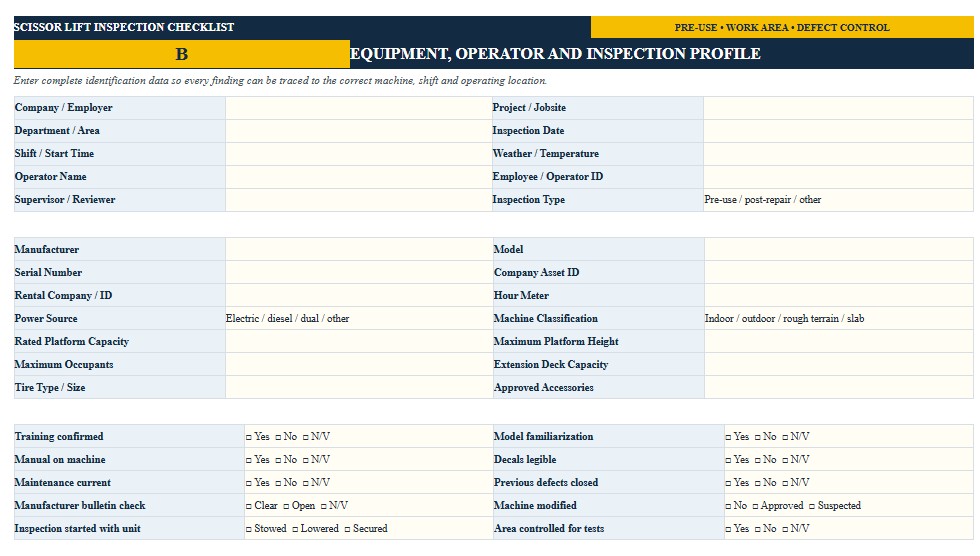
A Scissor Lift Inspection Checklist provides a structured method for documenting the condition of a mobile elevating work platform before it is operated. The template can be used by trained operators, equipment managers, rental companies, contractors, maintenance personnel, supervisors, and workplace safety teams to check identification data, structural components, guardrails, tires, hydraulic systems, batteries, controls, alarms, emergency functions, safety devices, and work-area hazards. A consistent inspection record can help identify damage, leaks, missing components, malfunctioning controls, unstable ground conditions, overhead obstructions, and other issues that may make the equipment unsafe to use. This page provides downloadable Word, PDF, and Excel versions of the Scissor Lift Inspection Checklist, together with practical guidance for completing, customizing, reviewing, and retaining the document. The checklist should always be adapted to the specific lift model, manufacturer instructions, employer safety program, jobsite conditions, and applicable federal, state, and local requirements.
Download the Scissor Lift Inspection Checklist Word Template
The Word format is useful when you want to edit the checklist freely before printing, sharing, signing, or adapting it to a particular scissor lift model, rental fleet, construction project, facility, inspection procedure, or company safety program. You can add branding, equipment-specific inspection points, internal approval fields, and maintenance instructions.

Download the Scissor Lift Inspection Checklist PDF Template
The PDF format is useful for printing, archiving, sharing, or using a consistent fixed-layout inspection form. It can be stored with equipment records, provided to operators, attached to service documentation, or retained as evidence that a pre-use inspection was completed.
Download the Scissor Lift Inspection Checklist Excel Template
The Excel format is useful for recording inspections across multiple units, dates, operators, shifts, jobsites, and service intervals. It can also support repeatable inspection rows, defect tracking, corrective-action deadlines, maintenance status, repair history, and summaries of equipment that is available, restricted, or removed from service.
How to Complete and Use This Document
Begin by recording the employer or company name, jobsite, department, inspection date, shift, operator, supervisor, and inspection purpose. Identify the scissor lift using the manufacturer, model, serial number, company asset number, rental identification number, power source, platform capacity, maximum platform height, and hour-meter reading when available. Accurate identification is important because inspection criteria, rated capacity, operating limits, warning systems, and maintenance procedures can differ between models.
Complete the checklist before operating the lift for the shift or at the inspection frequency established by the manufacturer and employer. Review the operator’s manual, warning labels, capacity information, maintenance status, and any previous defect or repair records. Confirm that the manual is available in the designated weather-resistant storage compartment when required by the manufacturer. Record missing, damaged, unreadable, or inconsistent labels rather than relying on memory or information from another machine.
Inspect the lift while it is lowered, parked on a suitable surface, and secured against unintended movement. Examine the chassis, frame, scissor arms, pivot points, welds, pins, retaining devices, platform structure, extension deck, entry gate or chain, guardrails, midrails, toe boards, and access steps. Look for cracks, bends, deformation, corrosion, loose hardware, missing fasteners, damaged welds, unauthorized modifications, and signs of impact. Do not use the checklist to determine whether structural damage is acceptable unless the person making that decision is qualified and has the applicable manufacturer or engineering criteria.
Check tires, wheels, casters, axles, wheel fasteners, steering components, brakes, stabilizers, outriggers, pothole-protection devices, and axle-oscillation systems when fitted. Record cuts, missing tread, embedded objects, excessive wear, loose fasteners, fluid contamination, or components that do not deploy correctly. Tire type and condition are especially important because replacing a tire or wheel with an unapproved component may affect stability.
Inspect hydraulic hoses, cylinders, fittings, valves, reservoirs, fuel systems, batteries, chargers, electrical cables, connectors, wiring, and covers. Note leaks, abrasion, cracked hoses, corrosion, exposed conductors, loose terminals, damaged insulation, low fluid levels, unusual odors, overheated components, or missing guards. Battery charging areas may require ventilation, ignition control, protective equipment, and procedures established by the employer and manufacturer.
Perform the required functional checks from the ground and platform control stations in accordance with the operator’s manual. Typical items include steering, drive, lift, lower, platform extension, brakes, emergency stop, emergency lowering, control enable devices, alarms, horns, indicators, tilt warning, load-sensing features, and other interlocks. Verify that controls are clearly marked and return to the intended position. Functional testing should take place in a controlled area clear of workers, vehicles, obstructions, drop-offs, and overhead hazards.
The checklist should also document the work-area inspection. Confirm that the travel route and operating location are firm, level, and capable of supporting the lift and intended load. Record holes, slopes, drop-offs, floor openings, soft ground, debris, unstable surfaces, ramps, curbs, overhead structures, energized electrical conductors, doors, traffic, moving equipment, and changing weather conditions. Outdoor use should remain within the manufacturer’s wind, slope, temperature, and environmental limits. Treat overhead electrical lines and similar conductors as energized unless an authorized party has confirmed otherwise, and verify the applicable clearance and protective procedures before work begins.
Review the platform load before operation. Include the weight of workers, tools, materials, accessories, and any extension-deck load. The total should not exceed the rated capacity or permitted load distribution. Guardrails, gates, chains, and access openings should be secure. Workers should remain on the platform floor and should not stand on rails, ladders, boxes, planks, or other devices to gain additional height. Personal fall protection requirements should be determined from applicable regulations, the manufacturer’s instructions, employer policy, and the specific work conditions rather than assumed to be identical for every lift and jobsite.
Mark each item as acceptable, defective, not applicable, or not verified, using definitions established by the employer. Describe every defect precisely and include its location, severity, immediate control, photograph reference, person notified, and recommended corrective action. A lift with a condition that may affect safe operation should be tagged or otherwise identified, removed from service, and protected against unauthorized use until it has been evaluated and repaired by an appropriately qualified person. Do not bypass alarms, interlocks, limit switches, guards, or safety devices to keep the machine operating.
The operator should sign and date the completed checklist, and a supervisor or designated equipment representative should review unresolved findings. Repair details should identify the technician, work completed, parts used, completion date, and person authorizing return to service. Retain inspection and repair records according to company policy and any applicable rental, manufacturer, insurance, contractual, federal, state, or local requirements. Consult the manufacturer, rental provider, qualified technician, safety professional, or applicable authority whenever equipment damage, inspection frequency, operator qualification, fall protection, electrical clearance, capacity, or regulatory coverage is uncertain.