
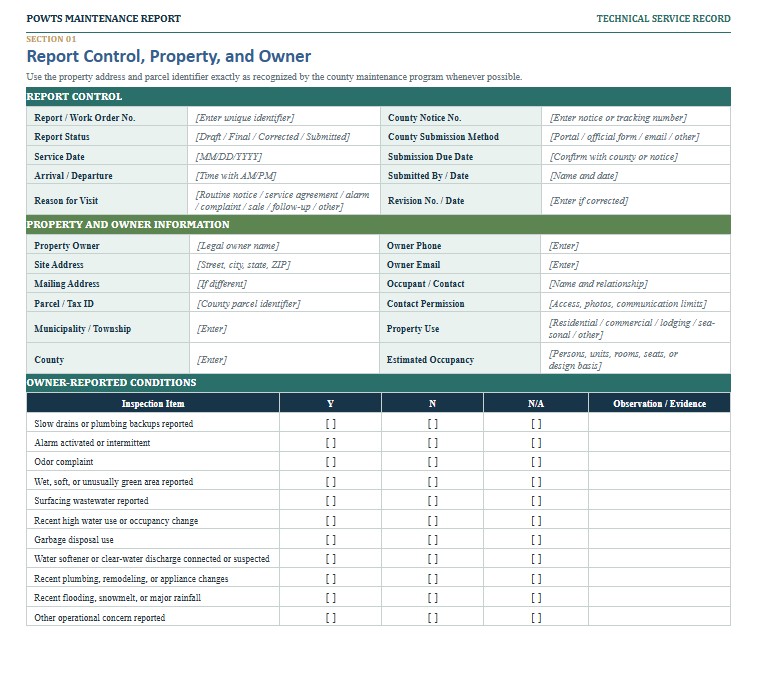
A POWTS maintenance report is used to document the inspection, servicing, condition, and corrective needs of a privately owned wastewater treatment system, commonly called a septic or onsite wastewater system. The term POWTS is used extensively in Wisconsin, where property owners, registered maintainers, septage servicing operators, plumbers, inspectors, and county officials may rely on maintenance records to track system performance and required service events. A well-prepared report identifies the property and system, records tank and component conditions, documents pumping or maintenance performed, notes evidence of malfunction, and provides recommendations for follow-up work. This page provides downloadable Word, PDF, and Excel versions of a POWTS maintenance report, together with practical guidance for completing and using the document. Because maintenance programs, reporting methods, service intervals, credential requirements, and submission procedures may differ by county and system type, users should compare the template with the current requirements of the applicable Wisconsin county or other local authority.
Download the POWTS Maintenance Report Word Template
The Word format is useful when a property owner, contractor, maintainer, inspector, or service company needs to edit the report freely before printing, sharing, signing, or adapting it to a particular county, company procedure, system design, or maintenance program.

Download the POWTS Maintenance Report PDF Template
The PDF format is useful for printing, archiving, sharing with a property owner or local authority, and maintaining a fixed-layout record of the inspection, findings, maintenance performed, and recommended corrective actions.
Download the POWTS Maintenance Report Excel Template
The Excel format is useful for service companies and property managers that need repeatable rows, maintenance histories, component inventories, measurements, service dates, pumping quantities, corrective-action tracking, status summaries, and future maintenance schedules.
How to Complete and Use This Document
Start by identifying the property and the POWTS accurately. Enter the property owner’s name, service address, mailing address when different, parcel number, sanitary permit number, county or municipality, and any local maintenance-program identification number. Record the service date, reason for the visit, previous service date if known, system use, estimated occupancy, and any recent complaints such as slow drains, sewage backup, unusual odors, alarms, wet areas, or surfacing wastewater.
Identify the System and Service Provider
Describe the system using available permits, plans, component manuals, installation records, and prior maintenance reports. Relevant information may include the system type, installation date, design flow, number and capacity of tanks, tank material, treatment unit, pump or dosing chamber, effluent filter, distribution method, control panel, alarm equipment, and dispersal component. Do not guess when system records are unavailable. Mark unknown information clearly and recommend that the owner or local authority locate the approved plan or sanitary permit file.
Enter the service company name, business address, telephone number, technician or operator name, applicable Wisconsin credential or registration number, and any separate septage servicing operator information. The person completing the report should work only within the scope of the credentials, training, and authorization required for the activity performed.
Document Inspection Findings and Measurements
Record how each accessible component was evaluated and whether it was satisfactory, deficient, inaccessible, not present, or not applicable. For septic or treatment tanks, note the liquid level, visible structural condition, covers, risers, baffles, tees, inlet and outlet condition, watertightness concerns, corrosion, leakage, and evidence that solids may have passed to downstream components. Where measurements are taken, record the total liquid depth, sludge depth, scum thickness, combined sludge and scum volume or percentage, and the measuring method.
Document the condition and servicing of the effluent filter. For pump or dosing systems, record observations relating to pumps, floats, switches, alarms, control panels, electrical connections, dose counters, elapsed-time meters, valves, siphons, and distribution equipment, as applicable. Any electrical testing or repair should be performed by a person qualified and authorized for that work.
Inspect the dispersal area from the surface and record evidence of ponding, seepage, wastewater breakout, erosion, settlement, vehicle traffic, soil compaction, improper vegetation, surface-water intrusion, damaged observation pipes, or other conditions that may affect performance. The report should distinguish observed facts from suspected causes or recommendations requiring further investigation.
Describe Maintenance and Corrective Actions
State whether the tank was pumped and, when appropriate, record the volume removed, pumping contractor, service vehicle or ticket reference, and authorized disposal or treatment destination. Document filter cleaning, pump servicing, component replacement, alarm testing, adjustment, cleaning, sampling, or other work completed. Attach photographs, pumping receipts, laboratory results, component readouts, repair invoices, or separate inspection sheets when they help establish traceability.
For every deficiency, explain the observed condition, its operational significance, any temporary measure taken, the recommended repair, the responsible party, and the suggested completion date. Conditions involving surfacing sewage, backups, damaged tanks, unsafe covers, failed alarms, uncontrolled discharge, or possible contamination should be communicated promptly to the owner and handled according to applicable local procedures.
Submit and Retain the Report Correctly
Review the completed report for missing identifiers, inconsistent measurements, unchecked components, and unsupported conclusions. The technician should sign and date the report, and the owner or representative may acknowledge receipt without being asked to certify technical findings outside that person’s knowledge.
Wisconsin counties administer POWTS maintenance tracking programs, but reporting procedures are not identical everywhere. Some counties require the service provider to submit maintenance information electronically, while others may prescribe a county form, portal, notice number, or specific reporting period. Before using this template, confirm the current county requirements, the applicable system management plan, manufacturer instructions, and any required service agreement. Keep copies with the property’s sanitary permit, approved plans, prior reports, pumping records, repairs, and component manuals. This template should supplement, not replace, an official county submission when a required form or electronic filing system applies.
Never enter a septic or treatment tank to complete a routine maintenance report. Tanks may contain toxic or oxygen-deficient atmospheres and present drowning, engulfment, collapse, electrical, and biological hazards. Confined-space entry, excavation, electrical work, and structural repair should be left to properly trained and equipped professionals. Consult the county zoning, sanitation, health, or land services department, a registered POWTS maintainer, licensed plumber, certified inspector, qualified engineer, or environmental professional when the system type, compliance status, failure condition, or required corrective procedure is uncertain.