
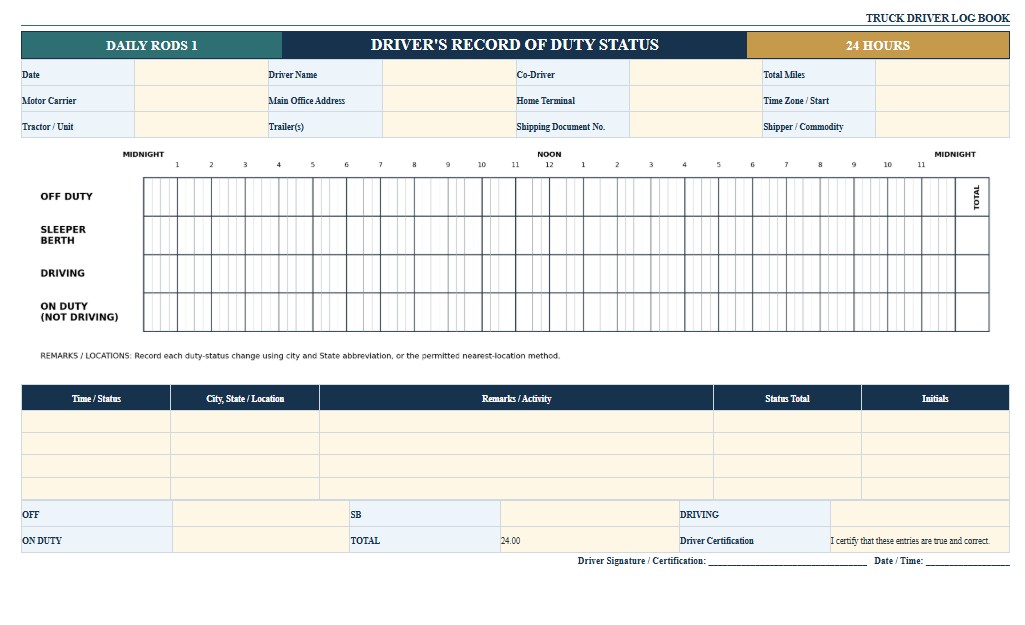
A truck driver log book is used to organize a commercial driver’s daily work, driving time, off-duty periods, sleeper-berth time, vehicle details, mileage, locations, shipment references, and supporting records. Drivers, owner-operators, motor carriers, dispatchers, fleet managers, and safety departments may use the template to document or review records of duty status and related operational information. A paper log book is appropriate only when paper records are permitted under the rules that apply to the driver and operation. It does not replace an electronic logging device when an ELD is required. This page provides downloadable Word, PDF, and Excel versions of a truck driver log book, together with practical guidance for completing the daily record, checking hours-of-service totals, recording status changes and locations, organizing supporting documents, correcting entries, certifying the record, and adapting the template to federal, state, and company-specific procedures.
Download the Truck Driver Log Book Word Template
The Word format is useful when a driver or motor carrier wants to edit the document freely, add company branding, adjust the instructions, duplicate daily pages, or adapt the log before printing, sharing, signing, or including it in a driver record packet.

Download the Truck Driver Log Book PDF Template
The PDF format is useful for printing blank log pages, archiving completed records, sharing a fixed-layout form, or maintaining a consistent daily document with a duty-status grid, remarks area, vehicle details, mileage, shipping references, and driver certification.
Download the Truck Driver Log Book Excel Template
The Excel format is useful for repeatable daily records, 15-minute duty-status intervals, mileage, driving and on-duty totals, seven-day and eight-day recap calculations, supporting-document registers, vehicle lists, short-haul records, ELD malfunction tracking, and carrier review.
How to Complete and Use This Document
Before completing the log, determine which recordkeeping method applies. Drivers operating under a qualifying short-haul exception may use carrier time records instead of a traditional record of duty status. Other limited ELD exceptions can apply to drivers who are required to keep paper RODS no more than eight days during a rolling 30-day period, qualifying driveaway-towaway operations, and vehicles manufactured before model year 2000. A paper template does not create an exception, so the carrier should document why paper records are authorized.
Enter the Driver, Carrier, and Vehicle Information
Complete the date, driver’s name, co-driver when applicable, motor carrier name, main office address, home terminal address, tractor or unit number, trailer numbers, total mileage, and shipping-document or shipper and commodity information. Use the same identifiers shown in dispatch records, bills of lading, fuel receipts, toll records, vehicle records, and carrier systems.
Identify the home-terminal time zone and use that time standard consistently throughout the 24-hour record. Each daily RODS should remain current and show every change in duty status. For each change, record the applicable city and state or another location description permitted by the current rule.
Complete the Duty-Status Grid
A conventional property-carrying log separates time into off duty, sleeper berth, driving, and on duty not driving. Draw or enter a continuous line for each status, changing lines at the exact time the status changes. Activities such as inspections, fueling, loading, unloading, cargo securement, paperwork, and vehicle repairs should be recorded under the appropriate working status rather than automatically treated as off-duty time.
Total the hours on each status line at the end of the day. The combined total must equal 24 hours. In the remarks section, explain significant activities and identify the corresponding time and location. Additional remarks can document delays, breakdowns, inspections, adverse conditions, sleeper-berth periods, border activity, or other events needed to understand the record.
Review the Applicable Hours-of-Service Limits
For property-carrying operations under the standard federal limits, a driver may generally drive up to 11 hours after 10 consecutive hours off duty and may not drive beyond the 14th consecutive hour after coming on duty. A 30-minute non-driving interruption is generally required after eight cumulative hours of driving without a qualifying interruption. Drivers must also monitor the applicable 60-hour or 70-hour limit over seven or eight consecutive days. Passenger-carrying operations use different driving, off-duty, and on-duty limits.
Do not apply the standard property-carrying limits to every operation. Sleeper-berth pairing, adverse driving conditions, intrastate transportation, passenger service, oilfield work, agriculture, emergency operations, and other specialized activities may involve different calculations, exceptions, or state requirements. Customize the template only after confirming which provisions apply.
Organize Supporting Documents
Use the document register to reference bills of lading, itineraries, schedules, dispatch or trip records, expense receipts, electronic communications, payroll records, settlement sheets, fuel receipts, toll records, and similar evidence. These records should agree with the times, locations, mileage, and activities shown in the log. Federal supporting-document rules identify several of these categories, and drivers generally must submit applicable records to the motor carrier within the required period.
Certify, Correct, and Retain the Record
Review the completed record for missing locations, unexplained gaps, incorrect totals, conflicting mileage, or inconsistencies with supporting documents. The driver should certify that the record is true and correct using the procedure required for the applicable paper or electronic system.
Corrections should preserve the original information and clearly identify the revised entry, reason, date, and person requesting the change. For ELD records, the driver must review, correct or annotate inaccurate information, and certify the record. Carrier-proposed edits require the driver’s review under the applicable process.
Motor carriers generally retain RODS and supporting documents for six months from receipt, but company procedures, litigation holds, state rules, contracts, tax records, or other obligations may justify longer retention. Consult a qualified transportation safety professional or attorney when the operation involves uncertain ELD applicability, repeated malfunctions, enforcement action, out-of-service issues, cross-border transportation, conflicting records, or an unfamiliar federal or state exception.