
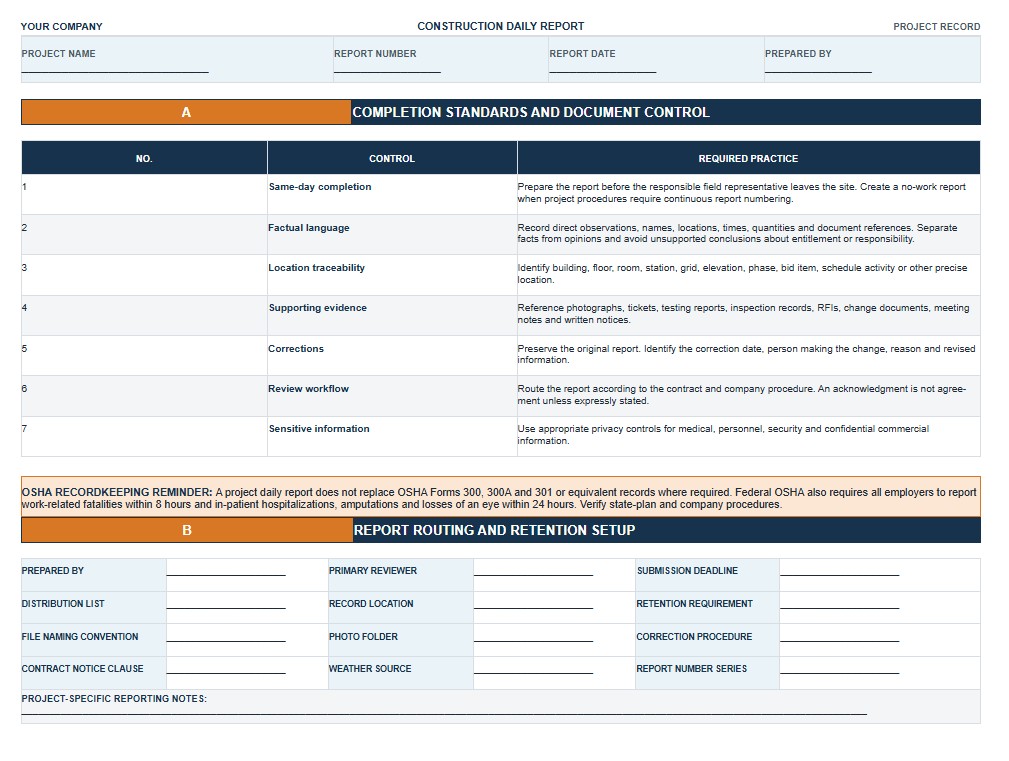
A Construction Daily Report Template provides a consistent record of the labor, equipment, materials, weather, work activities, inspections, safety events, delays, visitors, instructions, and site conditions observed during a construction workday. It is commonly completed by a superintendent, project manager, field engineer, inspector, foreman, construction manager, or contractor representative. Accurate daily reports help project teams monitor progress, confirm who was on site, support payment and schedule records, identify developing problems, and preserve contemporaneous evidence for change orders, claims, disputes, and warranty matters. This page provides downloadable Word, PDF, and Excel versions of the Construction Daily Report Template, together with practical guidance for completing and using the document. The template can be customized for residential, commercial, civil, public works, renovation, and specialty construction projects, but users should always compare it with the applicable contract documents, company procedures, owner requirements, and federal, state, or local reporting obligations.
Download the Construction Daily Report Word Template
The Word format is useful when you want to edit the report freely before printing, sharing, signing, or adapting it to a particular project. You can add company branding, contract-specific fields, custom work categories, approval sections, distribution details, and additional space for daily narratives.

Download the Construction Daily Report PDF Template
The PDF format is useful for printing, archiving, sharing, or using a fixed-layout version of the report. It helps maintain consistent formatting when daily records are distributed to the owner, general contractor, construction manager, inspector, architect, engineer, or project file.
Download the Construction Daily Report Excel Template
The Excel format is useful when the report contains repeatable rows for workers, subcontractors, equipment, production quantities, deliveries, inspections, delays, visitors, safety observations, and corrective actions. It can also support automatic totals, historical logs, schedule comparisons, and reporting across multiple projects or work locations.
How to Complete and Use This Document
Complete the report on the same day the work is performed, preferably before the superintendent, inspector, or responsible field representative leaves the site. Begin with the project name, project number, contract number when applicable, property address, report number, date, day of the week, shift, reporting period, and name of the person preparing the record. Use consecutive report numbers so missing days can be identified. When no work occurs, consider preparing a brief non-work-day report that explains the reason, such as weather, a scheduled shutdown, permit restrictions, or lack of access.
Record weather and site conditions with enough detail to explain their effect on operations. Include temperature range, precipitation, wind, ground conditions, and unusual events such as flooding, extreme heat, snow, or poor visibility. Do not simply state that weather caused a delay. Describe which activity was affected, when the impact began, how long it lasted, the location involved, and whether alternative work was available.
Document each contractor and subcontractor present, the trade or labor classification, headcount, shift hours, overtime, and work location. Labor totals should be internally consistent and should not be used as a substitute for certified payroll, timekeeping, prevailing-wage, or employment records when those documents are required. Identify supervisors, foremen, inspectors, owner representatives, design professionals, utility personnel, and important visitors who entered the site.
Describe work performed using objective, location-specific language. Identify the building, floor, room, station, area, elevation, phase, bid item, or schedule activity. Include quantities installed or completed when they can be reasonably verified. Statements such as “continued concrete work” provide limited value. A stronger entry identifies the placement location, quantity, start and finish times, crew involved, equipment used, tests performed, and any condition that affected production.
List major equipment used during the day, including identifying numbers when available, operating hours, idle hours, breakdowns, and the work supported. Equipment downtime should identify the cause and its effect on production. Record important materials received, including supplier, delivery ticket, quantity, condition, storage location, and whether the delivery was accepted, rejected, quarantined, or awaiting inspection. Attach delivery receipts, photographs, test certificates, and other supporting records when appropriate.
Use the safety section to record toolbox talks, inspections, observed hazards, corrective actions, near misses, injuries, property damage, environmental releases, and unsafe operations. The daily report should state who was notified and what immediate control was applied. It should not replace separate accident investigations, OSHA injury and illness records, emergency notifications, workers’ compensation forms, environmental reports, or other required records. Confirm applicable employer, contract, federal, state, and local procedures whenever an incident occurs.
Record quality-control activities, testing, inspections, rejected work, deficiencies, completed corrections, and approvals. Include the responsible inspector or testing agency, test or report number, location, result, and required follow-up. When work is covered before testing or inspection, document the circumstances and the direction received from the responsible party.
Describe delays and disruptions precisely. Identify the affected operation, cause, responsible or related party when known, start and finish time, workers and equipment affected, schedule activity, mitigation attempted, and any written notice issued. Avoid unsupported conclusions about entitlement, liability, compensation, or responsibility. The daily report should preserve facts, while formal notices and contractual claims should follow the procedures and deadlines stated in the contract.
Document verbal instructions, field directives, requests for information, design clarifications, change discussions, owner requests, and potential extra work. State who gave the instruction, who received it, the time, the exact subject, and any resulting action. Do not treat the daily report as automatic authorization for changed work or additional payment unless the contract permits that process. Cross-reference the applicable change order, directive, request for information, email, meeting record, or notice.
Review the completed report for missing totals, inconsistent dates, vague descriptions, and unsupported statements. Attach labeled photographs and identify the date, location, direction of view, and related report item. The preparer should sign and date the report, and the superintendent, project manager, inspector, or owner representative may review or acknowledge it according to the project workflow. An acknowledgment should not be described as agreement unless that is expressly intended.
Retain daily reports in a controlled project file with photographs, correspondence, schedules, testing records, delivery tickets, inspection reports, and change documentation. Do not alter an approved report without preserving the original entry, the correction date, the person making the change, and the reason. Record-retention periods and submission procedures may be established by the contract, company policy, insurer, public agency, funding source, or state law. Consult the project manager, construction attorney, accountant, safety professional, or applicable public authority when reporting requirements, payment support, claims, public works documentation, incident reporting, or retention obligations are uncertain.