
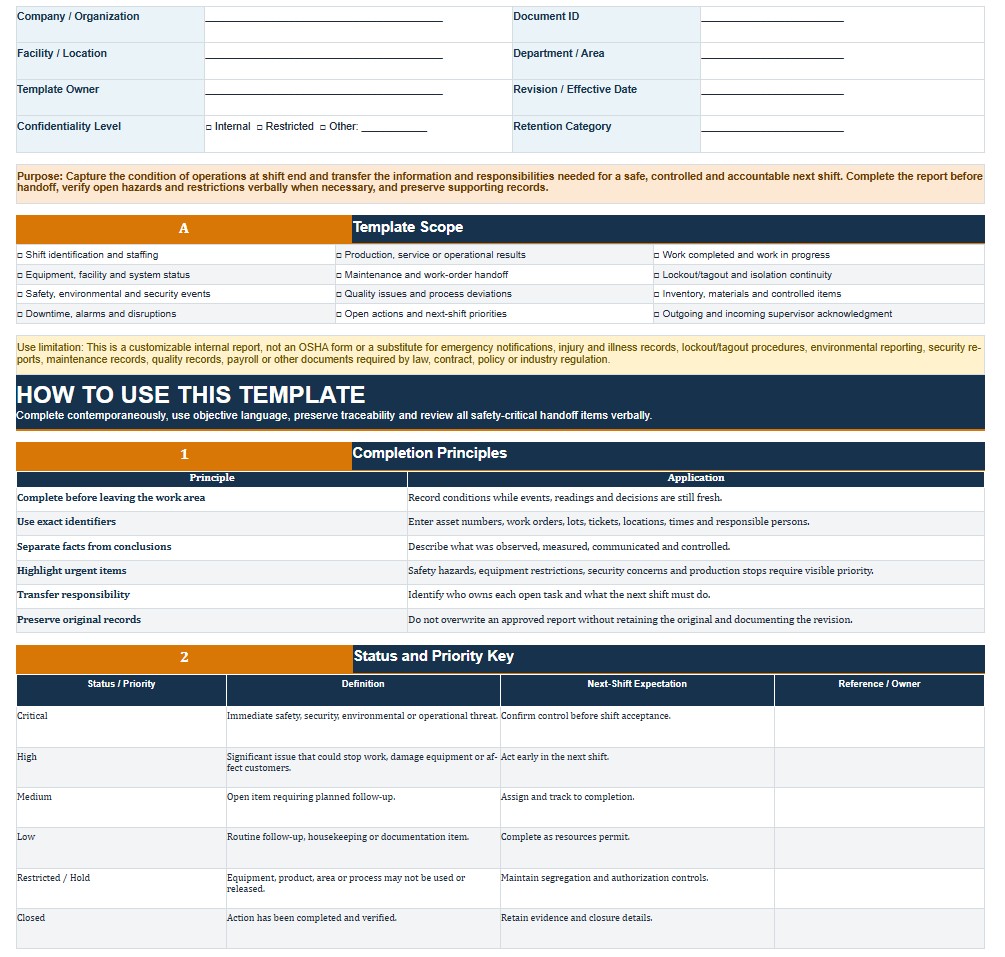
An End of Shift Report Template provides a structured record of work completed, operating conditions, staffing, production results, equipment status, safety events, quality concerns, unresolved issues, and responsibilities transferred to the next shift. It can be used by supervisors, team leaders, plant operators, warehouse managers, construction foremen, security personnel, facility managers, maintenance departments, and other organizations that depend on accurate shift-to-shift communication. A consistent report helps reduce missed tasks, clarify accountability, preserve operational history, and alert incoming personnel to hazards, equipment restrictions, shortages, customer issues, or priority work. This page provides downloadable Word, PDF, and Excel versions of the End of Shift Report Template, together with practical guidance for completing, reviewing, customizing, and retaining the document. The form should be adapted to the employer’s operations, internal approval process, safety program, confidentiality rules, and any applicable federal, state, local, contractual, or industry-specific requirements.
Download the End of Shift Report Word Template
The Word format is useful when you want to edit the report freely before printing, sharing, signing, or adapting it to a particular department, facility, production line, project, security post, warehouse, maintenance team, or customer-service operation. You can add company branding, custom performance indicators, approval fields, and industry-specific handoff instructions.

Download the End of Shift Report PDF Template
The PDF format is useful for printing, archiving, sharing, or using a consistent fixed-layout version of the report. It can be completed at a workstation, stored with operational records, or provided to the incoming supervisor as part of a formal shift handoff.
Download the End of Shift Report Excel Template
The Excel format is useful when the report contains repeatable rows, production quantities, staffing totals, equipment readings, downtime, inventory balances, quality results, open actions, dates, schedules, or performance measurements. It can also support automatic calculations and historical reporting across multiple shifts, teams, departments, or locations.
How to Complete and Use This Document
Complete the report near the end of the shift while events, readings, decisions, and work conditions are still fresh. Begin with the company or organization name, facility, department, work area, report date, shift name, scheduled start and end times, actual handoff time, outgoing supervisor, incoming supervisor, and report number. Consecutive report numbers or another controlled identification system can help users locate missing records and connect related events across several shifts.
Record staffing information accurately. Include the number of employees scheduled, the number present, absences, late arrivals, early departures, temporary workers, contractors, and overtime when relevant to operations. Identify important position gaps or qualification limitations that the incoming shift must address. The shift report should not replace payroll, timekeeping, staffing, union, or certified labor records when separate documentation is required.
Describe completed work using specific, objective language. Identify the production line, machine, customer order, warehouse zone, building area, service ticket, project activity, security post, or maintenance work order involved. Include planned and actual quantities, completed tasks, partially completed work, rejected units, backlog, downtime, and unusual operating conditions when applicable. Avoid vague entries such as “normal operations” when the next shift needs measurable information.
Document equipment and facility status before turnover. Record operating, idle, restricted, locked-out, under-repair, or out-of-service conditions. Include asset numbers, meter readings, alarms, fault codes, fluid levels, temporary repairs, maintenance requests, isolation points, and any limits placed on operation. State who was notified and whether a qualified person authorized continued or restricted use. The report should not be used to bypass lockout procedures, maintenance requirements, manufacturer instructions, or formal return-to-service approval.
Use the safety section to identify hazards, near misses, injuries, illnesses, spills, security concerns, damaged safeguards, housekeeping issues, and corrective actions. Enter the exact time, location, persons notified, immediate controls, and current status. An end of shift report is not a substitute for emergency notifications, OSHA injury and illness records, incident investigations, environmental reports, workers’ compensation documents, security reports, or other forms required by the employer or government agency. Verify the applicable federal OSHA, state-plan, state, county, city, and company procedures when a reportable event may have occurred.
Record quality inspections, testing results, rejected products, customer complaints, process deviations, hold items, sampling records, and corrective actions. Include the specification, order, batch, lot, ticket, inspection, or nonconformance reference when available. Clearly identify material or work that must remain segregated, quarantined, stopped, or subject to additional inspection during the next shift.
Document materials, inventory, tools, keys, radios, vehicles, controlled items, and supplies that require accountability. Include quantities received, used, transferred, damaged, missing, or awaiting replenishment. Where sensitive materials, hazardous chemicals, medications, confidential records, cash, or security credentials are involved, customize the form to match the organization’s custody, privacy, access-control, and reconciliation procedures.
The handoff section should identify every incomplete task and open issue. For each item, record its priority, exact location, current status, responsible person, due time, required next action, and related work-order or ticket number. Separate urgent safety or operational concerns from routine follow-up. Verbal handoff should be used when immediate clarification is necessary, but important information should also be recorded in writing.
Before submitting the report, compare entries with production systems, work orders, maintenance logs, inventory records, quality reports, incident documentation, and supervisor notes. Correct inconsistent times, totals, asset numbers, and status descriptions. Do not delete or overwrite an approved report without preserving the original entry, revision date, reason for the change, and identity of the person making the revision.
The outgoing supervisor should sign and date the report. The incoming supervisor may acknowledge receipt and document questions, rejected assumptions, or additional actions. An acknowledgment normally confirms receipt of the information and should not be described as agreement unless the organization intends that meaning. Retain completed reports according to company policy, contractual requirements, insurer instructions, applicable labor agreements, privacy rules, and federal or state recordkeeping obligations. Consult a safety professional, compliance officer, HR representative, operations manager, attorney, or appropriate public authority when incident reporting, employee information, confidential data, regulated operations, or retention requirements are uncertain.