
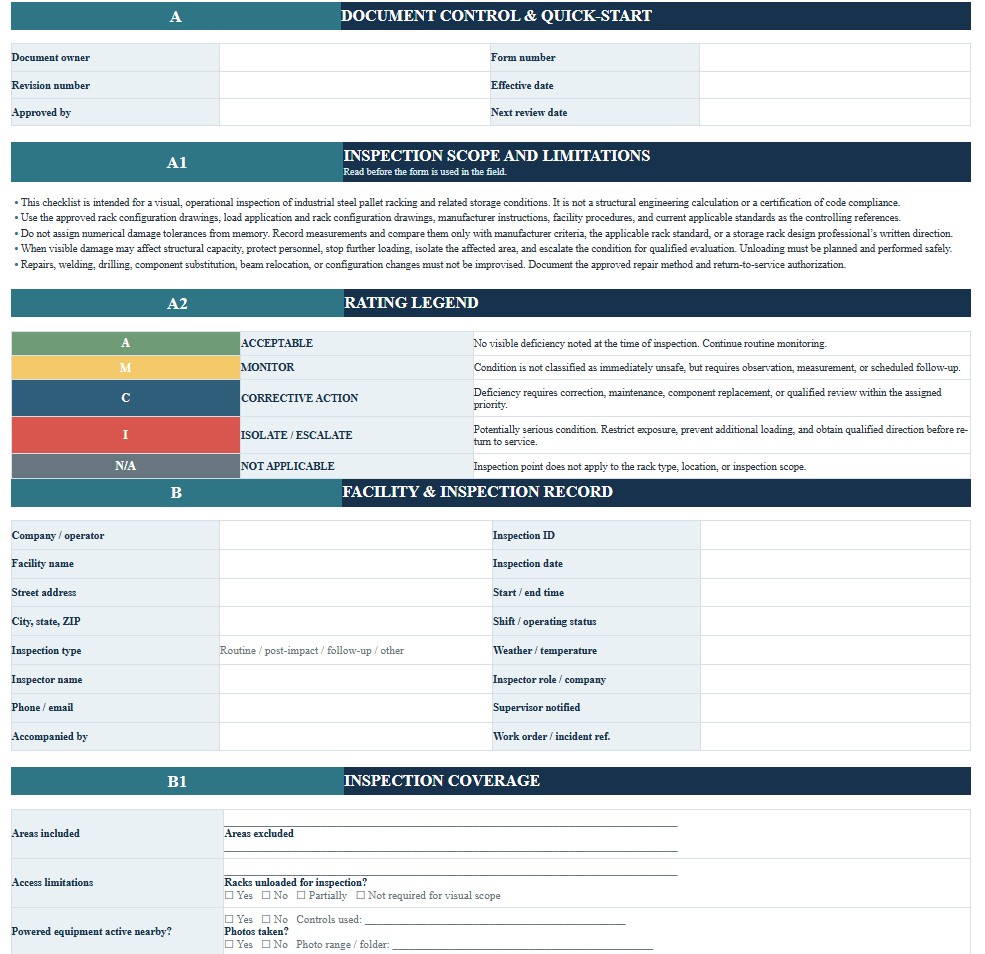
A Pallet Racking Inspection Checklist helps warehouses, distribution centers, manufacturing facilities, retail stockrooms, and other workplaces document the condition and safe use of industrial storage racks. The template can be used by warehouse managers, safety personnel, maintenance teams, supervisors, qualified inspectors, and rack professionals to identify visible damage, missing components, improper loading, unstable pallets, blocked aisles, and other conditions that may contribute to falling materials or rack collapse. It also creates a traceable record of findings, immediate controls, repairs, and follow-up inspections. This page provides downloadable Word, PDF, and Excel versions of the Pallet Racking Inspection Checklist, together with practical guidance for completing and using the document. The checklist should be adapted to the rack manufacturer’s instructions, approved rack configuration, facility procedures, applicable fire protection requirements, and current federal, state, and local workplace safety rules.
Download the Pallet Racking Inspection Checklist Word Template
The Word format is useful when you want to edit the checklist freely before printing, sharing, signing, or adapting it to a particular warehouse, rack system, inspection program, or company procedure. You can add facility branding, rack identification fields, custom inspection criteria, approval sections, and internal corrective-action requirements.

Download the Pallet Racking Inspection Checklist PDF Template
The PDF format is useful for printing, archiving, sharing, or using a fixed-layout version of the inspection document. It helps maintain consistent formatting when the checklist is distributed to supervisors, maintenance personnel, contractors, safety representatives, or facility records departments.
Download the Pallet Racking Inspection Checklist Excel Template
The Excel format is useful for inspecting multiple rack rows, bays, uprights, and beam levels using repeatable rows. It can also support status tracking, inspection dates, defect classifications, responsible persons, corrective-action deadlines, repair records, and summaries of open or recurring rack safety issues.
How to Complete and Use This Document
Begin by identifying the facility, inspection area, inspection date, shift, inspector, and reason for the inspection. Record a unique rack location using the facility’s normal identification system, such as building, zone, aisle, row, bay, and elevation. Where available, note the rack manufacturer, rack type, installation date, drawing number, approved configuration, and applicable load information. Consistent identification is essential because a defect report must lead maintenance personnel back to the exact component that was inspected.
Review the rack load plaques or capacity signs before examining individual components. Confirm that the signs are present, legible, and consistent with the current beam elevations, number of storage levels, pallet positions, and intended loads. Record the maximum unit load and beam-level capacity when known. Do not estimate rack capacity from appearance or from another rack system. Missing drawings, uncertain capacity, undocumented modifications, or a configuration that differs from the approved design should be referred to the rack manufacturer or a qualified storage rack design professional.
Inspect uprights for dents, bends, twists, tears, cracked welds, corrosion, and impact damage, especially near floor level where forklifts commonly contact the rack. Examine horizontal and diagonal bracing, column connectors, splices, base plates, floor anchors, row spacers, frame ties, and protective guards. Note missing, loose, damaged, or displaced components. Check whether frames appear out of plumb or out of alignment, but avoid declaring compliance with a numerical tolerance unless the measurement is made using the correct procedure and evaluated against the applicable rack design standard or manufacturer’s criteria.
Inspect beams for permanent deflection, dents, twists, cracks, damaged end connectors, incomplete engagement, and missing safety locks or retaining devices. Review pallet supports, wire decking, shelf panels, stops, back-to-back ties, and accessories for improper installation, overloading, displacement, or damage. Storage rack decking should be used only for the load type and distribution for which it was designed. Employees should not walk or stand on rack decking unless the system was specifically engineered and approved for that purpose.
Evaluate how materials are stored. Pallets should be suitable for the load, positioned correctly on the supporting beams, and free from severe damage that could cause instability. Record leaning, crushed, broken, or poorly wrapped loads, excessive pallet overhang, unstable stacking, and products extending into aisles or adjacent storage spaces. Verify that stored materials do not exceed posted capacities and that loads are stable and secure against sliding or collapse. Also check aisle clearances, passageways, emergency routes, housekeeping, lighting, and visibility around rack ends and intersections.
Fire protection conditions should be included when relevant to the facility. Observe whether stored materials obstruct sprinklers or interfere with required longitudinal or transverse flue spaces. Confirm that storage height, commodity type, rack arrangement, and sprinkler clearances remain consistent with the facility’s approved fire protection design. These requirements can vary according to the building, commodity, sprinkler system, fire code, insurer, and local authority having jurisdiction. Questions about sprinkler protection should be referred to a qualified fire protection professional or the appropriate local authority.
Classify every finding according to the company’s documented risk system. The form may use categories such as acceptable, monitor, repair required, or immediate action required, but each category should have a clear internal definition. When visible damage may affect structural capacity or create an immediate struck-by or collapse hazard, protect employees from the area, prevent further loading, and unload the affected portion when this can be done safely. Structural repairs, component substitutions, welding, drilling, or configuration changes should not be improvised. They should be evaluated and completed under the direction of the manufacturer or a qualified rack professional.
For each defect, describe the exact location, component, type of damage, severity, immediate control, recommended corrective action, responsible person, target date, and completion date. Attach photographs, measurements, repair proposals, manufacturer instructions, engineering evaluations, and invoices when available. After corrective work, document who verified the repair and whether the affected rack was approved for return to service.
The inspector should sign and date the completed checklist, and a supervisor or safety representative should review unresolved findings. Retain inspection records according to company policy so recurring impacts, delayed repairs, and problem areas can be identified over time. Inspection frequency should reflect rack use, forklift traffic, prior damage, manufacturer guidance, facility risk, and applicable requirements. OSHA rules require materials to be stored securely and aisles to remain safe, but company procedures, state-plan rules, consensus standards, fire codes, and local requirements may impose additional expectations. Consult a qualified rack engineer, manufacturer, safety professional, or fire protection specialist whenever damage severity, capacity, repair design, or regulatory applicability is uncertain.