
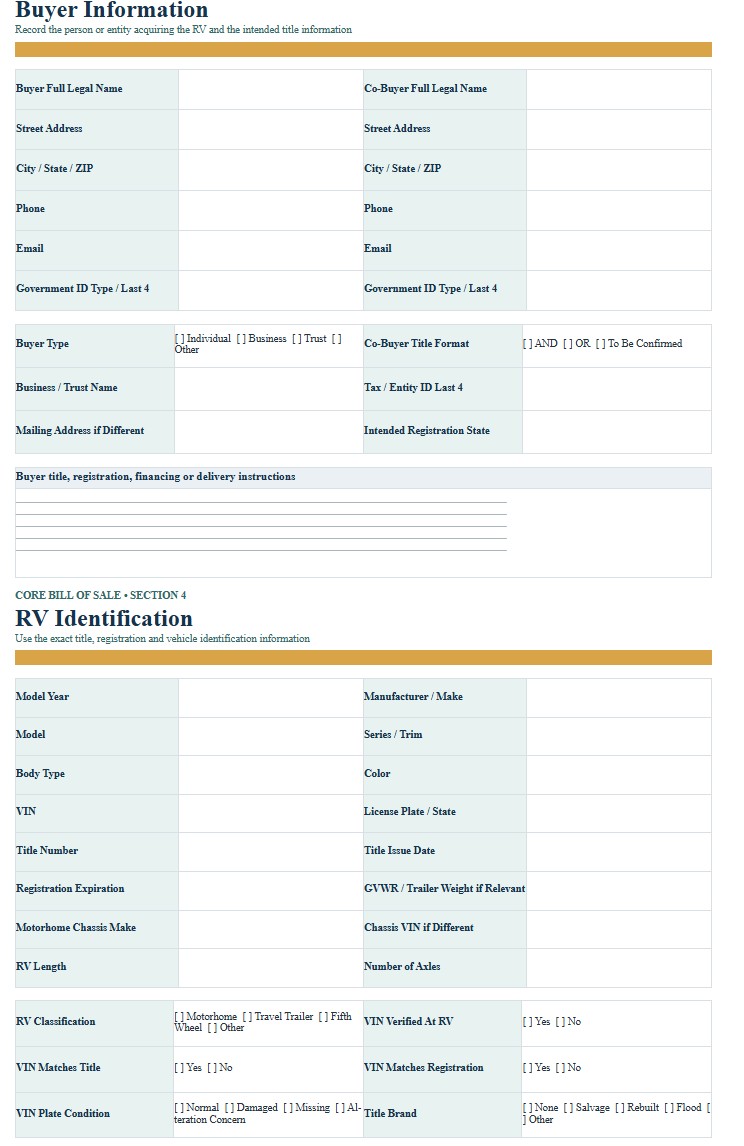
An RV Bill of Sale Template is used to document the private sale, purchase, gift, or other transfer of a motorhome, travel trailer, fifth wheel, camper van, truck camper, toy hauler, or similar recreational vehicle. The document creates a written record of the parties, vehicle identification, purchase price, payment terms, condition, included equipment, and transfer date. It can support title and registration processing, tax reporting, insurance changes, lien verification, and recordkeeping, but it does not automatically replace a properly assigned certificate of title or any state-required transfer form. This page provides downloadable Word and PDF versions of the RV Bill of Sale Template, together with practical guidance for completing and using the document. The editable Word version is suitable for customized transactions, while the fixed-layout PDF version is convenient for printing, signing, sharing, and retaining with the title, registration, payment records, inspection documents, and maintenance history.
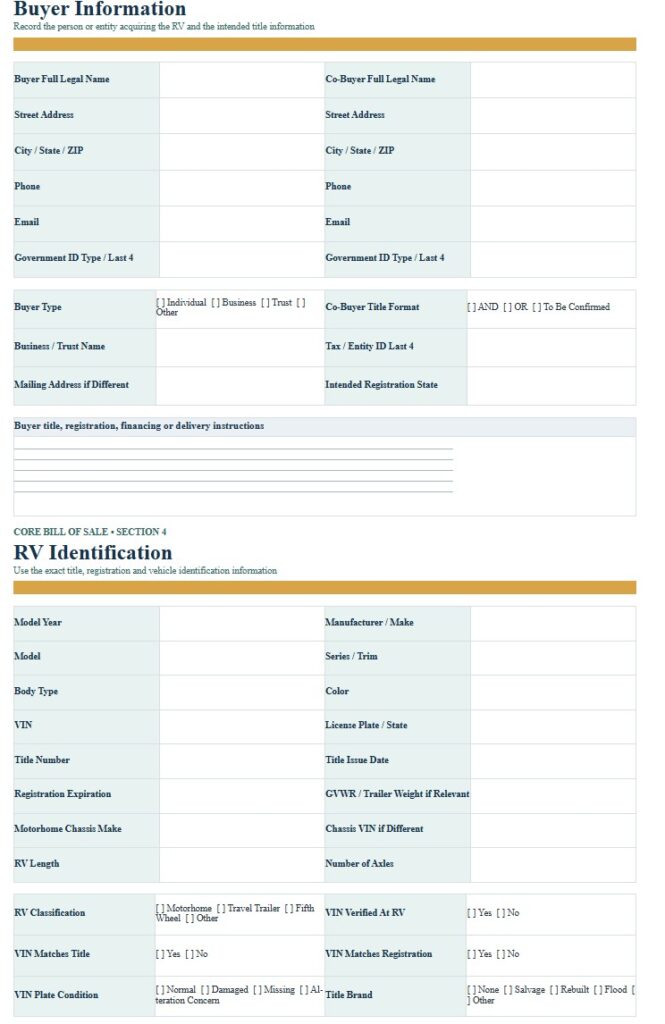
Download the RV Bill of Sale Word Template
The Word format is useful when the buyer and seller want to edit the document freely before printing, sharing, signing, or adapting it to a motorhome, towable RV, financed sale, installment arrangement, trade-in, gift, or transaction involving additional equipment and special conditions.

Download the RV Bill of Sale PDF Template
The PDF format is useful for printing, signing, archiving, sharing, or keeping a fixed-layout transaction record with the assigned title, registration documents, lien release, payment receipt, inspection report, warranty records, and state motor vehicle forms.
How to Complete and Use This Document
Begin by entering the full legal names, addresses, telephone numbers, and email addresses of the seller and buyer. The seller’s name should match the name shown on the certificate of title or other valid ownership document. When there is more than one titled owner, review how the names are joined on the title and determine whether every owner must sign. A person who is not the titled owner should not sign as the seller unless legally authorized through a valid power of attorney, business authorization, estate document, court order, or other acceptable authority.
Describe the recreational vehicle precisely. Include the model year, manufacturer, make, model, body type, color, vehicle identification number, license plate, title number, state of title, and registration expiration date when available. Identify whether the RV is a motorhome or a towable unit such as a travel trailer or fifth wheel. Some states apply different title, registration, tax, inspection, and ownership-document rules to motorized RVs and trailers. Trailer requirements may also vary according to weight, age, construction, or prior registration history.
Compare the VIN on the document with the VIN displayed on the RV and the number printed on the title. Do not complete the transaction when the numbers are missing, altered, inconsistent, or difficult to verify. The buyer should also confirm that the seller is the person or entity entitled to transfer ownership and should review the title for brands such as salvage, rebuilt, flood, junk, lemon-law buyback, or other disclosures.
For a motorized RV, record the odometer reading on the transfer date and indicate whether the mileage is actual, exceeds the mechanical limits, or is not the actual mileage. Federal and state odometer-disclosure requirements may apply according to the vehicle’s model year and classification. A bill of sale may not satisfy a requirement for a secure odometer statement on the title or an official reassignment form. A towable RV normally does not have an odometer, so mark that section as not applicable rather than entering an estimated figure.
Enter the sale date, delivery date, total purchase price, deposit, remaining balance, payment method, and payment deadline. State whether payment is being made in cash, by certified funds, through financing, by electronic transfer, through an installment plan, or partly through a trade. Do not describe the price as fully paid unless the seller has actually received the agreed funds. For installment transactions, identify the payment schedule, late-payment consequences, possession arrangements, title-holding terms, insurance responsibility, default procedure, and any security interest. Because financed private sales can create significant legal and lien issues, the parties should consider using an attorney and state-compliant financing documents.
Address existing liens before signing. Record the lienholder, payoff amount, payoff procedure, and expected lien-release documentation. The seller should not represent the RV as free of liens when a recorded security interest remains. The buyer should avoid relying only on a verbal promise that a loan will be paid later. When the title is electronic or held by a lender, contact the appropriate state motor vehicle agency and lienholder before completing the transaction.
Describe the RV’s condition and the items included in the sale. Identify installed appliances, generator, solar equipment, batteries, awnings, towing equipment, leveling systems, furniture, accessories, keys, remotes, manuals, maintenance records, covers, hoses, adapters, and other property. If an item is excluded, state that clearly. Attach a separate inventory, inspection report, photograph list, repair estimate, or equipment schedule when the transaction involves extensive accessories.
Select the appropriate warranty language. An “as-is” provision generally states that the buyer accepts the RV in its present condition without warranties from the seller, except for any written promises or warranties that cannot legally be disclaimed. Do not use an as-is clause to conceal fraud, misrepresent known facts, or contradict a warranty made elsewhere in the transaction. If the seller promises to repair a system, deliver a missing title, replace a component, or provide a limited warranty, put the exact obligation, deadline, cost responsibility, and remedy in writing.
State when possession, keys, risk of loss, insurance responsibility, registration responsibility, taxes, title fees, and transportation costs transfer to the buyer. The parties should not assume that signing the bill of sale alone completes the official ownership transfer. The seller may need to sign and deliver the title, remove or surrender plates, file a notice of sale or release of liability, and provide a lien release. The buyer may need to submit a title application, proof of insurance, identification, tax documentation, inspection records, and fees within a state-specific period.
Both parties should review every entry before signing. Use permanent ink for a printed document, avoid unexplained alterations, and have both parties initial any necessary correction. Signatures should be dated, and each party should receive a complete copy with all attachments. Notarization is not universally required, but certain states, title situations, transactions, or official forms may require a notary public or additional witnesses.
Check the current requirements of the buyer’s and seller’s state motor vehicle agencies before using the template. Rules can differ for motorhomes, trailers, gifts, inherited RVs, dealer sales, out-of-state titles, homemade or reconstructed units, missing titles, branded vehicles, business-owned RVs, trusts, estates, and financed transactions. Consult an attorney, tax professional, licensed dealer, lender, insurer, or state motor vehicle office when ownership is disputed, a lien is unresolved, the title is unavailable, the VIN is questionable, payment will occur over time, or the transaction includes unusual warranties or conditions.