
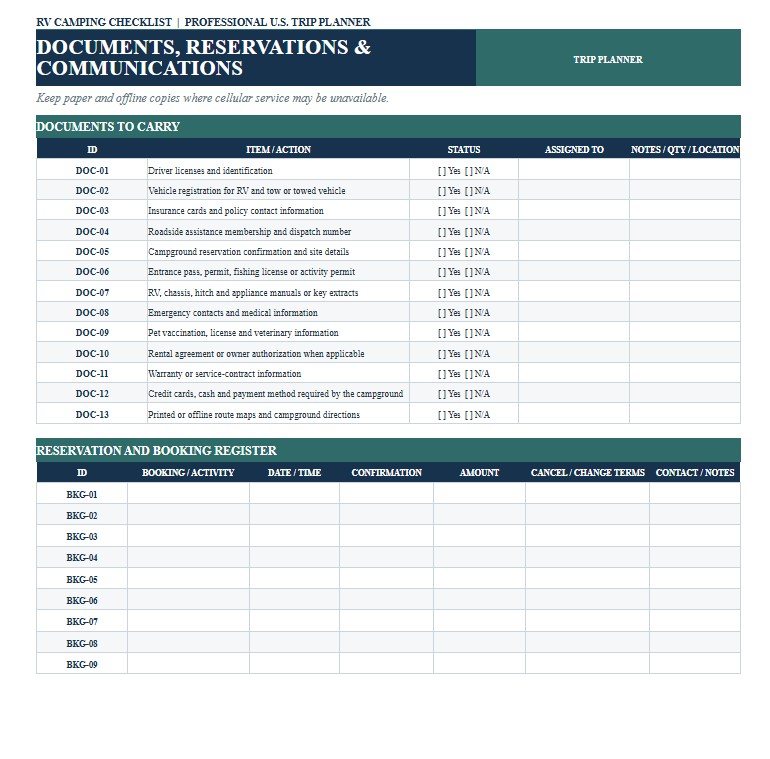
An RV Camping Checklist helps motorhome, travel trailer, fifth wheel, camper van, truck camper, and toy hauler users organize everything needed for a safe and comfortable camping trip. It can be used to confirm reservations, verify campsite compatibility, prepare the RV, plan meals, pack clothing and outdoor gear, organize utility connections, and complete arrival and departure procedures. A structured checklist reduces the chance of forgetting essential documents, medications, electrical adapters, leveling equipment, water hoses, sewer supplies, emergency gear, or campground-specific items. This page provides downloadable Word, PDF, and Excel versions of the RV Camping Checklist, together with practical guidance for completing and using the document. The Word version can be customized for different travelers and destinations, the PDF version provides a convenient printable format, and the Excel version is useful for managing quantities, packing responsibilities, reservations, expenses, meal plans, inventory, dates, and repeatable trip-preparation tasks.
Download the RV Camping Checklist Word Template
The Word format is useful when you want to edit the checklist freely before printing, sharing, or adapting it to a particular RV, campground, destination, family, season, trip length, or camping style.

Download the RV Camping Checklist PDF Template
The PDF format is useful for printing, archiving, sharing, or keeping a fixed-layout checklist in the RV, tow vehicle, trip-planning binder, or campground arrival folder.
Download the RV Camping Checklist Excel Template
The Excel format is useful for tracking packing quantities, food supplies, campground reservations, travel dates, assigned responsibilities, equipment inventory, estimated dollar amounts, trip expenses, meal plans, and repeatable preparation tasks for multiple RV trips.
How to Complete and Use This Document
Begin by entering the trip information, including the destination, campground, campsite number, reservation number, arrival and departure dates, number of travelers, pets, RV type, RV length, tow vehicle, planned route, and emergency contact. Record the campground address and any instructions needed for late arrival, gate access, parking, registration, or check-in.
Review the individual campground listing and confirmation before completing the packing sections. Confirm the maximum RV length, parking-pad dimensions, surface type, site access, pull-through or back-in configuration, electrical service, water connection, sewer connection, dump-station availability, generator restrictions, check-in and checkout times, quiet hours, pet rules, fire restrictions, vehicle limits, and seasonal closures. General reservation policies may not reflect every local rule, so the information published for the specific campground should control your planning.
Evaluate the route as well as the campsite. Record bridge, tunnel, height, width, weight, grade, fuel, ferry, propane, road-condition, or seasonal-access concerns that may affect the RV. Download directions and reservation details when cellular service may be unreliable. Keep registration, insurance information, roadside-assistance details, campground confirmation, identification and required permits in an accessible location.
Before packing, confirm that the RV is ready for travel. Check tires when cold, including pressure, visible damage, tread condition, and spare-tire readiness. Inspect wheels, lights, brakes, batteries, fluids, mirrors, windshield equipment, hitch components, safety chains, breakaway equipment, electrical connectors, doors, compartments, steps, awnings, antennas, stabilizers, and slide-outs as applicable. Follow the RV, chassis, tire, hitch, and component manufacturers’ instructions rather than treating the camping checklist as a substitute for a technical inspection.
Plan cargo carefully. Include passengers, water, fuel, propane, food, clothing, outdoor equipment, tools, and accessories when considering available carrying capacity. Do not exceed the RV, axle, hitch, tow vehicle, wheel, or tire ratings. Heavy items should be secured against movement and distributed according to the manufacturer’s guidance. Avoid adding unnecessary cargo simply because storage space remains available.
Customize the utility section for the campsite. Common items may include a properly rated shore-power cord, electrical adapter, electrical management or surge-protection device, potable-water hose, pressure regulator, filter, sewer hose, fittings, support, protective gloves, leveling blocks, wheel chocks, and basic tools. Do not assume that every site has full hookups. For dry camping, calculate expected battery use, generator fuel, propane, fresh water, waste capacity, lighting, food storage, and charging needs.
Complete the food, water, clothing, bedding, kitchen, hygiene, pet, recreation, and outdoor-equipment sections according to the destination and weather. Bring sufficient drinking water or confirm a reliable potable-water source. Include prescription medications, first-aid supplies, flashlights, batteries, weather protection, navigation tools, sunscreen, insect protection, and appropriate footwear. Adjust supplies for children, older travelers, medical needs, pets, heat, cold, storms, altitude, remote travel, and limited access to stores.
Include an emergency section with warning devices, fire extinguisher, tire-pressure gauge, basic repair supplies, spare fuses, charging equipment, roadside-assistance information, and a communication plan. Check the forecast and local alerts shortly before departure. Identify suitable shelter procedures for severe weather, since an RV may not provide adequate protection during events such as tornadoes or extreme winds.
Use a separate arrival checklist at the campsite. Before parking, inspect the site for branches, rocks, holes, slopes, utility locations, fire rings, posts, overhead obstacles, and clearance for slide-outs and awnings. Position the RV, level it according to the manufacturer’s instructions, set the parking brake, and install wheel chocks where appropriate. Confirm electrical compatibility before connecting power. Use drinking-water equipment only for potable water, and handle sewer equipment separately.
After setup, verify that doors, steps, handrails, awnings, slide-outs, utilities, ventilation, appliances, smoke alarms, carbon monoxide alarms, propane alarms, and fire extinguisher are ready for use. Secure food, garbage, cooking supplies, toiletries, and other scented items according to campground and wildlife rules. Fire restrictions can change rapidly, so confirm whether fires are permitted and never leave a fire unattended.
Use the departure section in reverse order. Extinguish fires completely, collect trash, secure food, disconnect utilities, close valves, retract awnings and slide-outs, raise stabilizers or leveling equipment, remove chocks at the proper stage, lock compartments, check lights, and complete a final walk-around. Dispose of wastewater only at authorized facilities and follow campground instructions.
Customize the checklist for full-hookup camping, dry camping, national parks, state parks, private RV resorts, festivals, winter camping, long-distance travel, rental use, or extended stays. Rules concerning reservations, pets, campfires, generator use, vehicle limits, waste disposal, permits, and length of stay vary by campground and jurisdiction. Verify current requirements with the campground, managing agency, state park system, local authority, or other responsible organization before departure.