
An RV Maintenance Checklist provides a structured way to plan, document, and track preventive maintenance for a motorhome, travel trailer, fifth wheel, camper van, truck camper, toy hauler, or other recreational vehicle. RV owners, rental operators, fleet managers, dealers, and service technicians can use it to monitor tires, brakes, batteries, roof sealants, plumbing, propane equipment, electrical systems, generators, appliances, safety devices, chassis components, and seasonal preparation. Regular documentation can help identify developing problems, preserve service records, support warranty claims, and reduce the risk of unexpected breakdowns or water damage. This page provides downloadable Word, PDF, and Excel versions of the RV Maintenance Checklist, together with practical guidance for completing and using the document. The Word version supports detailed customization, the PDF version offers a consistent printable layout, and the Excel version is useful for tracking service intervals, mileage, generator hours, due dates, costs, parts, service providers, and maintenance history.
Download the RV Maintenance Checklist Word Template
The Word format is useful when an RV owner, rental operator, dealer, or service business wants to edit the maintenance checklist freely before printing, sharing, signing, or adapting it to a specific RV type, manufacturer, equipment configuration, climate, or storage schedule.

Download the RV Maintenance Checklist PDF Template
The PDF format is useful for printing, archiving, sharing, or keeping a fixed-layout maintenance record in the RV, service file, rental office, storage facility, or workshop.
Download the RV Maintenance Checklist Excel Template
The Excel format is useful for managing repeatable maintenance tasks, mileage, generator hours, service intervals, inspection dates, parts, labor costs, warranties, recalls, responsible technicians, completion status, and future due dates for one or more recreational vehicles.
How to Complete and Use This Document
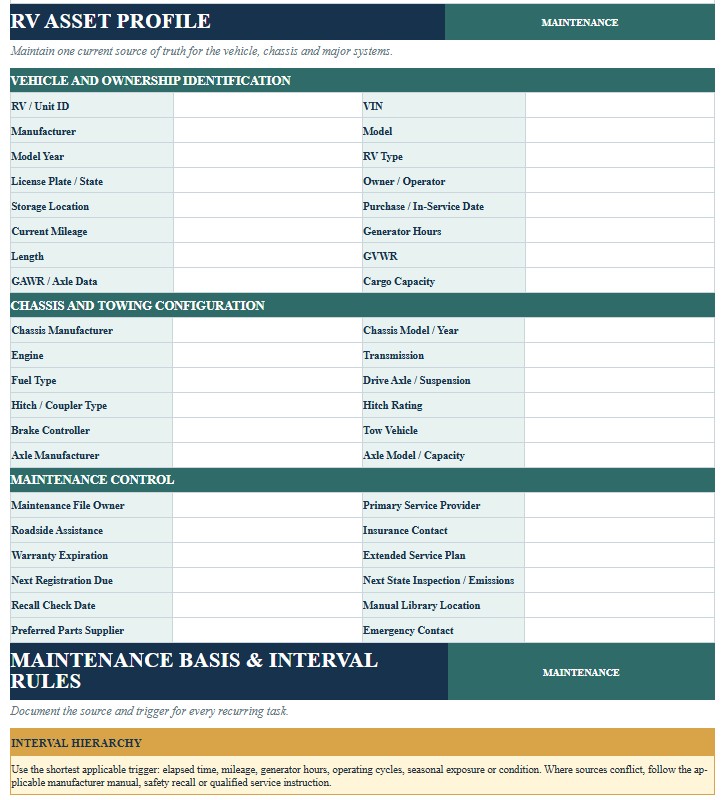
Begin by identifying the recreational vehicle and the maintenance record. Enter the manufacturer, model, model year, RV type, vehicle identification number, license plate, current mileage, generator hours, owner or operator, storage location, and date the checklist was opened. For a motorhome, record the chassis manufacturer and chassis service information separately. For a towable RV, include the axle, hitch, brake, tire, and suspension specifications when available.
Use the RV manufacturer’s owner manual, chassis manual, component manuals, warranty documents, and tire information label to determine the correct maintenance intervals. Avoid applying one universal schedule to every vehicle. Service requirements may be based on elapsed time, mileage, generator hours, seasonal use, operating conditions, or whichever limit occurs first. A task should include its interval or trigger, last completion date, next due date, responsible person, service provider, and completion status.
Organize exterior maintenance around water intrusion prevention. Record inspections of the roof surface, seams, moldings, windows, doors, clearance lights, vents, skylights, air-conditioning units, antennas, solar mounts, slide-outs, awnings, compartment doors, and exterior sealants. Note cracks, separation, loose components, soft areas, staining, delamination, or deteriorated sealant. Use only products approved for the relevant roofing and exterior materials. Roof access can create a serious fall hazard, so use a safe observation method and consult a qualified service provider when the roof is not designed for walking or cannot be accessed safely.
For motorized RVs, track engine oil, filters, coolant, transmission service, belts, hoses, brakes, steering, suspension, chassis batteries, windshield equipment, and other manufacturer-specified chassis items. Towable RV maintenance should address wheel bearings, electric or hydraulic brakes, breakaway equipment, safety chains, couplers, fifth-wheel components, landing gear, stabilizers, axles, springs, equalizers, and wiring connections.
Create a separate record for every tire. Include its position, size, load range, cold inflation pressure, tread depth, visible condition, and DOT date code. Check inflation before travel when the tires are cold and use the pressure selected for the vehicle according to the manufacturer’s information, loading requirements, and applicable tire guidance. Record cracking, bulges, cuts, uneven wear, leaks, overheating evidence, damaged wheels, or loose hardware. Tire age and appearance should be evaluated together rather than relying only on tread depth.
Document maintenance of the 12-volt and 120-volt electrical systems. Relevant items may include house and chassis batteries, terminals, disconnect switches, converter, charger, inverter, solar controller, distribution panels, circuit breakers, fuses, shore-power cord, inlet, transfer switch, receptacles, and ground-fault protection. Battery type matters because flooded lead-acid, AGM, and lithium systems may have different inspection, charging, temperature, and storage requirements. Electrical diagnosis or repair involving energized equipment should be assigned to qualified personnel.
Track generator maintenance by both date and operating hours. Record oil and filter service, coolant where applicable, air filter condition, fuel-system maintenance, battery condition, exhaust inspection, output testing, and operation under load. Follow the generator manufacturer’s instructions rather than assuming that the RV manufacturer’s general schedule covers every installed component.
The plumbing section should cover the fresh-water tank, water pump, city-water connection, faucets, toilet, water heater, drains, holding tanks, termination valves, vents, and visible piping. Include seasonal winterization and dewinterization tasks when the RV may be exposed to freezing temperatures. Record sanitation of the fresh-water system, replacement of filters, inspection of anodes when applicable, and repairs to leaks or damaged seals.
Propane maintenance should address cylinders or tanks, mounting, valves, pigtails, regulator, hoses, visible piping, compartment ventilation, shutoff devices, detectors, and propane-operated appliances. Do not use an open flame to locate a leak. Pressure testing, regulator evaluation, leak testing, combustion analysis, and repairs should be performed by a qualified RV or propane service professional using appropriate equipment.
Include the refrigerator, furnace, air conditioners, water heater, range, oven, microwave, ventilation fans, leveling system, slide-outs, awnings, and optional equipment. Record the manufacturer, model, serial number, energy source, last service date, test result, and next planned service. Replace or service smoke, carbon monoxide, and propane alarms according to their manufacturer instructions, and check the fire extinguisher and emergency exits regularly.
For each completed task, enter the date, mileage or generator hours, work performed, parts used, labor cost, total cost, service provider, work-order number, warranty status, and supporting document reference. Attach invoices, photographs, recall notices, inspection reports, and proof of completed repairs. A signed entry should identify who performed or verified the work, but it should not be treated as a professional certification unless the person is qualified and authorized to issue one.
Customize the checklist for seasonal storage, full-time use, rental turnover, severe climates, coastal exposure, long trips, heavy towing, or extended periods without use. Registration, safety inspection, emissions testing, rental, insurance, and road-use requirements vary by state and sometimes by county or city. Verify current requirements with the applicable motor vehicle authority and consult an RV technician, chassis mechanic, tire professional, electrician, propane technician, dealer, manufacturer, insurer, or other qualified professional when a task involves safety-critical systems, warranty coverage, recalls, structural damage, or specialized testing.